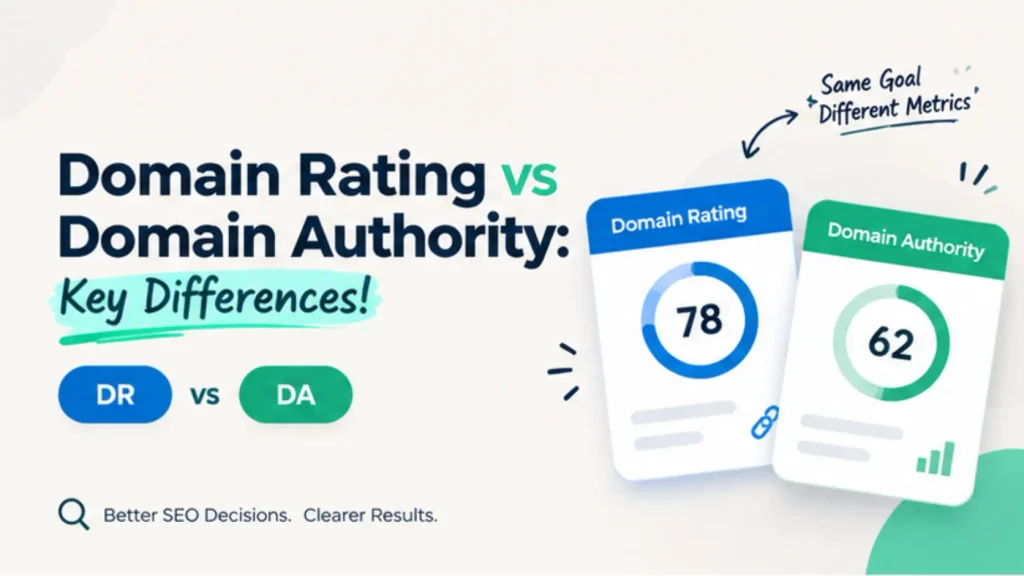
When comparing websites for SEO, Domain Rating vs Domain Authority is an important distinction to understand. Both metrics help you evaluate a website’s backlink profile and competitive position, but Ahrefs and Moz calculate them differently. Treating these scores as interchangeable can lead to poor competitor analysis and ineffective link-building decisions.
For businesses working to improve organic visibility, these metrics provide useful context when evaluating competitors, researching backlink opportunities, and planning off-page SEO. However, neither score guarantees better Google rankings. This guide explains how Domain Rating (DR) and Domain Authority (DA) differ, when to use each metric, and how to apply them to a practical SEO strategy.
What Is Domain Rating (DR) in SEO?
Domain Rating (DR) is an Ahrefs metric that measures the strength of a website’s backlink profile on a scale from 0 to 100. A higher score generally indicates a stronger backlink profile according to Ahrefs’ methodology.
Ahrefs evaluates factors related to referring domains and the links they provide. Its calculation also considers how linking websites distribute their link equity.
For example, a website that earns links from established industry publications may have a stronger DR than a comparable website with fewer referring domains.
However, DR does not directly measure content quality, organic traffic, conversion rates, or actual Google ranking performance. A high score alone does not prove that a website provides valuable information or attracts qualified visitors.
What influences Domain Rating?
Several backlink-related factors help explain why DR changes:
- Referring domains: The number of unique websites linking to a domain.
- Backlink quality: The characteristics and strength of the websites providing links.
- Link distribution: How linking domains distribute their link equity among the sites they reference.
- Ahrefs’ link index: Newly discovered, lost, or updated backlinks can affect the reported score.
DR uses a logarithmic scale, so increasing a score from 75 to 85 is generally more difficult than moving from 15 to 25.
For that reason, compare websites within similar competitive environments rather than treating every point as an equal improvement.
What Is Domain Authority (DA)?
Domain Authority (DA) is a metric developed by Moz to predict how likely a website is to rank in search engine results compared with other websites. Moz calculates DA on a scale from 1 to 100 using a machine-learning model and data from its link index.
Unlike DR, which focuses on backlink profile strength, DA estimates a domain’s relative ranking potential. Moz uses link-related data and other model inputs to calculate the score.
DA can help marketers compare competitors, assess potential backlink sources, and understand how their websites compare within a market. However, it remains a third-party estimate rather than an official Google ranking score.
If you want a deeper explanation of authority metrics and how they fit into an SEO strategy, read our pillar guide, Ahrefs Domain Authority: What the Score Really Means.
What affects Domain Authority?
Moz does not publish every detail of its proprietary calculation, but relevant factors include:
- Linking root domains: Unique domains that link to a website.
- Link quality: Characteristics of the websites providing backlinks.
- Moz’s link index: The links Moz discovers and processes.
- Competitive link profiles: DA reflects a website’s position relative to other domains in Moz’s model.
DA can change even when a website has not deliberately built new links. Changes to Moz’s index, its model, or the competitive landscape can influence the score.
Like DR, DA is not a direct Google ranking factor. It is a comparative metric that helps SEO professionals evaluate websites.
Domain Rating vs Domain Authority: Key Differences
The main difference between DR and DA is their provider and purpose. Ahrefs measures backlink profile strength through DR, while Moz uses DA to predict relative ranking potential.
| Comparison factor | Domain Rating (DR) | Domain Authority (DA) |
|---|---|---|
| Developed by | Ahrefs | Moz |
| Main purpose | Measure backlink profile strength | Predict relative ranking potential |
| Scale | 0–100 | 1–100 |
| Calculation | Ahrefs’ backlink data and methodology | Moz’s machine-learning model |
| Data source | Ahrefs’ link index | Moz’s link index |
| Best use | Backlink analysis and competitor benchmarking | Competitor comparison and SEO planning |
| Page-level equivalent | URL Rating (UR) | Page Authority (PA) |
| Google ranking factor? | No | No |
Both metrics help you assess a website’s competitive position, but neither provides a complete picture of SEO performance.
For example, a website with a DR of 42 and a competitor with a DA of 55 cannot be compared fairly using those numbers alone. The metrics come from different providers and use different calculations.
To make a meaningful comparison, measure every competitor using the same metric and tool.
If you want to understand how Ahrefs presents authority metrics and how to interpret them correctly, explore our detailed guide to Ahrefs Domain Authority: What the Score Really Means.
Domain Rating vs Domain Authority: Which Is Better?
Neither metric is universally better. The right choice depends on your SEO objective, available tools, and reporting requirements.
When should you use Domain Rating?
Use DR when you want to examine backlink profile strength, compare competitors using Ahrefs, or investigate potential link-building opportunities.
DR is particularly useful during backlink audits because it helps you understand how Ahrefs evaluates the domains linking to a website. You should still inspect the actual links, their relevance, and the pages receiving them before deciding whether a backlink opportunity is worthwhile.
When should you use Domain Authority?
Use DA when your team already works with Moz or needs a consistent metric for comparing competitors within Moz’s ecosystem.
DA can support competitive research and help identify websites worth investigating further. However, you should not accept or reject a backlink opportunity based solely on a DA threshold.
Leemjaz’s recommendation: Choose one metric for consistent reporting, and examine the underlying backlink data before making link-building decisions. If you have access to both tools, record DR and DA in separate columns rather than comparing them directly.
Why Are Domain Rating and Domain Authority Different?
A website can receive different DR and DA scores because Ahrefs and Moz do not share the same link index or scoring methodology.
Each company discovers and processes backlinks through its own systems. One tool may identify links that the other has not yet discovered, while their algorithms assign different significance to the available data.
Consider a hypothetical website with a DR of 42 and a DA of 36. These scores do not necessarily indicate a problem or an error. They reflect two separate calculations.
The difference also does not establish which tool is more accurate. Neither metric is an official Google authority score, so there is no single Google value against which to verify them.
If either score changes, investigate the underlying data before drawing conclusions. Check for lost backlinks, newly discovered referring domains, changes in link quality, and updates to the tool’s index or calculation.
Then review organic traffic and keyword rankings to determine whether your SEO performance has actually changed.
How to Compare Competitors Using DR and DA
Competitor analysis becomes more useful when you turn authority metrics into specific research questions. Rather than looking for the website with the highest score, examine what makes competing pages successful and where your website can realistically improve.
Step 1: Identify your actual search competitors
Search for your target keyword and record the websites ranking for the same query. Prioritize pages that serve the same audience and satisfy a similar search intent.
A large website may have a high authority score but compete for a different audience. Direct competitors provide more useful benchmarks.
Step 2: Compare websites using one metric
Choose Ahrefs DR or Moz DA and apply it consistently across your competitors. Record the score, referring domains, and relevant backlink information.
Do not compare one website’s DR with another website’s DA. If you want to use both metrics, create separate columns for each.
Step 3: Examine the backlinks behind the scores
Look beyond the headline numbers. Investigate the referring domains, the pages receiving links, the context of each link, and the relevance of the linking website.
A smaller website may have fewer backlinks but earn strong editorial links from relevant publications. Another site may have many links that contribute little value to its target audience.
Step 4: Find realistic backlink opportunities
Identify websites that link to several competitors but not to your website. Review why those websites linked to competing content and determine whether you can offer a genuinely useful resource.
For example, if several industry publications reference a competitor’s original research, you could develop a stronger study or a more useful resource and introduce it through relevant outreach.
Step 5: Track meaningful SEO outcomes
Monitor new referring domains, lost backlinks, organic traffic, keyword rankings, and conversions. Review DR and DA as supporting indicators rather than your primary measures of success.
This process helps you turn competitor research into a focused link-building plan instead of simply trying to increase a number.
How to Improve Domain Rating and Domain Authority
Although DR and DA use different calculations, both can respond to changes in a website’s backlink profile. The most sustainable approach is to earn relevant, credible backlinks and build content that other websites have a reason to reference.
Create content that earns relevant backlinks
Publish original research, practical guides, useful resources, and expert explanations that answer specific questions. Content becomes a stronger link-building asset when it offers information that readers cannot easily find elsewhere.
Earn editorial backlinks
Build relationships with relevant publishers, industry websites, and professional communities. Contribute useful insights and offer resources that fit naturally within their existing content.
Avoid purchasing links solely to inflate authority scores or participating in manipulative link schemes. A high third-party score does not guarantee that such links will improve search visibility.
For additional guidance, read Why Backlinks Are Meaningful and How to Obtain Them Properly.
Strengthen internal linking
Connect related articles and important service pages through descriptive, relevant anchor text. Internal links help readers discover useful information and help search engines understand the relationships between your pages.
Although internal links do not directly increase DR or DA in the same way that external referring domains influence these metrics, they support website navigation and SEO structure.
Review your backlink profile regularly
Monitor new and lost links, investigate unusual changes, and prioritize relevant opportunities. Do not assume every low-quality link requires removal or disavowal. Google generally handles many irrelevant links automatically, and disavowal is appropriate only in specific circumstances.
Businesses that need a broader strategy can explore Leemjaz’s off-page SEO services for small businesses to understand how backlink research and other off-page activities fit into a wider SEO plan.
Do DR and DA Affect Google Rankings or AI Overviews?
Neither Domain Rating nor Domain Authority is an official Google ranking factor. Google does not use the published DR or DA score as a direct ranking input.
However, this does not mean backlinks are irrelevant. Links can help Google discover pages and understand relationships between content. Relevant, editorially earned backlinks can also contribute to a website’s ability to compete in search results.
AI Overviews and other AI-powered search experiences require a similarly careful distinction. There is no confirmed rule that a specific DR or DA score guarantees inclusion in an AI-generated answer.
To improve your content’s chances of being understood and cited, focus on the following:
- Answer the primary question directly near the beginning of the article.
- Use clear headings that describe the questions each section answers.
- Provide accurate definitions, useful comparisons, and specific examples.
- Support factual claims with reliable sources.
- Demonstrate relevant experience and explain important limitations.
- Keep the article easy to navigate, with concise paragraphs and descriptive links.
- Maintain technically accessible pages and a clear internal linking structure.
These practices improve clarity and usefulness, but they do not guarantee rankings, featured snippets, or AI citations.
For official backlink research, use the Ahrefs Website Authority Checker to examine Domain Rating and begin investigating a site’s backlink profile.
Conclusion: Choose the Right Metric for Better SEO
The difference between Domain Rating and Domain Authority comes down to how Ahrefs and Moz measure a website’s competitive strength. DR focuses on backlink profile strength, while DA predicts relative ranking potential through Moz’s model.
Neither score guarantees rankings, and no reliable formula converts one into the other. Instead, use the metrics consistently, examine the backlinks behind them, and compare your website with genuine search competitors.
For businesses, the goal should not be to chase the highest authority score. It should be to earn relevant backlinks, publish useful content, strengthen internal linking, and improve measurable search performance.
Leemjaz recommends using authority metrics as part of a wider SEO strategy that prioritizes sustainable visibility, qualified traffic, and meaningful business outcomes.
Frequently Asked Questions
1. Is Domain Rating the same as Domain Authority?
No. Ahrefs calculates Domain Rating to measure backlink profile strength, while Moz calculates Domain Authority to predict relative ranking potential. Both use a 0–100-style scale, but their algorithms and data differ.
2. Which is better for SEO, DR or DA?
Neither is universally better. DR is useful for backlink analysis in Ahrefs, while DA helps compare domains using Moz. Choose the metric that suits your workflow and evaluate actual backlinks alongside it.
3. Does Domain Rating affect Google rankings?
No. Ahrefs DR is not a direct Google ranking factor. Backlinks themselves can influence search visibility, but a higher DR does not guarantee higher rankings.
4. Can I convert Domain Authority to Domain Rating?
No reliable conversion exists. Ahrefs and Moz use different data sources and calculations, so you should check both metrics independently if you need them.
5. How can I improve my Domain Rating and Domain Authority?
Earn relevant editorial backlinks, publish useful content, build genuine relationships with industry publishers, and review your backlink profile regularly. Track organic traffic and keyword rankings as well as authority scores to assess progress.