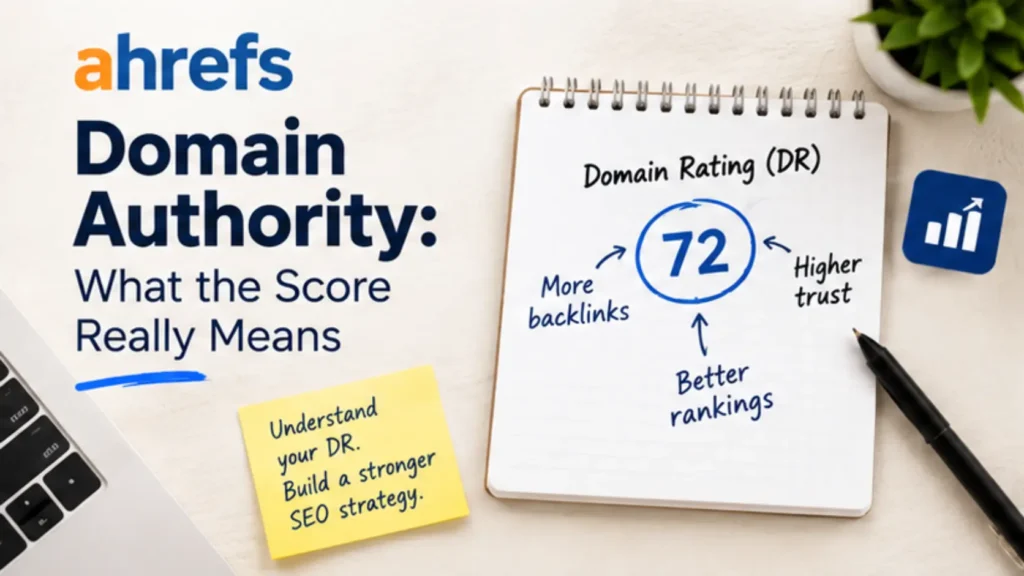
If you have checked your website in Ahrefs, you may have wondered what your Ahrefs Domain Authority score means and whether a higher score can help you rank on Google. Ahrefs actually uses a metric called Domain Rating (DR), while Domain Authority (DA) is a metric developed by Moz. Both help SEO professionals compare websites, but they measure authority differently. Understanding how these scores work can help you evaluate competitors, identify backlink opportunities, and make better SEO decisions without focusing on numbers alone.
What Is Ahrefs Domain Authority?
Ahrefs Domain Authority is a popular search term used by people who want to understand their website’s authority score in Ahrefs. The tool’s official metric is called Domain Rating (DR).
Domain Rating measures the relative strength of a website’s backlink profile on a scale from 0 to 100. A higher score generally indicates a stronger backlink profile within Ahrefs’ database.
However, a high DR does not automatically mean that a website has better content, more organic traffic, or higher Google rankings. It is one metric that helps you understand how a website compares with others.
For example, a small business website with a lower DR may still rank above a larger competitor if its content better matches the search intent and answers the user’s question more effectively.
Ahrefs Domain Rating vs. Domain Authority
Although people often use these terms interchangeably, they are not the same.
| Metric | Provider | Purpose |
|---|---|---|
| Domain Rating (DR) | Ahrefs | Measures the relative strength of a website’s backlink profile |
| Domain Authority (DA) | Moz | Predicts a website’s potential to rank in search results |
| URL Rating (UR) | Ahrefs | Measures the relative strength of an individual page’s backlink profile |
| PageRank | A link-analysis system used within Google’s search technology |
Each metric uses its own methodology. A website’s DR and DA scores may differ significantly, so comparing the numbers directly can be misleading.
The important thing is to understand what each metric tells you and use it alongside other SEO data.
How Does Ahrefs Domain Rating Work?
Ahrefs calculates Domain Rating using data about the websites linking to a domain. The strength of those linking websites and how they distribute their linking power influence the score.
1. Referring Domains
A referring domain is a unique website that links to your website. For example, if five different websites link to your content, you have five referring domains.
Having links from different relevant websites can help build a stronger backlink profile. However, gaining hundreds of links from unrelated or low-quality websites is not necessarily a good SEO strategy.
2. The Strength of Linking Websites
Backlinks from websites with stronger backlink profiles can contribute more to your DR than links from weaker domains.
Still, a high DR alone does not make a website a good link-building opportunity. Relevance, editorial quality, and the website’s actual audience also matter when evaluating potential backlinks.
3. The Number of Websites a Domain Links To
Ahrefs also considers how many unique domains a linking website links to. The score reflects how linking strength is distributed across the web.
This means two websites with similar DR scores may contribute different amounts of linking strength to the websites they reference.
4. Changes in the Backlink Profile
Your DR can change when Ahrefs discovers new backlinks, identifies lost links, or updates its backlink data. Your score may also change as other websites strengthen their own backlink profiles.
For this reason, a small increase or decrease does not necessarily mean your SEO performance has improved or declined. Review the changes in context rather than reacting to every movement.
How to Check Ahrefs Domain Authority
You can check your website’s Domain Rating through Ahrefs and use the available backlink data to understand your site’s link profile.
Step 1: Open Ahrefs Site Explorer
Visit Ahrefs and open Site Explorer if you have access. You can also use the free backlink checker for limited information.
Step 2: Enter Your Website URL
Enter your domain and select the appropriate scope. If you want to analyze the whole website, make sure you are viewing the domain-level data rather than a single page.
Step 3: Find the DR Score
Look for the Domain Rating metric in the overview. Depending on your account and the tool you use, you may also see backlink and referring-domain information.
Step 4: Review Your Backlinks
Look beyond the score. Check which websites link to your content, whether the links are relevant, and whether you have gained or lost referring domains.
Step 5: Compare Your Competitors
Analyze websites that rank for the same keywords as your business. Compare their DR, referring domains, and the backlink profiles of their ranking pages.
This process helps you understand the competition and identify realistic opportunities to improve your own website.
What Is a Good Ahrefs Domain Rating Score?
There is no universal DR score that guarantees strong rankings. A score that is competitive in one niche may be relatively low in another.
Instead of trying to reach an arbitrary number, compare your website with competitors that target similar keywords and audiences.
If your DR is lower than theirs, examine their backlinks and identify relevant websites that might also reference your content. If your score is similar, focus on the quality of your content, page-level backlinks, search intent, and internal linking.
A higher score can provide useful context, but it does not guarantee that your pages will rank above competing websites.
How to Improve Ahrefs Domain Authority Naturally
If you want to improve your Ahrefs Domain Rating, focus on earning relevant backlinks and creating content that other websites have a genuine reason to reference.
1. Earn Relevant Backlinks
Look for websites that cover topics related to your industry. Contributing useful insights, publishing expert articles, and building genuine relationships with publishers can create opportunities to earn relevant links.
Avoid pursuing backlinks simply because a website displays a high DR score. A relevant link from a trusted industry resource may be more valuable to your broader SEO strategy than an unrelated placement.
2. Create Content Worth Linking To
Useful content gives other websites a reason to reference your pages. Original research, detailed tutorials, practical examples, and well-organized resources can help your website stand out.
For example, an SEO agency could publish a detailed analysis of common website optimization problems and explain how businesses can address them. Other writers may find that resource useful when discussing SEO audits or website performance.
3. Analyze Competitor Backlinks
Study the websites linking to your competitors and look for opportunities that fit your content.
Ask yourself whether the linking website is relevant, whether its content attracts a real audience, and whether your own page offers something useful to its readers.
The goal is not to copy every competitor backlink. It is to understand why certain pages attract links and create resources that deserve similar attention.
4. Strengthen Internal Linking
Internal links connect related pages on your website and help visitors discover useful information. They also help search engines understand the relationships between your pages.
For example, a business investigating its backlink profile may also need a professional SEO audit to uncover technical issues, content gaps, and on-page problems that could affect organic visibility.
Use descriptive anchor text that tells readers what they can expect from the linked page. Add internal links only when they provide useful context, rather than inserting them simply to increase the number of links.
5. Find Better Keyword Opportunities
Backlinks are only one part of SEO. You also need content that targets relevant searches and answers users’ questions.
After reviewing your competitors, use keyword research tools to identify relevant search terms, understand search intent, and discover topics your website has not covered well.
This can help you find opportunities to create useful pages that attract organic traffic and give other websites a reason to reference your content.
6. Recover Valuable Lost Backlinks
Sometimes a website loses backlinks because a linking page disappears, a URL changes, or a publisher removes an old reference.
Review lost backlinks and investigate whether any important links can be recovered. If the linking page still exists and your content remains relevant, contact the website owner politely and explain the issue.
Recovering a valuable link can be a practical addition to your link-building efforts.
7. Avoid Manipulative Link-Building Tactics
Buying links purely to increase DR, participating in link schemes, or creating networks of low-quality websites can produce misleading results without improving the value of your website.
Google’s guidance explains how links intended to manipulate rankings can violate its spam policies. Read the official Google link spam policies to understand which practices to avoid.
Focus on relevant editorial links, useful content, and sustainable SEO improvements instead of chasing a higher score at any cost.
How to Use Ahrefs Domain Rating for Competitor Analysis
Domain Rating becomes more useful when you compare it with other SEO metrics and the actual content competing for your target keywords.
Suppose you want to rank for a keyword such as “technical SEO audit.” A competitor may have a higher DR, but its ranking page might not fully answer the user’s question. Another website with a lower DR may provide clearer instructions, better examples, and more relevant information.
To understand the competition, review the following factors.
| What to analyze | Why it matters |
|---|---|
| Domain Rating | Provides a broad comparison of backlink strength |
| URL Rating | Helps assess the backlink profile of a specific page |
| Referring domains | Shows how many unique websites link to a domain or page |
| Search intent | Helps determine whether the page answers the user’s actual question |
| Content quality | Reveals missing explanations, examples, and useful details |
| Organic traffic | Provides context about a page’s search visibility |
| Internal links | Shows how the page connects with other relevant content |
A Simple Competitor Analysis Process
Start by identifying pages that consistently appear in search results for your target keyword. Analyze their backlink profiles and record relevant metrics in a spreadsheet.
Next, read the competing pages. Look for missing explanations, outdated information, weak examples, and questions that remain unanswered.
Finally, create content that addresses those gaps with accurate information, practical examples, and a clear structure. The objective is to provide a better answer for the reader, not simply to publish a longer article.
Businesses that need support with technical improvements, content optimization, and link building can also explore search engine optimization services as part of a broader strategy.
Does Ahrefs Domain Rating Affect Google Rankings?
Ahrefs Domain Rating is not a direct Google ranking factor. Google does not use the Ahrefs DR or Moz DA score as an official ranking input.
However, backlinks themselves can influence search visibility. Google uses links among many signals to understand pages and their relationships, but a third-party score does not determine how a page will rank.
A website with a lower DR can outperform a stronger domain for a particular keyword when its content better satisfies the search intent or offers a more useful result.
This is why you should track more than DR when measuring SEO progress. Review organic clicks and impressions in Google Search Console, keyword positions, conversions, relevant backlinks, and the performance of important pages.
These indicators help you understand whether your SEO work is improving search visibility and delivering meaningful results.
How to Make Your Content Useful for AI Search
If you want your content to be eligible for AI Overviews and other AI-powered search experiences, focus on accuracy, clarity, and genuine usefulness.
Start with a direct explanation of the topic. Define Domain Rating early, distinguish it from Domain Authority, and use headings that clearly describe the questions answered in each section.
Support important claims with reliable sources, include practical examples, and explain concepts in your own words. Comparison tables and concise answers can make complex information easier to understand.
If you have original research or real experience using SEO tools, include it honestly and explain how you reached your conclusions. Do not invent statistics, case studies, or personal experience to make the article appear more authoritative.
There is no guaranteed formula for appearing in AI-generated results. Clear explanations, useful information, and trustworthy sourcing help readers understand the topic, but they cannot guarantee inclusion in an AI Overview.
Final Thoughts
Ahrefs Domain Authority is a common term, but Domain Rating is the actual name of Ahrefs’ domain-level backlink metric. Understanding this distinction helps you evaluate your backlink profile without confusing third-party scores with Google’s ranking systems.
Use DR to compare your website with relevant competitors, investigate backlink opportunities, and monitor changes over time. Combine it with page-level analysis, keyword research, content quality, and organic performance to make better SEO decisions.
Ultimately, a strong SEO strategy is not about achieving a particular score. It is about building a useful website, earning relevant backlinks, and helping the right audience find the information they need.
Frequently Asked Questions
1. Is Ahrefs Domain Authority the same as Domain Rating?
No. Ahrefs uses Domain Rating (DR) to measure the relative strength of a website’s backlink profile. Domain Authority (DA) is Moz’s metric for predicting ranking potential.
2. How can I check my Ahrefs Domain Rating for free?
You can use the Ahrefs Free Backlink Checker to view limited backlink information. More detailed metrics and analysis features may require a paid account.
3. What is a good Ahrefs Domain Rating score?
There is no universally good score. Compare your DR with relevant competitors and examine their backlinks, ranking pages, and organic search performance.
4. Does Ahrefs Domain Rating affect Google rankings?
No. Google does not use Ahrefs DR as a direct ranking factor. Backlinks can influence search visibility, but the third-party score itself does not determine rankings.
5. How can I increase my Ahrefs Domain Rating?
Earn relevant backlinks, publish useful resources, analyze competitor backlinks, and recover valuable lost links. Avoid manipulative tactics that prioritize the score over genuine SEO value.