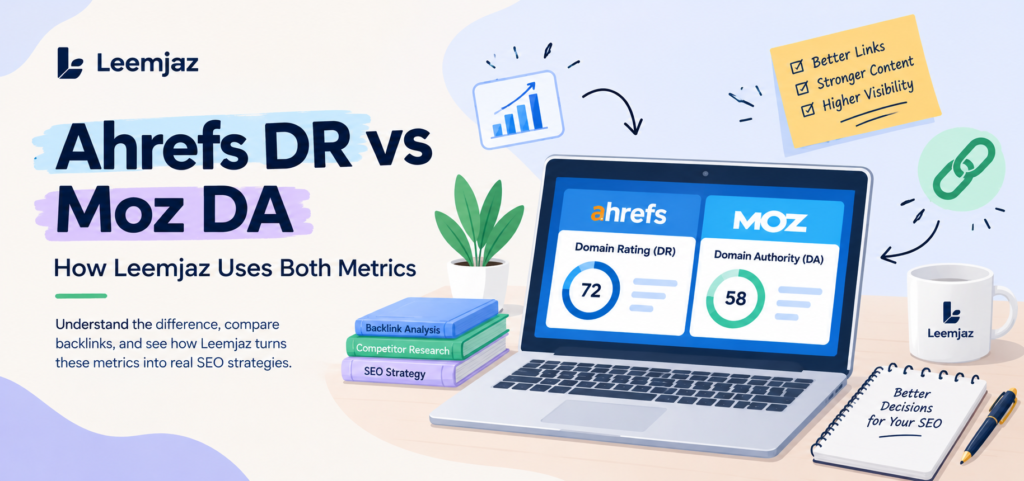
When comparing websites for SEO, two scores often appear in backlink reports: Ahrefs Domain Rating (DR) and Moz Domain Authority (DA). Both help SEO professionals compare websites, but they measure website strength in different ways.
At Leemjaz, comparing these metrics can support competitor research, backlink analysis, and link-building decisions. However, neither score tells the full story. A website with a high score may still have poor content, low traffic, or links that are not relevant to your industry.
So, which metric should you use? More importantly, how can you use both scores to make better SEO decisions? Let’s explore the differences and see how Leemjaz approaches website and backlink analysis.
What Is the Difference Between Ahrefs DR and Moz DA?
Ahrefs DR and Moz DA are third-party SEO metrics. They help estimate different aspects of a website’s strength, but they use separate tools, data, and calculation methods.
Ahrefs Domain Rating measures the strength of a website’s backlink profile. In contrast, Moz Domain Authority predicts how likely a website is to rank in search engine results compared with other websites.
Although both metrics use a scale from 0 to 100, their scores are not directly interchangeable. For example, a website might have a DR of 45 in Ahrefs and a DA of 38 in Moz. This difference does not automatically mean that one tool is wrong.
Each platform uses its own data and methods. Therefore, SEO professionals should compare websites using the same tool whenever possible.
For a deeper explanation of Ahrefs’ metric, read Leemjaz’s guide to Ahrefs Domain Authority: What the Score Really Means.
Ahrefs DR vs Moz DA: Key Differences
Understanding the main differences makes it easier to choose the right metric for your SEO work.
| Feature | Ahrefs Domain Rating (DR) | Moz Domain Authority (DA) |
|---|---|---|
| Developed by | Ahrefs | Moz |
| Main purpose | Measures backlink profile strength | Predicts a website’s ranking potential |
| Score range | 0–100 | 1–100 |
| Main use | Backlink analysis and competitor comparison | Competitor research and SEO planning |
| Calculation method | Ahrefs’ backlink data and proprietary formula | Moz’s link data and predictive model |
| Google ranking factor? | No | No |
These scores can help you understand how websites compare. However, they do not guarantee higher rankings.
For example, a website with a lower DR may rank above a competitor because it answers search intent more effectively, has stronger page-level content, or offers a better user experience.
As a result, the best approach is to use DR and DA as supporting metrics rather than final measures of SEO success.
How Ahrefs DR Helps With Competitor Analysis
Ahrefs DR is useful when you want to understand the strength of a competitor’s backlink profile. It provides a quick way to compare the websites linking to different domains.
A higher DR can indicate a stronger backlink profile in Ahrefs’ database. However, the score alone does not show whether those links are relevant, useful, or likely to bring visitors.
At Leemjaz, DR can be one part of a wider competitor analysis process. For example, an SEO professional might compare three websites in the same industry and review their DR scores alongside referring domains, organic traffic, and ranking keywords.
This comparison can reveal possible areas for improvement. If competitors have earned links from relevant industry websites, those sources may provide ideas for future outreach.
Nevertheless, avoid choosing a website for a backlink simply because it has a high DR. Check its content, audience, link placement, and overall quality before making a decision.
How Moz DA Supports SEO Decisions
Moz DA offers another way to compare websites. Its score predicts how well a domain may perform in search results based on Moz’s own data and model.
This can be helpful when reviewing competitors or comparing potential backlink sources. For instance, if two websites cover similar topics, their DA scores can provide an initial point of comparison.
However, DA does not measure every factor that affects rankings. It cannot tell you whether a website’s content meets search intent, whether its pages load quickly, or whether its audience matches your target market.
Therefore, use DA alongside other SEO checks. Review organic traffic, relevant keywords, content quality, and the website’s backlink profile before drawing conclusions.
The key takeaway: DR helps you assess backlink profile strength in Ahrefs, while DA helps you estimate ranking potential in Moz. Both offer useful information, but neither should decide your SEO strategy on its own.
How Leemjaz Evaluates Backlink Opportunities Beyond DR and DA
A strong backlink strategy requires more than chasing high scores. The source website should also be relevant, useful, and suitable for your audience.
Leemjaz focuses on SEO and link-building services, so evaluating backlink opportunities should involve several checks rather than relying on a single number.
Topical relevance: First, check whether the website covers topics related to your business. A relevant link may make more sense than a link from a website with a higher score but an unrelated audience.
Content quality: Next, review the website’s articles. Useful, original content can help you judge whether the site provides value to its readers.
Organic traffic: Also check whether the website receives search traffic and ranks for relevant terms. Traffic estimates are not perfect, but they can provide useful context.
Referring domains: Look at the websites linking to the potential source. A varied backlink profile may tell you more than the total number of backlinks alone.
Link placement: Finally, consider where and how the link will appear. A natural, relevant link within useful content is generally more valuable than an unrelated link placed only to influence SEO metrics.
These checks help reduce the risk of choosing a backlink source based on an impressive-looking score alone.
To learn more about this process, explore Leemjaz’s off-page SEO services.
How Leemjaz Can Use DR and DA to Build an SEO Strategy
DR and DA are most useful when they support a clear SEO goal. Instead of trying to increase scores without a plan, businesses can use these metrics to understand competitors and identify possible opportunities.
For example, an SEO campaign might begin by comparing several competing websites. The analysis could include DR, DA, referring domains, organic traffic, and the pages that attract backlinks.
Next, the SEO team can look for patterns. Are competitors earning links from industry blogs? Do their most-linked pages provide helpful guides or original research? Are there relevant websites that have not linked to your business yet?
These findings can guide content planning and outreach. A business might create a more useful resource, improve an existing page, or contact relevant publishers about a suitable contribution.
Leemjaz can use this type of analysis to support link-building and broader SEO planning. The goal is to find realistic opportunities that fit the business, not simply to achieve a higher third-party score.
Businesses comparing SEO platforms can also explore SE Ranking vs Ahrefs to understand how different tools support SEO research and competitor analysis.
Ultimately, the right strategy depends on your website, industry, competitors, and business goals.
Do Ahrefs DR and Moz DA Affect Google Rankings?
No. Ahrefs DR and Moz DA are third-party metrics, not official Google ranking scores.
Google does not use these exact scores as ranking factors. Instead, the metrics help SEO professionals estimate certain aspects of a website’s strength using their own tools and data.
That distinction matters because a higher DR or DA does not guarantee more organic traffic. A website can improve its score without seeing the same level of growth in search visibility.
For example, a website might gain backlinks and increase its DR. However, if its content does not answer users’ questions or target relevant search terms, its organic performance may remain limited.
Therefore, focus on the work that supports long-term SEO growth: useful content, a technically sound website, relevant backlinks, and a clear internal linking structure.
For the official explanation, read Ahrefs’ guide to Domain Rating.
Frequently Asked Questions
1. Which Is Better: Ahrefs DR or Moz DA?
Neither metric is universally better. Ahrefs DR is useful for comparing backlink profile strength, while Moz DA estimates ranking potential. Choose the metric that fits your task, and use other SEO data to support your decision.
2. Is a High DR or DA Score Always Good?
Not necessarily. A high score does not guarantee quality content, relevant backlinks, genuine traffic, or better rankings. Always review the website’s content, link profile, relevance, and organic performance.
3. What Is a Good Ahrefs DR or Moz DA Score?
There is no universal score that makes a website good. Compare your website with similar businesses in your industry. A score that is competitive in one niche may be low or high in another.
4. Can I Compare DR and DA Directly?
You can review both scores, but you should not treat them as equivalent. Ahrefs and Moz use different data and calculation methods. For a consistent comparison, compare DR with other DR scores and DA with other DA scores.
5. How Can Leemjaz Use DR and DA for Link Building?
Leemjaz can use these metrics as initial indicators when researching competitors and potential backlink sources. The next step is to review topical relevance, content quality, referring domains, organic traffic, and link placement before prioritizing an opportunity.
Conclusion
Ahrefs DR and Moz DA help SEO professionals understand different aspects of website strength. DR measures backlink profile strength, while DA predicts ranking potential. Although both scores can support competitor analysis, neither guarantees better Google rankings.
For Leemjaz, the practical approach is to combine these metrics with backlink quality checks, topical relevance, organic traffic, and competitor research. This provides a clearer picture of potential link-building opportunities.
Rather than chasing a higher score, focus on earning relevant backlinks, publishing helpful content, and building a website that serves its audience. Over time, these efforts can support a stronger and more sustainable SEO strategy.