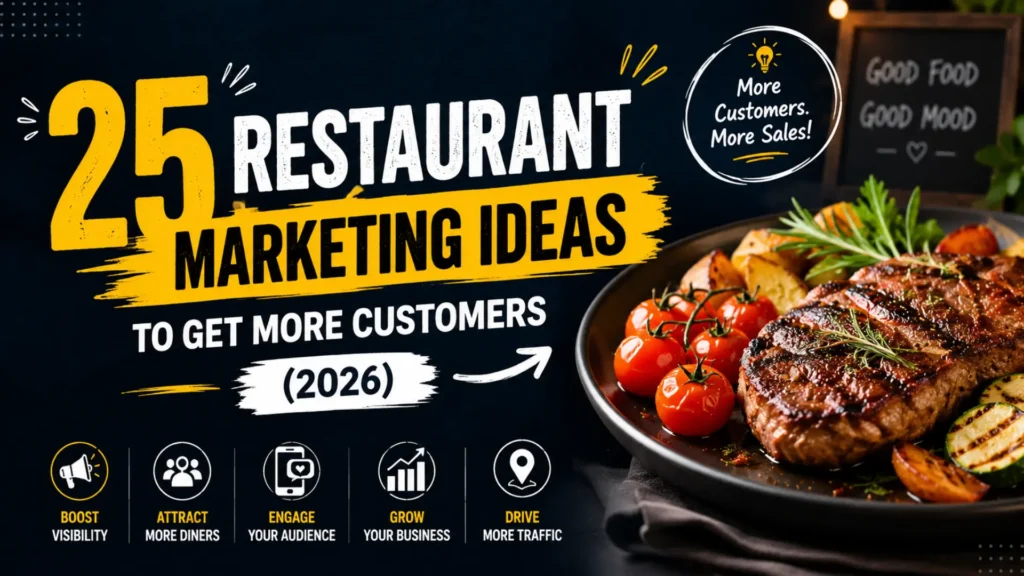
Running a restaurant is hard enough without wondering why the tables are not full. You cook great food, your service is warm, and yet the customers who should be finding you are walking into the place down the street instead. The problem is almost never the food. It is visibility. And that is exactly what the right restaurant marketing ideas fix. In 2026, 74 percent of people use social media to decide where to eat, most diners check Google before they ever check your menu, and the restaurants winning are not the ones spending the most. They are the ones marketing smart. This guide gives you 25 restaurant marketing ideas that actually work right now, organized by what they cost and what they deliver, with real numbers behind them, so you can stop guessing and start filling seats.
The best restaurant marketing ideas in 2026 combine local SEO (claiming and optimizing your Google Business Profile), short form video on Instagram Reels and TikTok, an automated loyalty program (75 percent of consumers say loyalty programs increase their spending), email and SMS campaigns, micro influencer partnerships, and community events. Most restaurants should invest 3 to 6 percent of revenue into marketing, focusing first on free high impact channels like Google reviews and social media before moving to paid ads. The goal is simple: get found, get chosen, get repeat visits.
Why Restaurant Marketing Feels Harder in 2026
Let us be honest about what changed, because it explains why the old playbook stopped working.
Ten years ago, a good location and word of mouth could carry a restaurant. Today, your customers discover new places through TikTok videos, Google Maps searches, and “best breakfast near me” queries typed at 9 AM on a Saturday. Social media is now the number one driver of restaurant discovery. Ghost kitchens and delivery only brands have crowded the market. And diners expect your online presence to match reality perfectly: accurate hours, current menus, and photos that look like what actually arrives at the table.
Here is the good news though. Most of your competitors are doing this badly. The restaurants that get even the basics right stand out fast, because the bar is lower than you think. That is why the restaurant marketing ideas in this guide start with fundamentals before anything fancy. The way customers find you online runs through the same systems every business competes in, and understanding how a search engine works helps you see exactly why some restaurants dominate local search while others stay invisible.
Free Restaurant Marketing Ideas (Start Here)
Before spending a single dollar on ads, lock in these free restaurant marketing ideas first. They deliver more than most paid campaigns.
Claim and Fully Optimize Your Google Business Profile
This is the single highest impact free move in all of restaurant marketing. Your Google Business Profile is what shows up when someone searches your restaurant’s name, or better, when they search “restaurants near me” or “breakfast open now.” It powers your presence on Google Search and Google Maps at the same time, which is where most hungry customers actually decide.
A complete, active profile delivers four direct benefits:
- You appear in the local pack. Those top three map listings for “near me” searches get the majority of clicks. An optimized profile is how you earn a spot there.
- Customers can act instantly. Your hours, menu, photos, phone number, directions, and reservation links sit in one place. A hungry searcher goes from “found you” to “table booked” in under a minute.
- Your reviews work as a 24/7 salesperson. Star ratings and recent reviews appear right in the search results, convincing new diners before they even click.
- Google favors active profiles. Regular photo uploads, posts about specials, updated hours, and review responses lift your ranking above competitors who set up their profile once and forgot it.
The setup takes about 20 minutes. Add real photos of your food and space, fill in every field, upload your menu, and keep your hours current, especially around holidays. Restaurants that treat their profile like a living channel routinely pull ahead of better funded competitors, because most owners never bother.
Build Your Review Engine
2. Ask for reviews the smart way. Train your staff to mention reviews to happy guests at the right moment (after a compliment, not with the bill). A steady flow of fresh reviews lifts your local ranking and convinces new diners to try you.
3. Respond to every review, good and bad. A thoughtful reply to a bad review often impresses future customers more than a five star rating. It shows you care and you are paying attention.
4. Keep your info consistent everywhere. Your name, address, phone, and hours should match across Google, your website, Instagram, and delivery apps. Inconsistency confuses both customers and search engines.
Free Channels That Compound
5. Set up a simple email list. Collect emails through your WiFi, receipts, or online orders. Email remains one of the highest return channels in all of marketing, and it costs almost nothing.
6. Post your food where people are hungry. Share photos and videos consistently on Instagram and TikTok. You do not need a photographer. A smartphone, good natural light, and real dishes beat polished stock photos every time.
7. Join local Facebook groups and Nextdoor. People constantly ask “where should we eat tonight?” in these communities. Be present, be helpful, and your name comes up naturally.
Social Media Ideas That Actually Get Attention
Social media is where restaurants win or lose in 2026, so let us get specific about what works.
Content That Stops the Scroll
8. Go all in on short form video. Every major algorithm now favors short video over static images. Film your kitchen prep, a signature dish coming together, the cheese pull, the sizzle. Hook viewers in the first two seconds, because attention is the scarcest thing on the internet.
9. Show your people, not just your plates. Staff personalities, the chef’s story, the regular who has ordered the same thing for eight years. People connect with people, and that connection turns viewers into visitors.
10. Repost your customers’ content. When guests tag you in photos and stories, share them with credit. User generated content builds trust that polished marketing never can, because diners trust other diners more than they trust you.
Grow Beyond Your Followers
11. Partner with local micro influencers. Skip the celebrities. Invite local food creators with small but loyal followings for a tasting. Their genuine posts reach exactly the audience that can actually visit you.
12. Make your space worth photographing. A statement wall, distinctive plating, good lighting. If your restaurant gives people a reason to take photos, your customers become your marketing team for free.
13. Post consistently, not constantly. Two to three quality posts per week on a reliable schedule beats daily posting that burns you out by March. Consistency over perfection wins the algorithm and the audience.
How Do You Get Customers to Come Back?
New customers are expensive. Repeat customers are profit. These restaurant marketing ideas turn one time visitors into regulars.
Automate the Reasons to Return
14. Launch a loyalty program that runs itself. This is the highest ROI move on this entire list. 75 percent of consumers say loyalty programs increase their spending. Use a digital system connected to your POS or online ordering, so points and rewards happen automatically without staff effort.
15. Send birthday and anniversary offers. A free dessert on someone’s birthday costs you three dollars and buys you a table of four plus a social media post. Collect birthdays through your email signup and automate the sends.
Win Back and Multiply Your Regulars
16. Text your regulars before slow nights. A simple SMS on a quiet Tuesday (“Tonight only: free appetizer with any main”) fills tables that would have sat empty. SMS open rates crush email, so save it for offers that matter.
17. Create a win back campaign. Set up an automatic email or text for guests who have not visited in 60 days. A warm “we miss you” with a small incentive brings back customers who simply forgot about you.
18. Reward referrals. Give existing customers a reason to bring friends: a discount for both, a free item, or loyalty points. Word of mouth is still the strongest restaurant marketing there is. Referral rewards just speed it up.
Paid Marketing Ideas Worth the Money
Once the free foundations are working, these paid restaurant marketing ideas amplify everything.
19. Run Google Local Ads for high intent searches. When someone searches “pizza near me” at 7 PM, they are not browsing, they are hungry. Local search ads capture that intent at the exact moment of decision. Start with 20 to 50 dollars a day and adjust weekly based on calls and bookings.
20. Use geo targeted social ads. Facebook and Instagram let you show ads only to people within a radius of your restaurant. Promote your best dishes to people who can actually walk in, and schedule ads for the hours when people decide where to eat (11 AM for lunch, 4 to 6 PM for dinner).
21. Retarget your website visitors. Someone who viewed your menu but did not book is your warmest lead. A simple retargeting ad reminding them of what they were craving converts remarkably well.
22. Boost your online ordering. Direct online ordering turns your website into a revenue engine. One family breakfast spot, Biscuit Love, saw a 23 percent aggregate sales increase within four weeks of adding online ordering to their site. If you rely only on third party apps, you are paying commission on customers who would have ordered direct.
Community and Local Marketing Ideas
The restaurants people love are the ones woven into their community. These ideas build that.
23. Host events that give people a reason to come. Trivia nights, live music, wine tastings, charity fundraisers. Events create experiences beyond food, and experiences create stories people share.
24. Sponsor local teams and causes. A youth soccer team sponsorship costs little and puts your name in front of loyal community members every weekend. People support businesses that support their community.
25. Show up at local markets and festivals. Bring your crowd favorites, hand out samples and coupons, and be genuinely friendly. Every festival attendee is a potential regular who now knows your name and your food.
The 2026 Edge: Get Your Restaurant Recommended by AI
Here is the bonus idea almost no restaurant is thinking about yet, which is exactly why it is worth your attention now.
People are no longer just searching Google. They are asking ChatGPT, Google’s AI, and other assistants questions like “where should I take my parents for dinner this weekend?” The AI answers with specific restaurant recommendations, and the diner often goes exactly where the AI suggests without ever seeing a traditional search result.
How a Restaurant Gets Picked by AI
The signals are surprisingly practical:
- An accurate, active Google Business Profile. AI tools pull heavily from Google’s data, so everything in idea 1 feeds directly into AI recommendations too.
- Fresh, detailed reviews. AI reads review content, not just star counts. Reviews that mention specific dishes and occasions teach the AI exactly when to recommend you.
- Consistent information everywhere. AI cross checks your website, listings, delivery platforms, and press mentions. Conflicting hours or menus make AI skip you for a source it trusts more.
- Being mentioned in local articles and lists. “Best of” roundups, local food blogs, and community features are exactly the sources AI cites when recommending restaurants.
This practice is called generative engine optimization, and in the restaurant world almost nobody is doing it deliberately yet. The restaurants that build these signals now will own the AI recommendations in their area while competitors are still wondering where their foot traffic went.
How Much Should a Restaurant Spend on Marketing?
Here is the honest answer with real industry numbers.
Most established restaurants invest 3 to 6 percent of total revenue into marketing, a range consistent with National Restaurant Association industry guidance and operator surveys. If you are in a highly competitive area or pushing for growth, 7 to 10 percent may be needed. Brand new restaurants in their first year often need 10 to 15 percent, because building awareness from zero costs more than maintaining it.
The smarter question is where to spend it. The order that works for most restaurants: free channels first (Google profile, reviews, social, email), then loyalty and retention systems, then paid ads to amplify what is already working. Restaurants that jump straight to paid ads with a weak foundation burn money promoting a presence that is not ready to convert.
The Mistakes That Waste Your Marketing Budget
Even good restaurant marketing ideas fail when these patterns creep in. They quietly drain money without filling tables.
Marketing to everyone. Trying to appeal to all diners means appealing to none. Know exactly who your core customer is and speak directly to them.
Chasing every trend. You do not need to be on every platform. Two channels done consistently beat six channels done poorly.
Discounting your way to traffic. Constant discounts attract deal hunters who never return at full price and quietly train regulars to wait for offers. Save discounts for strategic moments like slow nights and win back campaigns.
Ignoring capacity. A viral post that floods your kitchen on an already busy Friday creates bad experiences and bad reviews. Time your promotions for when you actually need the traffic.
Not measuring anything. If you do not know which channel drives bookings, you cannot spend smart. Track where new customers come from, even if it starts with staff simply asking “how did you hear about us?”
What We Learned Marketing Food Brands at Leemjaz
Let me share what actually moves the needle, because we have seen these patterns repeat across the food and hospitality clients we have worked with at Leemjaz.
The Foundation Comes Before the Ads
The biggest lesson: visibility compounds, but only if the foundation is right. One food business came to us spending heavily on social ads while their Google Business Profile sat half empty, with outdated hours and no review responses. Their ads were working, but the customers those ads sent to Google were finding a ghost town and choosing competitors instead. We fixed the foundation first: complete profile, review responses, consistent info across every platform, and locally optimized website content. Then we restarted the ads. Within three months, their “near me” search visibility climbed steadily and the same ad budget started producing roughly double the bookings, because the clicks finally landed on a presence that converted.
Local Search Is Your Highest Intent Channel
The second lesson: local search is the highest intent channel a restaurant has, and most restaurants barely compete there. Every “best biryani near me” or “family restaurant open now” search is a hungry customer ready to decide in the next ten minutes. Winning those searches is a system, not luck.
If your restaurant or food brand is putting effort into marketing but the tables and orders do not reflect it, the digital marketing team at Leemjaz builds exactly this kind of local visibility system, from search optimization to the social and ad strategy on top, so hungry customers searching in your area find you first instead of your competitor.
Frequently Asked Questions
1. What is the best marketing strategy for a restaurant?
The best restaurant marketing strategy in 2026 combines a fully optimized Google Business Profile, consistent short form video on social media, a digital loyalty program, and email or SMS campaigns for repeat visits. Start with free local SEO channels first, then layer paid ads on top once the foundation converts well.
2. How can I promote my restaurant with no money?
Claim and optimize your free Google Business Profile, ask happy customers for reviews, post smartphone videos of your food on Instagram and TikTok, join local Facebook groups where people ask for recommendations, and collect emails for a simple newsletter. These free channels drive real traffic and cost only your time.
3. How much should a restaurant spend on marketing?
Most established restaurants spend 3 to 6 percent of total revenue on marketing, while restaurants in competitive areas or growth mode invest 7 to 10 percent. New restaurants in their first year often need 10 to 15 percent to build awareness from scratch. Spend on free foundations first, then paid amplification.
4. What attracts customers to a restaurant the most?
Visibility and social proof attract customers most: showing up in “near me” searches, strong Google reviews, and appetizing photos and videos on social media. 74 percent of people use social media to decide where to eat, so a consistent, authentic online presence directly translates into foot traffic.
5. Do loyalty programs really work for restaurants?
Yes, loyalty programs are one of the highest ROI restaurant marketing tools available. 75 percent of consumers say loyalty programs increase their spending, and repeat customers cost far less than acquiring new ones. Digital programs connected to your POS work best because rewards happen automatically without staff effort.
6. How do restaurants get noticed on social media?
Post short form video consistently (two to three times per week), hook viewers in the first two seconds, show real kitchen moments and staff personalities, repost customer content with credit, and partner with local micro influencers for authentic reach. Video of food being made outperforms polished static photos on every major platform in 2026.
Conclusion
Restaurant marketing ideas only matter if they fill tables, and the ones in this guide are chosen for exactly that. Start with the free foundations: your Google profile, your reviews, your social presence, and your email list. Add a loyalty system that runs itself, because repeat customers are where the profit lives. Then, and only then, put money behind paid ads to amplify what already works. Keep an eye on the AI recommendation shift too, because the restaurants building those signals now will own their local market while everyone else catches up. Spend 3 to 6 percent of revenue, measure where your customers actually come from, and resist the urge to discount your way to busy nights. The restaurants winning in 2026 are not the loudest or the biggest spenders. They are the ones showing up consistently where hungry people are already looking, with a presence that makes choosing them feel easy. Do that, and the tables take care of themselves.