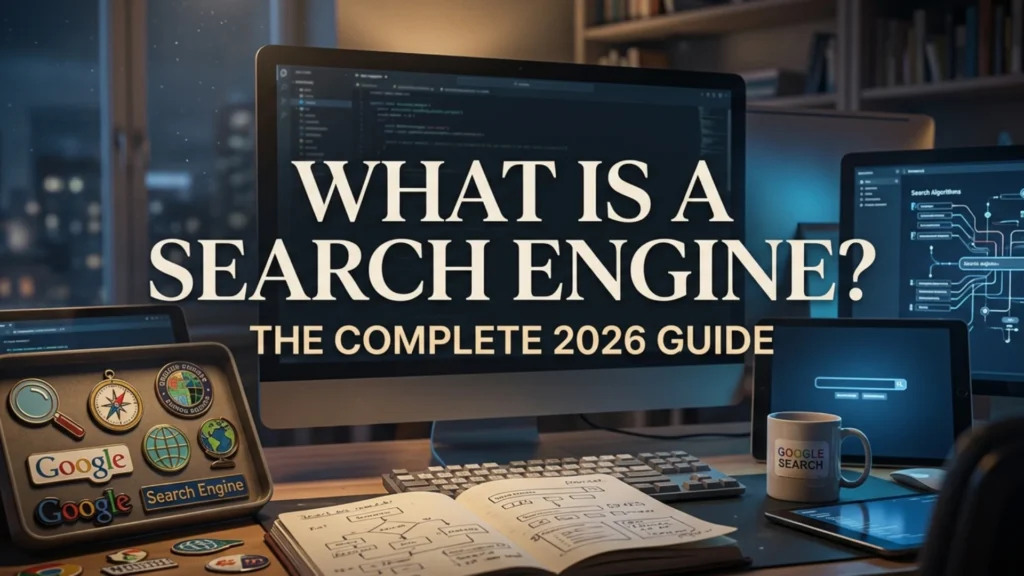
A search engine is one of those things almost everyone uses every day but very few people can actually explain. We type a question into Google, get an answer, and move on. But the definition of a search engine has changed more in the last two years than in the previous two decades. With AI Overviews answering more than half of all queries directly, ChatGPT and Perplexity now functioning as search alternatives, and TikTok being used as a discovery engine by Gen Z, the line between “search engine” and “answer engine” has blurred. This guide explains exactly what a search engine is in 2026, how it actually works behind the scenes, the different types you should know, and how the rise of AI is reshaping the entire category.
A search engine is a software system that crawls, indexes, and ranks content on the internet, then returns relevant results when a user enters a query. In 2026, the definition has expanded to include AI powered answer engines like ChatGPT, Gemini, and Perplexity, which generate direct answers rather than just listing links. Google still dominates with around 89 percent market share, but Bing, DuckDuckGo, Brave Search, and AI assistants are growing fast as users look for privacy, less advertising, and faster answers.
The Simple Definition of a Search Engine
A search engine is a software system that helps you find information on the internet by matching what you type with content that has been indexed from millions of websites. You enter a query (a word, a question, a phrase), and the search engine returns a ranked list of web pages, images, videos, news articles, maps, or AI generated answers that it believes best matches what you are looking for.
Think of it like an extremely fast librarian who has already read every book in a library the size of the entire internet, organized them by topic and quality, and can pull the most relevant ones off the shelf in under a second based on what you ask. The librarian also remembers your past preferences, your location, your device, and roughly what kind of answer you are likely looking for.
That is the simple version. The actual process is far more complex, and the way it has changed in 2026 makes the old definition incomplete.
How a Search Engine Actually Works (3 Stages)
Every search engine, from Google to a small specialized academic search tool, runs on three core processes. Understanding these three stages is the foundation of understanding everything else about search.
Stage 1: Crawling
Crawling is the process where the search engine sends out automated programs called crawlers, bots, or spiders to discover content across the internet. Google’s crawler is called Googlebot. Bing’s is Bingbot. These bots visit websites, follow links from page to page, and collect data about what they find: the text, images, videos, structure, internal links, and metadata.
Crawling never stops. Major search engines crawl billions of pages every day, prioritizing high authority sites that update frequently and revisiting smaller sites less often. If a page is not crawled, it cannot appear in search results.
Website owners can guide this process using a robots.txt file (telling crawlers which pages to skip) and an XML sitemap (telling crawlers which pages exist and should be prioritized).
Stage 2: Indexing
Once a page is crawled, the search engine processes its content and stores it in a massive database called the index. This index is like an enormous, structured library catalog. It records what each page is about, the keywords it contains, the topics it covers, the structure of its content, and the relationships it has to other pages on the web.
Google’s index contains hundreds of billions of pages and is measured in terabytes. The index is what makes near instant search results possible. When you type a query, the search engine is not searching the live internet, it is searching its index.
A page that is crawled but not indexed will not appear in results. This is why “indexed status” is one of the first things to check in Google Search Console when a page is not ranking.
Stage 3: Ranking
When a user enters a query, the search engine pulls every relevant page from its index and ranks them in order of relevance and quality. This ranking process happens in fractions of a second and uses hundreds of signals.
Google has publicly stated that its algorithm uses more than 200 ranking factors, including content quality, backlinks, page speed, mobile usability, user engagement signals, and topical authority. The exact weighting of each factor is proprietary and constantly changing, which is why no SEO expert can guarantee a specific position.
In 2026, ranking has also started including AI signals: how often a page gets cited inside AI Overviews, how often it appears in ChatGPT and Perplexity answers, and how well its content can be parsed by large language models.
The 5 Main Types of Search Engines in 2026
Most people think “search engine” means Google. But the category is broader than that, and understanding the types helps you pick the right tool for the right job.
1. General web search engines. Google, Bing, Yahoo, Yandex, Baidu. These crawl the entire web and return results across every topic. They are the default for most users.
2. Privacy focused search engines. DuckDuckGo, Brave Search, Startpage, Mojeek. These return general web results but do not track users or sell data. Brave Search and Mojeek run on their own independent indexes rather than pulling from Google or Bing behind the scenes.
3. Specialized and vertical search engines. Google Scholar (academic), PubMed (medical research), YouTube (video), Pinterest (visual ideas), Indeed (jobs). These cover a specific niche in deeper detail than general search engines can.
4. AI answer engines. ChatGPT, Gemini, Claude, Perplexity. These generate direct answers using large language models instead of returning a list of links. Perplexity is the closest to traditional search because it cites its sources, while ChatGPT and Gemini blend live search with model knowledge.
5. Conservative and alternative search engines. Freespoke, TUSK Search, Swisscows. These are built for users who want a specific ideological angle or family safe filtering. The market for these has grown significantly in the last two years, and the best conservative search engine breakdown covers the top picks for users moving away from Google.
Search Engine vs Web Browser: The Confusion People Still Have
This is one of the most common misunderstandings, and even experienced internet users get it wrong sometimes. A search engine and a web browser are not the same thing.
A web browser is the software application that lets you access the internet. Examples: Chrome, Safari, Firefox, Edge, Brave Browser, Arc.
A search engine is a service that helps you find information on the internet. Examples: Google, Bing, DuckDuckGo, Brave Search.
You use a browser to reach a search engine. You open Chrome (the browser), type “google.com” (or the query goes through Chrome’s URL bar which routes to Google by default), and Google (the search engine) shows you results.
The reason this confuses people is that browsers often have search built into the URL bar, and many users say “I Googled it on Chrome” without realizing they used two separate tools.
Search Engine vs Answer Engine vs LLM: The 2026 Landscape
This is the part that almost no competitor article addresses properly, and it is the biggest shift in the search world in 2026.
Traditional search engine. Returns a list of links. You click. read. You decide. Answer engine. Returns a direct answer summarized from multiple sources, with citations. Perplexity is the clearest example. Large language model (LLM). Generates an answer based on what the model already knows, plus optionally pulling live web data. ChatGPT, Claude, and Gemini are LLMs that now have search built into their experience.
The line is blurring fast. Google itself is no longer a pure search engine in 2026, because AI Overviews generate direct answers above the link list for most queries. Bing has Copilot built in. Perplexity and ChatGPT are pulling search traffic that used to go to Google.
For users, this means the definition of “search” is broader than ever. For businesses, it means optimizing for search now includes a new layer called answer engine optimization (AEO), which is the practice of getting your content cited inside AI generated answers. This is the kind of work covered in detail in the answer engine optimization guide for brands trying to stay visible across both traditional and AI search.
How Search Engines Rank Results (The Core Signals)
Ranking is the most important and most misunderstood part of search. Here are the signals that actually matter in 2026, simplified from Google’s official documentation and observed algorithm patterns.
Content quality and depth. Pages that fully answer a query, cover the topic in depth, and add original insight rank higher than thin or templated content. Google’s Helpful Content System actively demotes generic AI generated content that adds nothing new.
Topical authority. A site that publishes consistently on one topic over time is treated as more authoritative on that topic than a site that publishes scattered content. This is why a focused blog about coffee outranks a generalist site for coffee queries.
Backlinks from trusted sources. When other reputable websites link to your page, Google reads that as a credibility signal. Quality matters more than quantity in 2026.
Page experience. Page speed, mobile friendliness, secure connection (HTTPS), and Core Web Vitals all influence rankings, especially on competitive queries.
E E A T signals. Experience, Expertise, Authoritativeness, and Trust. Google explicitly evaluates whether content is written by someone with real experience on the topic, especially for medical, financial, and health related queries (called YMYL, or Your Money Your Life topics).
User engagement. How long users stay on the page, whether they bounce back to the search results, and whether they engage with the content all feed back into ranking signals.
Freshness. For news, trends, and time sensitive topics, recent content ranks higher. Older content can still rank if it is regularly updated.
The Biggest Search Engines in 2026 (Market Share Data)
Despite all the new entrants, the global search market is still concentrated. Here is the 2026 picture.
| Search Engine | Global Market Share | Best For |
| ~89% | General use, dominant in most countries | |
| Bing | ~3.5% | Integration with Microsoft products, Copilot AI |
| Yandex | ~2.6% | Dominant in Russia and parts of Eastern Europe |
| Yahoo | ~1.2% | Aging user base, US and Japan |
| DuckDuckGo | ~0.7% | Privacy focused users |
| Baidu | ~0.6% | Dominant in China |
| Brave Search | ~0.3% | Independent index, privacy first |
AI answer engines are not counted in traditional search market share data, but estimates suggest that ChatGPT, Perplexity, and Gemini collectively now handle 12 to 18 percent of the search style queries that used to go to Google, especially among users under 35.
How Gen Z Is Changing What “Search” Means
This is the trend most articles miss completely. According to research from Forbes and Adobe, only around 46 percent of Gen Z users say Google is their primary search starting point. The rest split across multiple platforms.
Gen Z search behavior in 2026:
- TikTok for product reviews, local recommendations, and how to videos
- Reddit for honest discussion based answers, especially after the AI content flood made Google’s top results feel templated
- ChatGPT and Perplexity for direct factual questions and research
- Instagram for fashion, food, and travel inspiration
- YouTube for tutorials and deep dives
For businesses, this is a major shift. Optimizing only for Google in 2026 is leaving 20 to 35 percent of your potential audience invisible. The right strategy now spans multiple discovery channels, which is exactly the kind of multi platform optimization the social media marketing team at Leemjaz builds into client campaigns rather than treating each platform as a separate project.
Why This Matters for Businesses and Creators
Understanding what a search engine actually is matters because it shapes how you reach the people who matter to your business. Three practical implications.
1. SEO is no longer just about Google. A complete search strategy in 2026 includes Google, Bing, AI answer engines, conservative and privacy alternatives, and platform native search on TikTok, Reddit, and Instagram. Brands that optimize only for Google are losing visibility to younger and privacy conscious audiences.
2. AI search has reshaped content strategy. Content that ranks in AI Overviews and gets cited inside ChatGPT and Perplexity answers is now as valuable as content that ranks at position 1 on Google. Many brands now create videos alongside written content to increase their visibility across search, social media, and AI-driven discovery platforms. The optimization patterns are different. AI engines reward clear structure, factual accuracy, and citation worthy formatting more than they reward backlinks alone.
3. Trust signals matter more than ever. Google’s Helpful Content System and the E E A T framework explicitly demote thin content, fake expertise, and AI generated articles with no human input. The brands winning in 2026 are the ones publishing genuine experience based content, with real author credentials, real client work, and real depth.
We have worked with US brands across e-commerce, SaaS, and personal services who saw their Google traffic drop 30 to 50 percent over the last 12 months as AI Overviews took over their top queries. The fix was always the same: rebuild content for clarity and depth, add real E E A T signals, and expand visibility into AI search engines and platform native search. Most clients recovered cross platform visibility within four months and saw revenue growth above their pre drop baseline.
If your business depends on search visibility and you are watching your traffic shrink while competitors keep growing, the SEO team at Leemjaz handles this kind of multi channel search optimization end to end.
Frequently Asked Questions
1. What is the difference between a search engine and Google?
Google is a specific search engine, the most popular one globally. The term “search engine” is the broader category, which includes Google, Bing, Yahoo, DuckDuckGo, Brave Search, and many others. Saying “search the web” technically applies to any search engine, while “Google it” specifically means using Google’s search service.
2. How does a search engine make money?
Most search engines make money primarily through advertising. Google, Bing, and Yahoo show paid ads at the top and bottom of search results, and they earn money each time a user clicks. Some search engines like DuckDuckGo and Brave Search show non personalized ads or take a small percentage from affiliate partnerships, while Brave Search also has a paid premium tier.
3. What is the most used search engine in the world?
Google is by far the most used search engine in the world, holding around 89 percent global market share in 2026. Bing is a distant second at roughly 3.5 percent, followed by Yandex, Yahoo, DuckDuckGo, and Baidu. Google’s dominance has held steady for over 15 years, though AI answer engines like ChatGPT and Perplexity are starting to take a share of search style queries.
4. Is Google the only search engine?
No, Google is one of dozens of search engines. Major alternatives include Bing (Microsoft), Yahoo, Yandex (Russia), Baidu (China), DuckDuckGo, Brave Search, Startpage, and Mojeek. AI answer engines like ChatGPT, Gemini, Claude, and Perplexity now also function as search style tools, even though they generate answers rather than list links.
5. What is the best search engine for privacy?
Brave Search, DuckDuckGo, Startpage, and Mojeek are the top privacy focused search engines in 2026. Brave Search and Mojeek run on their own independent indexes (not relying on Google or Bing data), while DuckDuckGo and Startpage protect users from tracking but pull results from larger indexes. For users who want full privacy plus algorithmic neutrality, Mojeek is widely considered the strongest option.
6. Are AI tools like ChatGPT considered search engines?
Technically no, but they are increasingly used like search engines. ChatGPT, Gemini, Claude, and Perplexity are large language models that generate answers rather than indexing and ranking web pages. Perplexity comes closest to traditional search because it cites real time sources. In 2026, the line between “search engine” and “answer engine” has blurred significantly, especially as Google added AI Overviews to its own results.
Conclusion
A search engine in 2026 is no longer just Google returning a list of blue links. It is a layered system that spans traditional search, AI answer engines, platform native search on TikTok and Reddit, and privacy and conservative alternatives. The mechanics behind every one of them still rely on the same three stages of crawling, indexing, and ranking, but the way users actually search has fragmented across more channels than ever before. For everyday users, this means more choice and faster answers. For businesses, it means search optimization has become a multi channel discipline rather than a single platform game. The brands winning are the ones who built visibility across the full search ecosystem early. The brands still treating Google as the entire internet are the ones quietly losing ground every month. Understanding what a search engine actually is, including how it has changed, is the first step toward not being on the losing side of that shift.