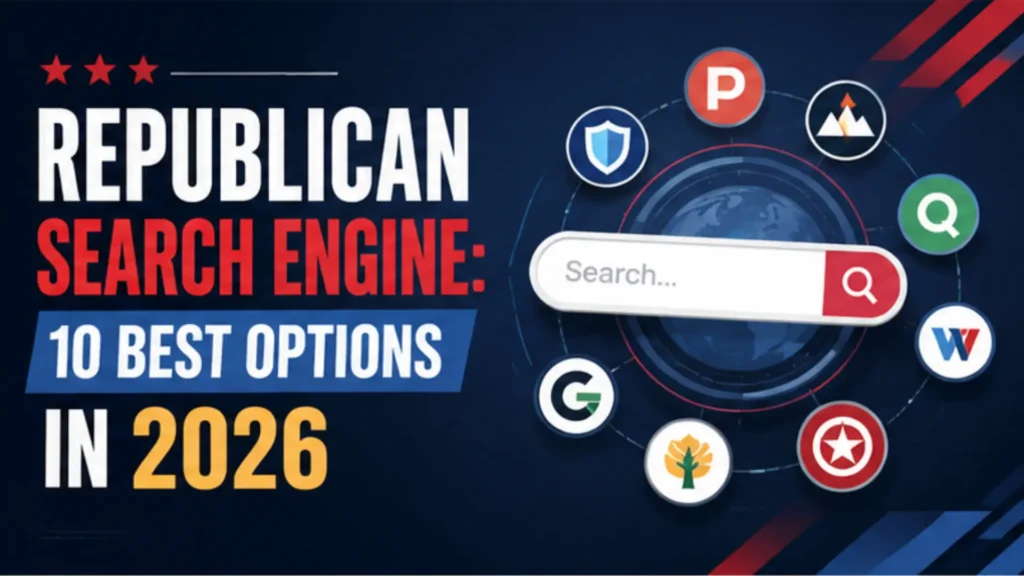
Searching for a republican search engine usually starts with one frustration: the feeling that mainstream results lean one way, bury certain outlets, and quietly decide what you see. Whether or not you share that view, the demand is real, and a whole ecosystem of search tools has grown around it. The problem is that most articles ranking for this topic just recycle a list of privacy engines and call it a day. This guide does the job properly. We cover the search engines actually built for conservative and republican audiences, when and why each one was made, the neutral engines that serve the same need without the politics, and the honest truth about which options deliver. By the end, you will know exactly which republican search engine fits how you actually browse.
The best republican search engine options in 2026 fall into two camps. Purpose-built platforms include Freespoke (launched 2021, labels media bias and shows left, right, and center sources side by side), TUSK (free speech search with a customizable news feed), 4Republican (a topic-specific engine for Republican news, policy, and candidates), and Gibiru (uncensored search running since 2009). Neutral independents that conservatives widely use include Brave Search (own index, no tracking), Mojeek (fully independent UK index since 2004), and Startpage (Google results without Google tracking). Freespoke is the strongest pick for most people searching this term.
What Is a Republican Search Engine?
A republican search engine is a search tool built or favored by conservative users who believe mainstream engines filter, down-rank, or editorialize results against right-leaning viewpoints. The term covers two genuinely different things, and knowing the difference saves you from picking the wrong tool.
Purpose-built political engines curate or label results with a conservative audience in mind. Freespoke, TUSK, and 4Republican sit in this camp. They exist specifically to surface right-leaning outlets alongside or above mainstream ones.
Neutral independent engines do not lean right at all. They simply run their own index or strip out personalization, which removes the algorithmic filtering conservatives object to. Brave Search, Mojeek, and Startpage sit here. Their neutrality is the feature.
Both camps solve the same complaint through opposite methods: one adds a conservative lens, the other removes every lens. Understanding how a search engine works underneath makes the difference obvious, because ranking is always a set of choices, and the only question is who makes them.
Why Are People Searching for a Republican Search Engine?
The demand did not appear from nowhere. Three forces drive it.
Distrust of Big Tech filtering. Pew Research Center polling has repeatedly found that a large majority of Republicans believe major tech platforms intentionally censor political viewpoints they disagree with. Whatever your own take, that belief shapes real behavior, and search habits shifted with it.
The DuckDuckGo turning point. For years, DuckDuckGo was the default “conservative” recommendation. That changed in 2022 when the company announced it would down-rank what it called Russian disinformation. Many conservative users read that as editorial judgment entering a supposedly neutral engine, and a visible migration toward Brave Search and purpose-built alternatives followed. Most articles ranking for this keyword still have not caught up with that shift.
The rise of labeled-bias search. A newer generation of tools, led by Freespoke, stopped pretending neutrality was possible and instead made bias visible, showing users left, right, and center sources on the same page. That transparency model turned out to be the most popular answer of all.
The 10 Best Republican Search Engine Options in 2026
Each entry covers when the engine launched, why it was made, and the features that matter. Purpose-built political options come first, neutral independents after.
1. Freespoke: Best Overall Republican Search Engine
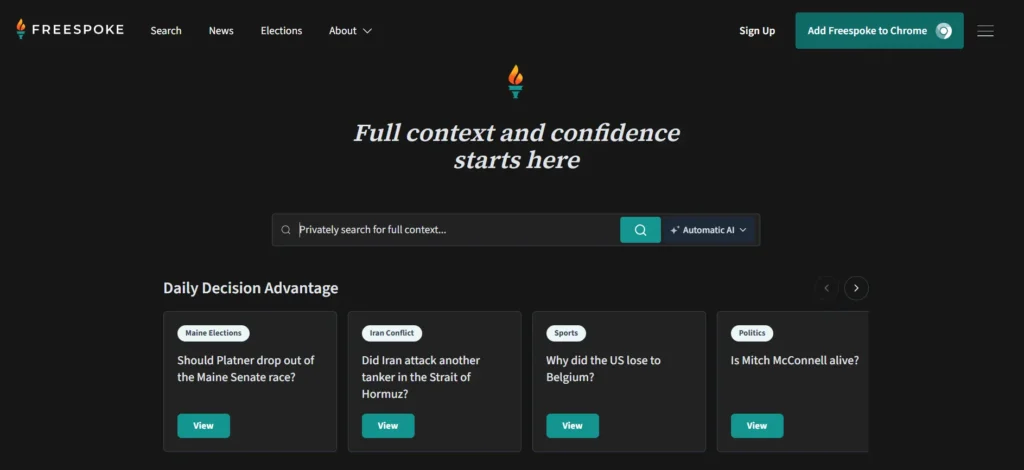
Freespoke launched in 2021, founded by Todd Ricketts and a team who felt mainstream search had stopped showing both sides. Its signature move is honesty about bias: news results display left, right, and center sources side by side, each labeled, so you see the full spectrum and judge for yourself.
Key features:
- Media bias labels on news results (left, center, right)
- “Both sides” story pages for major controversies
- Porn-free and censorship-light by design
- Election hubs and candidate information during voting seasons
Best for: Anyone searching this keyword. It answers the actual need better than any other tool.
2. TUSK: Best for a Customized Conservative News Feed
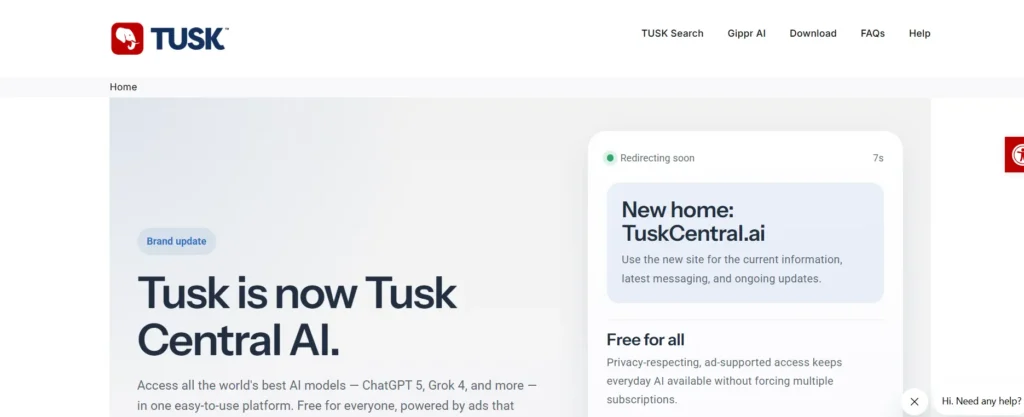
TUSK is a free speech search engine and browser built around one idea: you choose your trusted outlets. Its built-in news feed shows only articles from media sources you select, and the search layer avoids the down-ranking policies that pushed users away from mainstream engines.
Key features:
- Censorship-free search with a free speech emphasis
- News feed limited to outlets you personally trust
- Companion browser for a fully separate browsing setup
- No tracking of personal search behavior
Best for: Users who want their news diet fully under their own control.
3. Brave Search: Best Independent Index
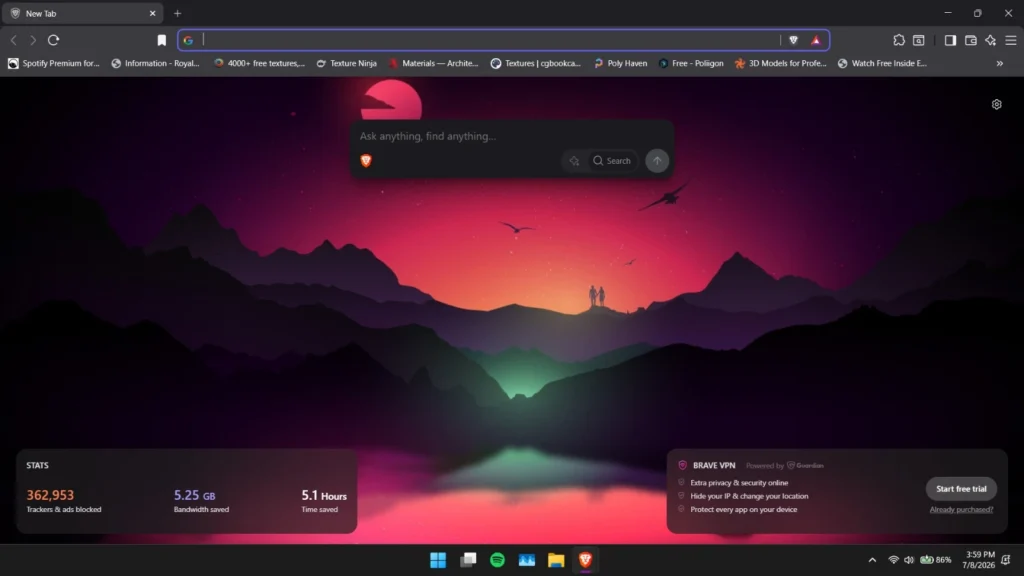
Brave Search launched in 2021 from Brave Software, the company behind the Brave browser, after acquiring the Tailcat search engine. It is not a conservative product, and that is the point: it runs its own independent index of the web, free of Google and Bing infrastructure, with no user tracking and no personalized filtering.
Key features:
- Fully independent search index, over 30 million daily users
- Zero tracking, zero profiles, zero personalized results
- Goggles feature lets you re-rank results through custom lenses
- Built-in AI answers without surveillance
Best for: Users who want the filtering gone rather than reversed.
4. 4Republican: Best Topic-Specific Republican Search
4Republican, part of the Las Vegas based 4Search network, takes the narrowest approach on this list. It is a specialty engine indexing Republican news, policy documents, candidate information, events, and merchandise, with multiple indexes and AI tools focused entirely on that niche.
Key features:
- Dedicated index of Republican-focused websites and news
- Candidate, policy, and event search in one place
- Part of a network of hundreds of topic-specific engines
- AI tools to surface focused political results
Best for: Political research, campaign tracking, and Republican-specific shopping.
5. Gibiru: Best Long-Running Uncensored Search
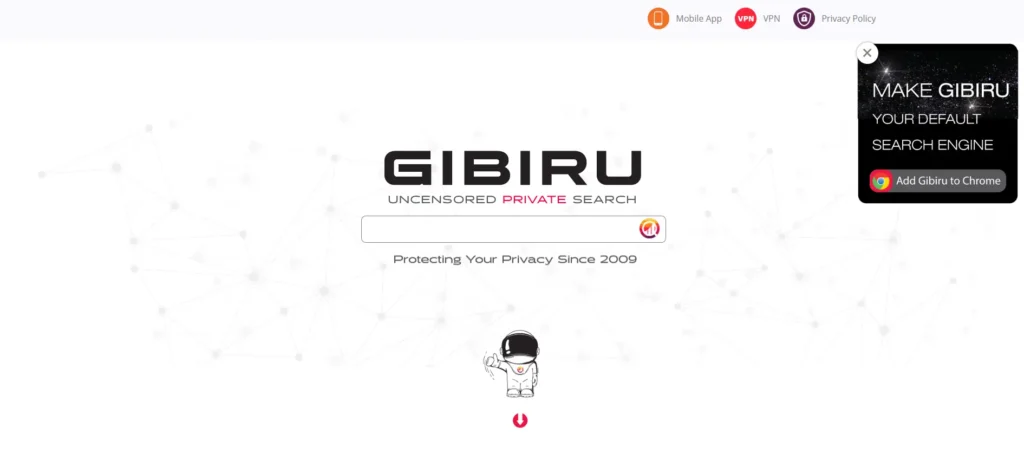
Gibiru has run since 2009, making it one of the oldest “uncensored search” projects on the web. It uses a modified algorithm to surface results it says mainstream engines suppress, and it neither logs IP addresses nor sells user data.
Key features:
- Uncensored results tab alongside standard results
- No cookies, no IP logging, no data sales
- One of the longest track records in alternative search
- Works with a companion mobile app
Best for: Users who want to see what standard engines might bury.
6. Mojeek: Best for True Neutrality
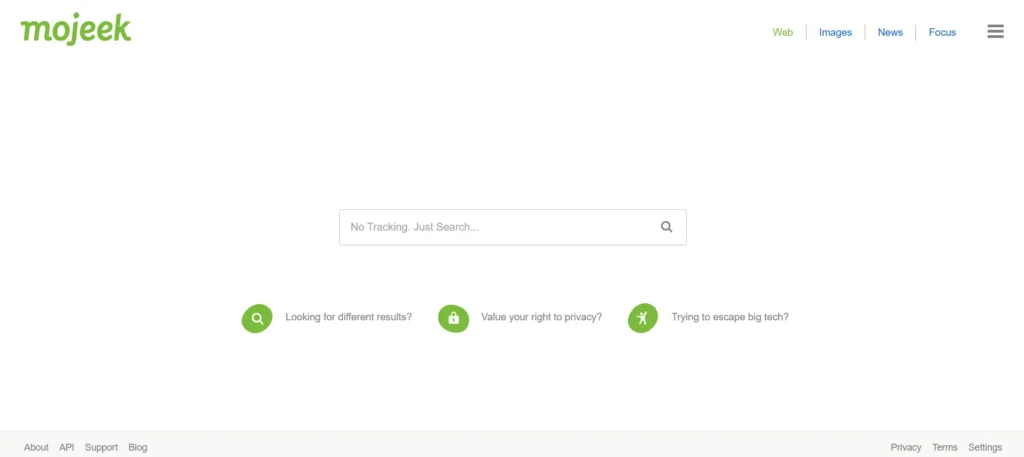
Mojeek started in 2004 in the UK and did something almost nobody else bothered to do: it built its own crawler and index from scratch. No Google results, no Bing results, no political mission either way. Its neutrality is structural rather than promised.
Key features:
- Fully independent index, crawling since 2004
- No tracking and no personalization of any kind
- Based outside US Big Tech infrastructure entirely
- Transparent, algorithm-first ranking
Best for: Users who distrust every editorial layer, left or right.
7. Startpage: Best for Google Results Without Google
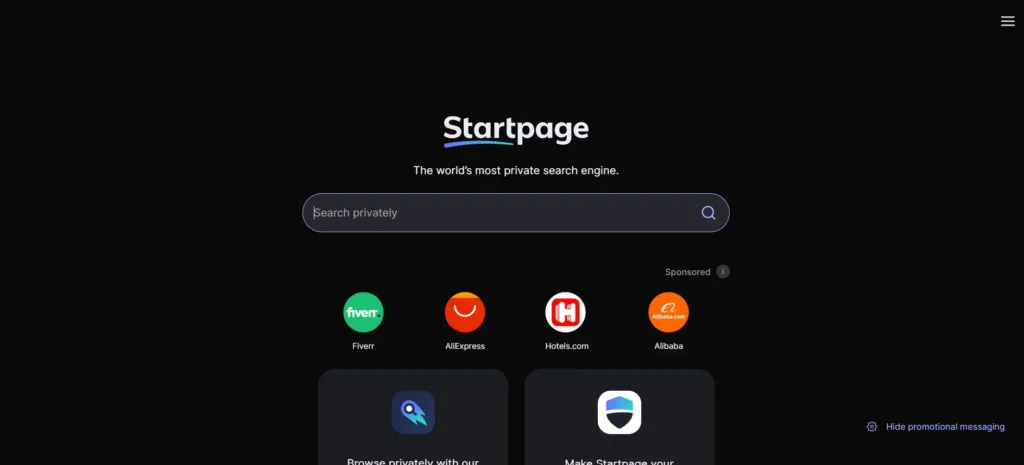
Startpage, founded in the Netherlands in 1998, acts as a privacy proxy: it fetches actual Google results but strips your identity before the query ever reaches Google. You get the index conservatives still find most complete, minus the profile building.
Key features:
- Real Google results with zero Google tracking
- Anonymous View lets you open sites without revealing your IP
- No search history, no profiles, EU privacy law protection
- Familiar results quality with none of the personalization
Best for: Users who like Google’s results but not Google’s surveillance.
8. Presearch: Best Decentralized Option
Presearch launched in 2017 with a Web3 twist: the engine runs on community-operated nodes rather than corporate servers, and users earn PRE tokens for searching. Decentralization means no single company controls what ranks.
Key features:
- Decentralized infrastructure run by node operators
- Token rewards for daily searching
- No user tracking or profiling
- Community governance over the project’s direction
Best for: Crypto-comfortable users who want structural independence.
9. Swisscows: Best Family-Safe Alternative
Swisscows operates from Switzerland under strict privacy law and filters explicit content permanently, which appeals to family-values users. It runs on Bing’s index through a privacy layer and stores nothing about you.
Key features:
- Always-on family filter that cannot be disabled
- Swiss data centers under Swiss privacy law
- Semantic search technology for cleaner results
- No tracking, no data storage
Best for: Families who want values-aligned filtering plus privacy.
10. DuckDuckGo: Still Useful, With an Honest Caveat
DuckDuckGo, founded by Gabriel Weinberg in 2008, remains the biggest privacy engine with billions of monthly searches. The caveat matters though: its 2022 decision to down-rank certain content cost it standing with the exact audience searching this keyword. It still tracks nothing and profiles nobody, but users wanting zero editorial judgment now tend to prefer Brave or Mojeek.
Key features:
- No tracking, no search history, no profiles
- Massive index via Bing partnership, mainstream polish
- Bangs feature for instant searches on other sites
- Duck.ai for anonymous AI conversations
Best for: Privacy-first users who care less about the 2022 controversy.
Republican Search Engines Compared: All 10 Side by Side
| Engine | Launched | Type | Own Index | Tracking | Standout Feature |
| Freespoke | 2021 | Conservative-built | Partial | No | Left/right/center bias labels |
| TUSK | 2021 era | Conservative-built | No | No | Pick-your-outlets news feed |
| Brave Search | 2021 | Neutral independent | Yes | No | Independent index + Goggles |
| 4Republican | 2010s | Conservative-built | Niche | Minimal | Republican-only topic index |
| Gibiru | 2009 | Uncensored | Modified | No | Uncensored results tab |
| Mojeek | 2004 | Neutral independent | Yes | No | Oldest independent crawler |
| Startpage | 1998 | Privacy proxy | No (Google) | No | Google results, anonymous |
| Presearch | 2017 | Decentralized | Hybrid | No | Token rewards, node network |
| Swisscows | 2014 | Family-safe | No (Bing) | No | Permanent family filter |
| DuckDuckGo | 2008 | Privacy | No (Bing) | No | Scale and polish |
Which One Should You Actually Use?
Match the engine to the reason you searched this keyword.
You want conservative perspectives visible in news: Freespoke. The bias labels genuinely change how you read a story.
You want total control over your news sources: TUSK. Nothing enters your feed that you did not approve.
You want the filtering removed, not reversed: Brave Search or Mojeek. Independent indexes, no editorial layer.
You research Republican politics specifically: 4Republican. Purpose-built for candidates, policy, and events.
You want Google quality without Google: Startpage. Same results, no surveillance.
You browse with kids around: Swisscows. The family filter never switches off.
A smart setup uses two: Freespoke or TUSK for news, and Brave or Startpage as your everyday default. Many of the engines above overlap heavily with the broader world of private search engines, so if privacy weighs as heavily as politics for you, that comparison completes the picture.
The Honest Truth About Bias and Search
Here is the part every competitor article dodges, and it matters for choosing well.
No search engine is unbiased. Ranking means choosing, and every choice reflects values: which sources count as authoritative, which content gets filtered, what “relevant” even means. Mainstream engines make those choices one way. Conservative engines make them another way. Neutral independents make fewer choices, but fewer is not zero.
The practical takeaway is to pick your bias consciously instead of absorbing one by default. Freespoke’s label-everything model handles this best, because it shows you the spectrum rather than hiding the choice. Independent engines like Mojeek handle it second best, because their small teams have little incentive to editorialize. What serves you worst is believing any single engine, mainstream or alternative, shows you the objective truth. The wider landscape of conservative search engines makes the same point across even more platforms: informed choice beats blind trust in either direction.
How We See It at Leemjaz
Our team at Leemjaz tracks alternative search platforms for a practical reason: our clients’ customers search everywhere, not just on Google.
When we audited traffic sources across client sites through 2025 and 2026, a clear pattern emerged. Referrals from alternative engines (Brave, DuckDuckGo, Startpage, and newer players like Freespoke) remained small in volume, usually 2 to 6 percent of organic traffic, but they converted noticeably better than average. The users arriving from these platforms chose their search engine deliberately, which tends to mean they act deliberately too: longer sessions, lower bounce rates, and stronger conversion intent.
The lesson for any business is simple. Visibility now means being findable across the whole search ecosystem, from Google to the independents to AI answer engines. Sites built on clean structure, genuine authority, and honest content rank everywhere at once, because every engine on this list rewards the same fundamentals. If your brand’s visibility stops at Google, the SEO team at Leemjaz maps where your audience actually searches and builds presence across all of it.
Frequently Asked Questions
1. What is the best republican search engine? (est. 1,000 searches/month)
Freespoke is the best republican search engine for most users in 2026. It launched in 2021 specifically to show left, right, and center news sources side by side with bias labels, so conservative perspectives stay visible without hiding the other side. TUSK and 4Republican are strong alternatives for custom news feeds and Republican-specific research.
2. Is there a conservative alternative to Google? (est. 1,300 searches/month)
Yes, several. Freespoke and TUSK were built specifically for conservative audiences, while Brave Search and Mojeek offer fully independent indexes with no Big Tech filtering in either direction. Startpage delivers actual Google results through a privacy layer, giving you Google’s quality without its tracking or personalization.
3. What search engine do most conservatives use? (est. 900 searches/month)
Brave Search and DuckDuckGo carry the largest conservative user bases by volume, mainly for their no-tracking, no-personalization models. Freespoke has grown fastest among purpose-built options since 2021. Many conservative users run a two-engine setup: a neutral independent for everyday searches and Freespoke or TUSK for news.
4. Is DuckDuckGo conservative? (est. 2,400 searches/month)
No, DuckDuckGo is a privacy engine, not a conservative one. It gained conservative users by refusing to track or personalize, but its 2022 decision to down-rank content it labeled Russian disinformation pushed many of those users toward Brave Search and Freespoke. It remains excellent for privacy, just not editorially neutral in the strictest sense.
5. What is Freespoke search? (est. 1,900 searches/month)
Freespoke is a search engine launched in 2021 that labels the political lean of news sources and displays left, center, and right coverage of the same story together. It filters explicit content, avoids down-ranking outlets by ideology, and adds election hubs during voting seasons. It has become the leading purpose-built option for conservative searchers.
6. Is Brave Search unbiased? (est. 700 searches/month)
Brave Search is as close to unbiased as mainstream-quality search gets, because it runs its own independent index with no tracking, no profiles, and no personalized filtering. True neutrality is impossible since all ranking involves choices, but Brave’s independence from Google, Bing, and advertising pressure removes the layers most users object to.
Conclusion
The republican search engine question has a better answer in 2026 than a recycled list of privacy tools. Purpose-built platforms like Freespoke, TUSK, and 4Republican now serve the political need directly, with founding stories and features designed for exactly this audience, while independents like Brave Search and Mojeek solve the same frustration by removing filters instead of adding them. Pick consciously: Freespoke for labeled, full-spectrum news, TUSK for a feed you control, Brave or Startpage as a clean everyday default. And keep the honest principle in mind that no engine on earth is truly neutral, so the winning move is knowing whose choices you are trusting. Choose deliberately, pair two engines for balance, and you get exactly what this search was really about: information on your terms.