Old blog posts can continue attracting visitors long after their publication dates. However, outdated information, changing search intent, and weak on-page optimization can gradually reduce their performance. Businesses that want to optimize old blog posts for SEO should review existing content, identify what needs improvement, and make updates that genuinely help readers.
At Leemjaz, content optimization is part of a wider organic search strategy. It connects keyword research, content quality, technical SEO, and internal linking with business goals. Instead of publishing new articles constantly, businesses can often find valuable opportunities in the content they already have.
Why Should Businesses Optimize Old Blog Posts for SEO?
Publishing a blog post does not guarantee that it will continue performing well in search results. Search trends change, competitors publish better resources, and information can become outdated.
An article that once attracted organic traffic may gradually lose visibility because it no longer answers users’ questions as effectively as competing pages.
Updating existing content can help businesses:
- Improve relevance for current search queries.
- Replace outdated facts, statistics, and examples.
- Address missing information and unanswered questions.
- Improve organic click-through rates with clearer titles and descriptions.
- Strengthen internal links to important service pages.
- Make existing articles more useful for potential customers.
For example, an article about SEO strategies written several years ago may contain outdated recommendations. Updating its examples, explaining current practices, and improving its structure can make it more useful.
Businesses should optimize old blog posts for SEO when meaningful improvements can help readers and support the website’s overall content strategy. Changing a publication date without improving the article is not a meaningful content update.
How to Identify Old Blog Posts That Need SEO Optimization
Before making changes, identify which articles have the greatest improvement potential. Updating every old post at once is rarely the most efficient approach.
A content review helps businesses understand which pages need attention and why.
1. Review Google Search Console Performance
Google Search Console provides useful information about how website pages perform in Google Search.
Open the Performance report and review clicks, impressions, average position, and click-through rate. Compare recent performance with previous periods to identify changes.
Pay attention to pages that:
- Receive impressions but generate relatively few clicks.
- Have experienced a steady decline in organic traffic.
- Appear for keywords that do not closely match their content.
- Rank near the top of page two or lower in search results.
- Attract visitors but generate few meaningful enquiries.
These patterns can reveal opportunities to optimize old blog posts for SEO.
For example, an article may receive impressions for relevant searches but have a weak title that does not encourage clicks. Improving its title and meta description may help communicate its value more clearly.
2. Identify Content Decay
Content decay happens when an article gradually loses traffic, rankings, or relevance over time.
Several factors can contribute to this decline. Competitors may publish more comprehensive resources, search intent may change, or the original article may contain outdated information.
Review your older posts and compare their current performance with earlier periods.
Do not assume that every traffic decline requires a complete rewrite. First, investigate whether the problem comes from outdated information, weak keyword targeting, technical issues, or stronger competition.
3. Check Whether the Content Supports Business Goals
Traffic alone does not determine whether an article is valuable.
A blog post may attract many visitors without generating enquiries or supporting the services your business offers. Another article with fewer visits may attract people who are more likely to become customers.
Review whether each article:
- Addresses a relevant audience.
- Connects naturally with your products or services.
- Answers a genuine customer question.
- Supports an important topic on your website.
- Provides useful next steps for interested readers.
This approach helps businesses prioritize content that contributes to meaningful results.
How to Optimize Old Blog Posts for SEO Step by Step
Once you identify articles that need improvement, review each page carefully. The goal is not to add keywords everywhere. It is to make the content more accurate, useful, relevant, and accessible.
1. Recheck Keyword Research and Search Intent
Start by reviewing the primary keyword and the search intent behind it.
Search intent explains what users expect to find when they enter a particular query. Their needs may change over time, so an article that once matched the search may no longer satisfy visitors.
Search your target keyword and review the pages currently appearing in the results. Look at the topics they cover, their content structure, and the questions they answer.
Then compare those pages with your existing article.
Ask yourself:
- Does the article answer the main search query?
- Is the content aligned with informational, commercial, or transactional intent?
- Are important subtopics missing?
- Are users likely to find the information they need?
- Does the article offer something useful beyond competing content?
For example, an old guide about keyword research may focus only on keyword definitions. Current readers may also expect practical examples, search intent analysis, and keyword grouping.
Update the article around the needs of its audience rather than copying competitor headings.
2. Update Outdated Information and Examples
Old statistics, broken references, discontinued tools, and outdated recommendations can reduce the usefulness of an article.
Review every section and check whether its information remains accurate.
Replace outdated examples with relevant ones. Update statistics only when you can verify them through reliable sources. Remove recommendations that no longer apply.
You should also review screenshots, product references, pricing information, and external links.
When you optimize old blog posts for SEO, prioritize meaningful updates over simply increasing the word count. A shorter article with accurate and relevant information can be more useful than a longer article filled with unnecessary explanations.
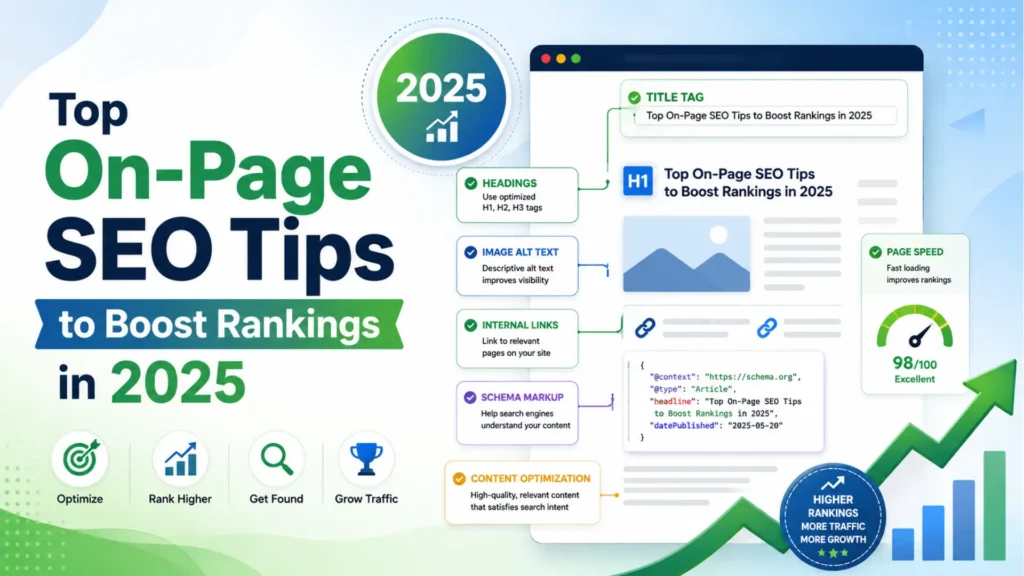
3. Improve Headings and Content Structure
Clear headings make articles easier to read and help visitors locate specific information.
Review the H1, H2, and H3 headings in your existing post. Make sure each heading describes the section accurately and follows a logical order.
Use the primary keyword and related terms naturally where they fit.
For example, an article about content optimization could include sections about keyword research, internal linking, search intent, and performance tracking.
Avoid repeating the same keyword in every heading. Search engines and readers benefit more from clear, descriptive headings than forced keyword placement.
4. Strengthen Internal Linking
Internal links connect related pages on your website. They help visitors discover useful resources and provide search engines with additional context about your site’s structure.
When updating an article, look for relevant pages that can support its topic.
For example, a post about updating old content could link to your SEO services page when discussing professional content optimization.
You can also connect it with related resources, such as Leemjaz’s guide on organic traffic for small businesses.
Use short, descriptive anchor text that tells readers what they will find after clicking. Avoid adding links where they do not provide value.
5. Improve Titles and Meta Descriptions
Your SEO title and meta description help users understand what a page offers in search results.
Review both elements when you update an older article.
A useful SEO title should:
- Clearly describe the page’s main topic.
- Include the primary keyword naturally.
- Give users a reason to visit.
- Avoid unnecessary repetition or keyword stuffing.
Your meta description should summarize the article accurately and explain its value.
For example, instead of using a vague description such as “Read our latest SEO tips,” explain what readers will learn and why the information is useful.
When you optimize old blog posts for SEO, make sure the title and description match the actual content. Avoid promising information that the article does not provide.
6. Optimize Images and Page Experience
Images can make an article more engaging, but large files and poorly described visuals can affect the overall experience.
Review the images used in older posts.
Compress large image files, use suitable dimensions, and choose descriptive filenames. Add meaningful alt text when an image communicates useful information.
Also check whether the page works properly on mobile devices.
Review:
- Image loading and display.
- Mobile responsiveness.
- Page navigation.
- Font readability.
- Broken links and buttons.
- Page loading performance.
- Core Web Vitals.
A technically sound page makes it easier for visitors to access and use your content. However, improving page speed alone does not guarantee higher rankings. It should be part of a broader optimization process.
7. Check Technical SEO Issues
Sometimes, an article loses visibility because of technical problems rather than weak content.
Check whether the page can be crawled and indexed. Review its canonical tag, URL, internal links, and indexability settings.
Also look for:
- Broken internal or external links.
- Accidental noindex directives.
- Incorrect canonical URLs.
- Redirect chains.
- Duplicate or competing pages.
- Missing or inaccurate structured data.
If you change a URL, set up an appropriate 301 redirect from the old address to the relevant new one. Avoid changing URLs unnecessarily because existing pages may already have backlinks, search visibility, and user visits.
Technical checks are an important part of deciding how to optimize old blog posts for SEO without creating new problems.
8. Add Useful Calls to Action
An updated article should help readers understand what to do next.
Review whether your content includes a relevant call to action. Depending on the topic, you could encourage visitors to explore a service, read a related guide, request a consultation, or contact your business.
For example, an article about organic search optimization can naturally introduce readers to professional SEO support.
Keep calls to action relevant to the content. Avoid placing promotional messages in every section because they can distract readers from the information they came to find.
When Should You Update, Rewrite, or Consolidate Old Blog Posts?
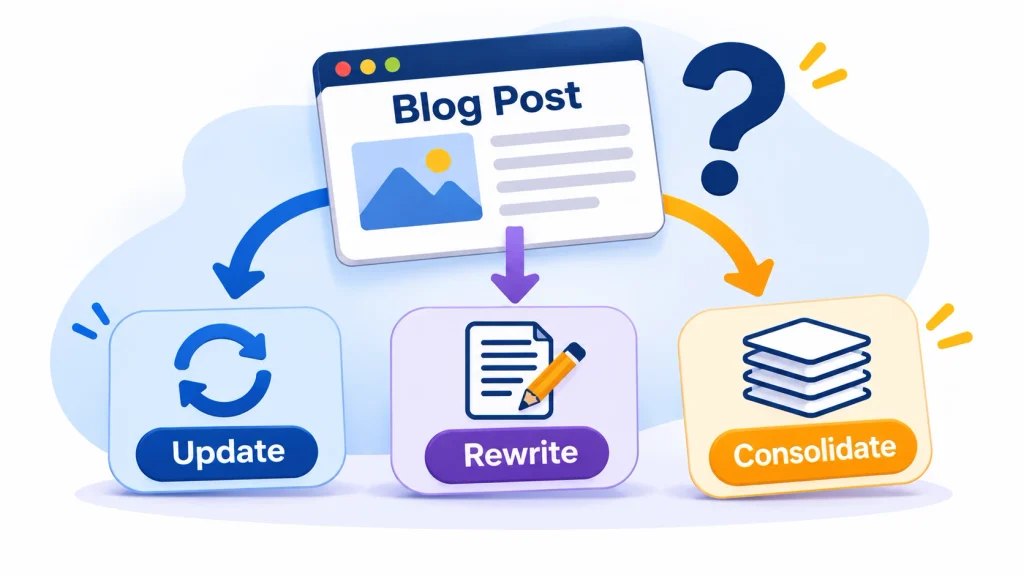
Not every older article needs the same type of improvement. Choose an approach based on its current performance, relevance, and purpose.
Update Existing Content
Update an article when its main topic is still relevant but some information needs improvement.
This may include refreshing statistics, adding missing examples, improving headings, updating links, or correcting outdated recommendations.
This is usually the most suitable option when the existing page already receives relevant impressions or backlinks. Once the post is refreshed, you can also look for relevant link insertion opportunities on existing articles, and a niche edit finder like Insertora can help you spot them.
Rewrite the Article
A rewrite may be necessary when the content is too thin, poorly structured, inaccurate, or no longer matches the search intent.
You may also need a substantial rewrite when competitors provide much more useful information and your article has important gaps.
Preserve useful information and existing URL value wherever possible. A rewrite should improve the page rather than replace its content without a clear reason.
Consolidate Similar Articles
Sometimes, several posts cover almost identical topics.
These pages may compete for similar search queries and make it difficult for users to find the most useful resource.
Review their content, performance, and backlinks before deciding what to do. If consolidation makes sense, combine the strongest information into one comprehensive page and redirect outdated or redundant URLs where appropriate.
The decision to update, rewrite, or consolidate should come from evidence rather than the publication date alone.
How Leemjaz Uses Content Optimization to Improve Organic Search Visibility
At Leemjaz, content optimization works alongside broader SEO activities. The purpose is to improve the website’s relevance, strengthen its search visibility, and connect content with business objectives.
The process can include:
Content performance review: Identifying pages that have lost traffic, receive impressions without clicks, or no longer meet user expectations.
Keyword and search intent analysis: Reviewing target queries and understanding what information searchers expect.
On-page improvements: Refining titles, headings, content structure, and relevant keyword placement.
Internal linking: Connecting supporting articles with important service pages and related resources.
Technical checks: Reviewing indexability, page experience, redirects, and other issues that may affect search performance.
Performance monitoring: Tracking changes in impressions, clicks, rankings, and conversions after updates.
These activities work together. Improving one article may help, but a consistent content strategy gives businesses a clearer way to manage their website over time.
Businesses looking for a structured approach can explore Leemjaz’s organic SEO services to understand how content optimization fits into a wider search strategy.
How to Optimize Old Blog Posts for AI Overviews and LLM Visibility
Search experiences are changing as people use Google AI Overviews, AI Mode, ChatGPT, and other AI-powered tools to find information.
Businesses should make sure their content answers questions clearly and provides useful information. However, there is no guaranteed method for getting a page included in an AI-generated response.
When you optimize old blog posts for SEO, consider these content practices as well:
Answer questions directly: Explain the main point clearly before adding supporting details.
Use descriptive headings: Organize information into sections that address specific questions and related topics.
Include original insights: Add practical examples, comparisons, and explanations that provide value beyond generic advice.
Support factual claims: Link to reliable sources when discussing statistics, research, or important recommendations.
Demonstrate genuine expertise: Explain processes, services, and industry knowledge accurately. Avoid unsupported claims and invented results.
Maintain technical accessibility: Make sure important content is available as readable text and that search engines can access the page.
Google’s AI search guidance explains how its AI search experiences relate to established Search practices.
Leemjaz treats AI search visibility as an extension of helpful content and sound SEO foundations, not a replacement for them.
How to Measure Results After Updating Old Blog Posts

Updating an article is only one part of the process. You also need to monitor its performance to understand whether the changes are helping.
Use Google Search Console to review:
- Organic clicks: The number of visits coming from Google Search.
- Impressions: How often the page appears in search results.
- Click-through rate: The percentage of impressions that generate clicks.
- Average position: The page’s average position for selected queries.
- Search queries: The terms that bring users to the page.
You can also use Google Analytics 4 to understand visitor behavior and track relevant conversions.
Compare performance over similar periods rather than judging an update after only a few days. Search engines need time to recrawl and reassess changed pages, and results can vary depending on competition and other factors.
Look beyond rankings alone. If an article receives more relevant visitors and generates more enquiries, the update may be supporting business goals even if its average position changes only slightly.
A consistent review process helps businesses decide which pages need further attention and where future content improvements will have the greatest value.
Conclusion
Older blog posts can remain valuable assets when businesses maintain their accuracy, relevance, and usefulness. A thoughtful content refresh can improve search intent alignment, strengthen internal links, resolve technical issues, and make information easier for visitors to understand.
To optimize old blog posts for SEO, start with performance data, identify the pages that need attention, and make changes that provide genuine value. Avoid updating content simply to change its publication date or add more keywords.
Leemjaz connects content optimization with keyword research, technical SEO, internal linking, and business goals. This approach helps businesses improve existing resources while building a stronger foundation for long-term organic search visibility.
Frequently Asked Questions
1. How often should you optimize old blog posts for SEO?
Review important blog posts every six to twelve months, or sooner when information changes or performance declines. The right schedule depends on the topic, industry, competition, and how frequently the information becomes outdated.
2. Does updating old blog posts improve Google rankings?
Updating old posts can improve their relevance, accuracy, and usefulness, which may support better search performance. However, an update does not guarantee higher rankings. Results depend on content quality, competition, technical health, and search intent.
3. Should I change the publication date when updating an old blog post?
Only change the visible publication or update date when it accurately reflects a meaningful content update and your website’s publishing practices. Changing the date without improving the article does not provide a genuine SEO benefit.
4. How do I find old blog posts that are losing traffic?
Use Google Search Console to compare clicks, impressions, click-through rates, and search queries across different periods. Look for pages with declining traffic, outdated information, or impressions that are not generating enough clicks.
5. Is it better to update an old blog post or publish a new one?
Update an existing post when it already covers the topic and can become more useful through improvements. Publish a new article when the topic addresses a genuinely different search intent or audience need. If several pages overlap, consider consolidating them instead.