Your highest-converting campaign isn’t necessarily your most profitable one.
Imagine you’re spending $20,000 across Google Ads, LinkedIn, and organic content. Google Ads generates the most leads, LinkedIn produces fewer but higher-value opportunities, and organic content influences customers who eventually convert through another channel.
Where should the next $5,000 go?
If you’re looking only at conversion volume or cost per lead, you might increase spending on the wrong channel.
That’s why marketing budget optimization requires more than tracking clicks, impressions, and conversions. You need to understand which activities contribute to valuable customers, where money is being wasted, and which investments deserve a larger share of your budget.
Fortunately, several tools can help. Some connect marketing spend to revenue, others consolidate campaign performance, and some uncover conversion problems that make existing traffic less valuable.
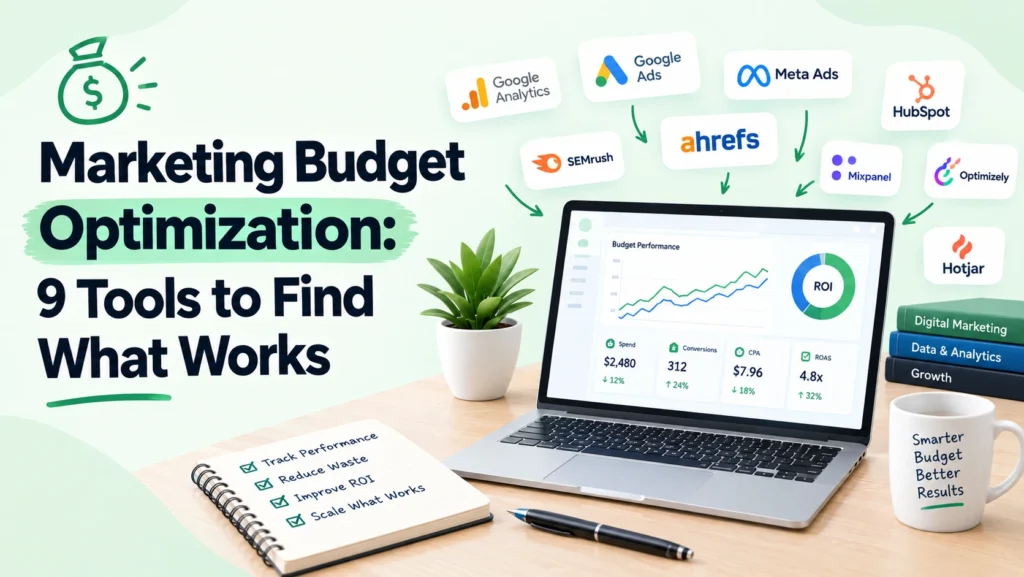
Here are nine tools worth considering.
What makes a marketing budget perform well?
A marketing budget performs well when it contributes to meaningful business outcomes at an acceptable cost.
That sounds straightforward, but marketers often evaluate performance using metrics that tell only part of the story.
A campaign might generate hundreds of leads at a low cost per lead while producing very little pipeline. Another might look expensive until you discover that its customers have higher contract values and better retention.
The difference becomes clearer when you evaluate several metrics together.
| Metric | What it helps you understand |
| Customer acquisition cost (CAC) | How much it costs to acquire a customer |
| Return on ad spend (ROAS) | Revenue attributed to advertising relative to ad spend |
| Marketing ROI | Financial return relative to marketing investment |
| Cost per qualified lead | Cost of generating leads that meet qualification criteria |
| Pipeline generated | Value of sales opportunities associated with marketing |
| Revenue attribution | Which marketing interactions receive credit for revenue |
| Customer lifetime value (LTV) | Expected value of a customer over the relationship |
| Conversion rate | How efficiently traffic or leads progress toward a goal |
No single metric tells the whole story.
For example, ROAS can help evaluate paid campaigns, but it doesn’t automatically explain whether a campaign attracts profitable, long-term customers.
Likewise, pipeline generation is valuable, but pipeline isn’t the same as closed revenue. If you want to model the return a campaign needs to hit before committing budget to it, a free ROAS calculator does that arithmetic in a few seconds.
The goal is to connect marketing activity with business outcomes while understanding the limitations of each metric.
Quick comparison
| Tool | Primary focus | Best use case |
| Usermaven | Multi-touch attribution and revenue measurement | Understand which marketing investments contribute to revenue |
| Google Analytics 4 | Website acquisition and conversions | Compare traffic and conversion performance |
| Supermetrics | Marketing data integration and analysis | Consolidate cross-channel performance reporting |
| Funnel | Marketing data management | Standardize campaign data across platforms |
| Google Ads | Search and Google advertising optimization | Improve paid campaign efficiency |
| Meta Ads Manager | Paid social optimization | Optimize social advertising budgets |
| Triple Whale | Ecommerce attribution and profitability | Evaluate ecommerce advertising returns |
| Microsoft Clarity | Behavioral analytics | Find conversion friction and wasted traffic |
| HubSpot Marketing Hub | CRM-connected marketing reporting | Connect marketing campaigns with sales outcomes |
1. Usermaven — Best for connecting marketing spend to revenue
Usermaven is an AI-powered marketing attribution platform that helps businesses understand which marketing channels, campaigns, ads, and content contribute to conversions, pipeline, and revenue.
Designed for B2B SaaS companies, growth teams, and agencies, Usermaven combines multi-touch attribution with marketing measurement to help marketers evaluate spending efficiency and make better budget allocation decisions.
The platform supports eight attribution models, including Custom Attribution Models, allowing teams to compare how different touchpoints influence conversions and revenue. It also connects advertising spend, CRM data, customer journeys, and offline conversions to provide a more complete picture of marketing performance.
A notable differentiator is its Measurement Trust Center, which identifies tracking issues and data gaps that could affect reporting accuracy. Meanwhile, Maven AI and AI Agents help teams investigate performance trends, uncover opportunities, and automate recurring analyses.
Unlike tools focused primarily on advertising metrics or dashboard reporting, Usermaven connects attribution insights with CAC, ROAS, pipeline, and revenue to help teams identify where marketing investments deliver the most value.
This helps marketers investigate questions such as:
- Which campaigns generate the most valuable customers?
- Which channels contribute to pipeline but receive little last-click credit?
- Where is CAC increasing without a corresponding improvement in revenue?
- Which campaigns have the strongest attributed ROAS?
- Where should we reduce or increase spending?
Key features:
- Eight attribution models, including Custom Attribution Models
- Multi-channel revenue attribution and customer journey analysis
- CAC, ROAS, and pipeline measurement
- HubSpot, Salesforce, and advertising integrations
- Measurement Trust Center
- Maven AI and automated AI Agents
Best for: B2B SaaS companies, agencies, and growth teams looking to optimize marketing spend based on revenue outcomes.
Pricing: Custom pricing for Business and Enterprise plans.
2. Google Analytics 4 — Best for understanding website acquisition and conversions
Google Analytics 4 helps marketers understand how visitors arrive at a website, what they do, and whether they complete important actions.
For budget optimization, GA4 provides a useful starting point.
You can compare traffic sources, investigate conversion rates, examine landing-page performance, and identify channels generating engagement or key events.
For example, suppose paid social traffic is increasing, but very few visitors are completing your signup process.
GA4 can help reveal that disconnect.
It also provides attribution reporting, including data-driven attribution, to help marketers examine how eligible channels contribute to conversions.
However, GA4 alone may not provide the complete revenue picture for businesses where conversions involve CRM opportunities, offline sales activities, and long buying cycles. It also misses visitors blocked by ad blockers or declined consent, which is one reason teams increasingly run a privacy-first tool alongside it, and our comparison of Google Analytics alternatives covers which ones suit which setup.
Best for: Teams that want foundational acquisition, engagement, and conversion reporting.
Budget optimization use case: Identify traffic sources and landing pages that generate visits but struggle to convert.
3. Supermetrics — Best for consolidating marketing performance data
Supermetrics helps marketers collect, organize, and analyze data from different marketing platforms.
This becomes valuable when campaign performance is scattered across Google Ads, Meta, LinkedIn, analytics tools, and spreadsheets.
Without consolidated reporting, marketers can spend considerable time exporting data and reconciling inconsistent metrics before making any decisions.
Supermetrics connects marketing data sources and supports analysis through dashboards, spreadsheets, business intelligence tools, and AI-powered workflows.
Teams can combine advertising spend with other performance data to compare channels more consistently.
For example, an agency managing several accounts could use Supermetrics to build standardized reporting that highlights changes in spend, conversions, and campaign efficiency.
It’s important to distinguish consolidated reporting from attribution, though.
Bringing metrics into one dashboard doesn’t automatically establish which interactions contributed to revenue. That requires appropriate measurement data and attribution logic.
Best for: Agencies and marketing operations teams managing reporting across multiple platforms.
Budget optimization use case: Compare channel spending and performance without manually combining reports.
4. Funnel — Best for organizing cross-channel marketing data
Funnel is a marketing data platform that brings information from multiple sources into a unified reporting environment.
It helps teams collect, transform, and organize marketing data before sending it to dashboards, spreadsheets, or business intelligence platforms.
This is useful when different advertising channels use inconsistent naming conventions, metrics, or reporting structures.
For example, one platform may label a campaign differently from another, making it difficult to compare performance across channels.
Funnel helps standardize that data so teams can analyze spending and outcomes more consistently.
Its value is particularly clear for organizations managing large amounts of campaign information across multiple accounts or regions.
However, teams still need to define which metrics represent meaningful business outcomes.
Best for: Marketing operations teams that need standardized cross-channel reporting.
Budget optimization use case: Create a consistent reporting foundation for evaluating spending across channels.
5. Google Ads — Best for optimizing search advertising spend
Google Ads provides campaign-level tools for managing and optimizing paid search and other Google advertising campaigns.
It offers performance reporting, conversion tracking, bidding strategies, audience information, and recommendations that can help advertisers identify opportunities to improve results.
For example, marketers can investigate which keywords consume significant budget without producing valuable conversions.
They can also evaluate campaign-level performance and adjust bidding or spending based on conversion goals.
However, Google Ads primarily reports performance from its own advertising environment.
When customers interact with several marketing channels before converting, relying exclusively on Google Ads reporting may give an incomplete picture of the broader journey.
That’s why platform-level optimization works best alongside cross-channel measurement.
Best for: Teams managing significant Google advertising budgets.
Budget optimization use case: Identify inefficient keywords, campaigns, and bidding strategies.
6. Meta Ads Manager — Best for optimizing paid social campaigns
Meta Ads Manager helps businesses manage advertising across Facebook, Instagram, and other supported Meta placements.
It provides campaign reporting, audience targeting, conversion measurement, and budget controls.
For businesses investing heavily in paid social, these capabilities are essential for identifying which campaigns and audiences produce desirable outcomes.
For example, marketers might discover that one audience generates cheaper conversions while another produces higher-value purchases.
That distinction matters when deciding where to allocate spending.
Meta’s reporting is valuable for optimizing campaigns within its advertising ecosystem, but it shouldn’t automatically be treated as an independent measure of cross-channel marketing contribution.
Best for: Businesses running paid social acquisition campaigns.
Budget optimization use case: Compare audiences, creatives, and campaigns to improve paid social efficiency.
7. Triple Whale — Best for ecommerce marketing profitability
Triple Whale is a marketing intelligence and attribution platform focused on ecommerce businesses.
It combines advertising, ecommerce, and customer data to help brands understand how marketing activities relate to sales and profitability.
This is particularly useful for businesses selling products online through platforms such as Shopify.
For ecommerce marketers, revenue alone isn’t always enough to evaluate campaign success.
Product margins, customer acquisition costs, repeat purchases, and other business expenses can significantly change whether a campaign is worth scaling.
Triple Whale helps ecommerce teams investigate advertising performance alongside commercial outcomes.
Its ecommerce focus makes it more relevant to online retail businesses than companies with long, CRM-driven B2B sales processes.
Best for: Ecommerce and direct-to-consumer brands.
Budget optimization use case: Evaluate advertising performance against ecommerce revenue and profitability.
8. Microsoft Clarity — Best for finding conversion problems before increasing spend
Microsoft Clarity approaches marketing efficiency from a different direction.
Instead of primarily analyzing advertising budgets, it helps businesses understand what visitors do after arriving on a website.
Its session recordings and heatmaps reveal user interactions, including where visitors click, scroll, hesitate, or encounter friction.
Why does this matter for budget optimization?
Because sometimes the problem isn’t the campaign.
It’s the experience visitors encounter after clicking the ad.
Imagine spending $5,000 to drive traffic to a landing page with a confusing form or a broken mobile experience.
Increasing the budget won’t solve that problem.
Clarity can help identify usability issues worth investigating before investing more in acquisition.
It doesn’t replace marketing attribution or revenue reporting, but it can help improve the efficiency of existing traffic.
Best for: Marketing and conversion optimization teams.
Budget optimization use case: Identify landing-page friction that may be reducing returns from paid traffic.
9. HubSpot Marketing Hub — Best for connecting marketing activity with CRM outcomes
HubSpot Marketing Hub combines marketing automation, campaign management, lead nurturing, and reporting with HubSpot’s CRM ecosystem.
For businesses where marketing generates leads that later progress through sales, CRM-connected reporting can be particularly useful.
A campaign might generate relatively few form submissions but influence opportunities with significant potential revenue.
Connecting marketing activity with CRM records helps teams evaluate more than immediate conversions.
Depending on the HubSpot subscription and configuration, teams can use campaign and attribution reporting to investigate marketing influence across customer and revenue outcomes.
HubSpot is especially relevant to organizations already using its CRM and marketing automation capabilities. For smaller teams where the Marketing Hub tiers are hard to justify, our comparison of marketing automation tools for small business covers what $10 to $80 monthly delivers instead.
However, businesses should confirm which attribution reports and features are available in their selected plan.
Best for: CRM-led marketing teams managing lead nurturing and sales-assisted conversions.
Budget optimization use case: Evaluate marketing activities against leads, opportunities, and downstream revenue.
How to identify where your marketing budget performs best
Having the right software is useful, but the way you evaluate performance matters just as much.
A practical budget review should move through four stages.
Step 1: Compare spending against meaningful outcomes
Start by examining spend, conversions, and revenue across your main marketing channels.
Consider this hypothetical example:
| Channel | Spend | Leads | Attributed revenue | ROAS |
| Google Ads | $10,000 | 320 | $24,000 | 2.4x |
| LinkedIn Ads | $7,000 | 85 | $35,000 | 5.0x |
| Meta Ads | $5,000 | 210 | $9,000 | 1.8x |
Google Ads generates the most leads, but LinkedIn has the highest attributed revenue relative to spend.
If the team evaluates only cost per lead, that difference could go unnoticed.
This is why marketing ROI analysis should extend beyond top-of-funnel conversions whenever downstream revenue data is available.
Step 2: Investigate the customer journey
Before shifting budget, examine how channels contribute across the journey.
LinkedIn might introduce prospects who later convert through Google Ads.
Organic content might influence customers during evaluation without receiving final-click credit.
A multi-touch attribution platform can help identify these relationships.
However, attributed revenue is not the same as incremental revenue. Attribution assigns credit according to a model; it doesn’t independently prove what would have happened without the campaign.
Step 3: Identify inefficient spending
Look for campaigns with patterns such as high spending but low qualified conversion volume, increasing CAC, weak downstream revenue, or persistent landing-page conversion problems.
Not every underperforming campaign should be paused immediately.
Some channels play an important role in generating awareness or influencing future conversions.
The goal is to distinguish genuinely inefficient spending from activities whose contribution isn’t visible in basic conversion reporting.
Step 4: Reallocate gradually and measure the results
Once you’ve identified promising opportunities, avoid moving the entire budget based on one reporting period.
Start with a controlled adjustment.
For example, you might shift 10–15% of the budget from a consistently underperforming campaign toward one producing stronger business outcomes.
Then monitor changes in acquisition costs, conversion quality, pipeline, and revenue.
Where possible, use experiments or incrementality testing to evaluate whether additional spending actually improves results.
The purpose of marketing budget optimization isn’t simply to spend less.
It’s to generate more business value from the money you invest.
Final thoughts
Finding where your marketing budget performs best requires more than a dashboard showing which campaign generated the most clicks or leads.
You need to understand which investments create valuable outcomes, where conversion problems reduce efficiency, and how different channels contribute throughout the customer journey.
The nine tools covered here solve different parts of that challenge, and they sit inside a wider stack that our breakdown of the best digital marketing tools with real pricing maps out in full.
But the most important shift is in how you evaluate performance.
Instead of asking, “Which channel generated the most conversions?”, start asking:
“Which marketing investments contribute the most business value, and what evidence supports spending more there?”
That’s the question that turns marketing reporting into better budget decisions.