Most people searching for Semrush alternatives are not looking for a better tool. They are looking for the same job done for less than $139.95 a month, and the right answer depends entirely on which part of Semrush you actually use.
This guide starts by narrowing that down, then covers ten semrush alternatives with verified 2026 pricing. One disclosure before we start: this page carries no affiliate links and no commission arrangements with any tool listed. That matters on this particular topic, because several pages ranking for it rank tools partly by what those tools pay out.
Why Are You Leaving Semrush?
Four reasons, and each points to a different tool.
Price. Semrush Pro sits at $139.95 monthly, and the jump to Guru is steeper. If the platform works and only the invoice is the problem, Serpstat or SE Ranking give you most of the same modules at roughly a third to a half.
You use one part of it. Most Semrush users touch keyword research and rank tracking and ignore the rest. If that is you, Mangools at around $29.90 covers it and you stop paying for the social, PPC, and content modules you never open.
Backlink data specifically. Semrush is broad. Ahrefs is deeper on links. If link building is the actual job, that is the switch.
Agency and multi-client work. Per-project limits and seat fees are what usually break Semrush for agencies, not features. SEO PowerSuite and WebCEO solve that differently from everyone else.
Work out which one applies before reading the list, because “best alternative” has four different answers.
The 10 Best Semrush Alternatives in 2026
Prices reflect annual billing where offered, since monthly typically runs higher.
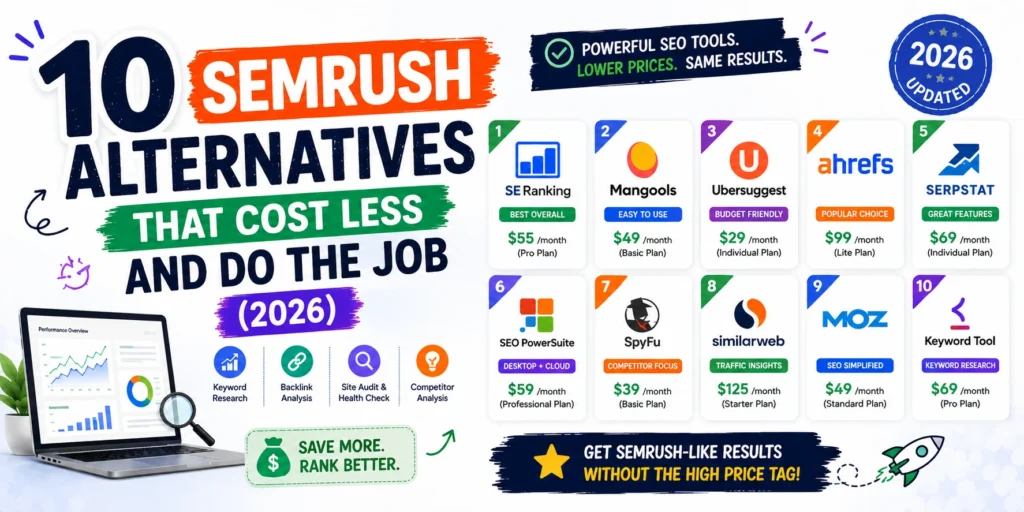
1. SE Ranking
Closest overall match to Semrush.
Pricing: From roughly $52 to $65 monthly on entry tiers, with higher Core plans near $129.
What you get: Keyword research, competitor analysis, site audits, backlink monitoring, rank tracking, white-label reporting, and the most comprehensive AI visibility tracking in the category, covering AI Overviews, Google AI Mode, ChatGPT, Gemini, and Perplexity.
Best for: Small agencies and in-house teams who want the full Semrush feature set at a fraction of the price.
Where it falls short: Database size does not match Semrush, and pricing has crept upward across recent tiers.
This is the default recommendation for most people leaving Semrush, and the AI tracking is a genuine reason to pick it over cheaper rivals. Our detailed SE Ranking versus Ahrefs comparison covers which suits which workflow if you are choosing between the two.
2. Ahrefs
Best for backlink analysis.
Pricing: Starter around $29 monthly, Lite around $129.
What you get: The largest live backlink index in the industry, Site Explorer, Content Explorer, keyword research, and rank tracking. Ahrefs Webmaster Tools remains free for verified sites you own.
Best for: Link building campaigns, content gap analysis, and anyone whose SEO work is link-led.
Where it falls short: No PPC intelligence to speak of, and no social tools. Credit-based limits catch people out on lower tiers.
The Starter plan changed this recommendation. At around $29 it puts Ahrefs’ link data within reach of solo operators for the first time, though feature access is deliberately narrow at that price.
3. Mangools
Best budget pick and best for beginners.
Pricing: From around $29.90 monthly on annual billing, with a limited free tier.
What you get: KWFinder for keyword research, SERPChecker, SERPWatcher for rank tracking, LinkMiner for backlinks, and SiteProfiler.
Best for: Bloggers, niche site owners, and small businesses whose SEO work is mostly keyword research.
Where it falls short: No full technical site audit, no white-label reporting, and considerably less depth than the platforms above.
Built for clarity rather than depth, with a learning curve measured in hours rather than weeks. For a content creator this covers the daily work at a fifth of Semrush’s cost.
4. Serpstat
Best value for a full feature stack.
Pricing: From around $50 to $59 monthly.
What you get: Keyword research with strong international data, site audits with generous crawl limits, rank tracking with historical positions, backlink analysis, keyword clustering, batch analysis, and an LLM brand monitor on higher tiers.
Best for: Freelancers and agencies wanting generous data limits and predictable pricing.
Where it falls short: Interface feels less polished than SE Ranking, and the AI features sit behind higher tiers.
The keyword clustering is genuinely better than most competitors at this price, which matters if you build topical content silos.
5. SpyFu
Best for competitor and PPC research.
Pricing: From around $39 monthly with unlimited searches.
What you get: Competitor keyword history going back years, ad copy archives, estimated ad spend, and PPC competitor intelligence.
Best for: People whose main Semrush use case was competitive and paid search research.
Where it falls short: Weak on technical SEO and site auditing. This is a research tool, not a suite.
Unlimited searches at $39 is unusual in a category built on credit limits, and the historical ad data goes deeper than Semrush’s.
6. SEO PowerSuite
Best for agencies and unlimited projects.
Pricing: Free desktop version available, with paid tiers well below the subscription platforms.
What you get: Rank tracking, site auditing, backlink analysis, and link building tools with unlimited projects and unlimited keywords.
Best for: Anyone managing many websites who resents per-project pricing.
Where it falls short: Desktop software rather than cloud, so it runs on your machine and does not share easily across a team.
The unlimited model changes the maths entirely once you are operating across ten or more domains, and the free desktop version is a legitimate starting point.
7. Ubersuggest
Cheapest entry point.
Pricing: Around $29 monthly, with a lifetime deal option and a free tier limited to three daily searches.
What you get: Keyword ideas, basic site audit, rank tracking, and competitor overview.
Best for: Beginners and very small budgets, particularly if the lifetime deal appeals.
Where it falls short: Volume estimates can differ noticeably from Google Keyword Planner, and the free tier is tight enough to be a demo.
The lifetime deal is the genuine differentiator. Paying once for a tool you use occasionally beats a subscription you forget to cancel.
8. Moz Pro
Best for support and ease of use.
Pricing: Mid-range, generally between Mangools and SE Ranking.
What you get: Keyword research, rank tracking, site crawls, link explorer with Domain Authority, and unusually good customer support and learning resources.
Best for: Beginners and small teams who value being taught rather than handed a dashboard.
Where it falls short: Smaller keyword and backlink databases than Ahrefs or Semrush, and Domain Authority is a Moz metric rather than a Google one.
Worth considering if the reason you are leaving Semrush is that nobody on your team understood it.
9. Sitechecker
Best for monitoring and alerts.
Pricing: Mid-range, below the major suites.
What you get: Continuous site monitoring, change alerts, technical auditing, and native Search Console and GA4 integration, with AI answer visibility surfacing in current versions.
Best for: Teams whose priority is knowing immediately when something breaks rather than doing deep research.
Where it falls short: Narrower keyword and competitor data than the full suites.
The less obvious pick on this list, and the right one if your actual need is monitoring rather than analysis.
10. The Free Stack
Genuinely viable for small sites.
Pricing: Nothing.
What you get: Google Search Console for query data straight from Google with no caps, Ahrefs Webmaster Tools for real Ahrefs backlink data on domains you own, Google Keyword Planner for volumes, Google Trends for direction, and Screaming Frog free for 500-URL technical crawls.
Best for: Sites under a few hundred pages where competitor research is not a weekly requirement.
Where it falls short: Competitor analysis. This is the wall in every free stack, and no combination of free tools clears it.
If you are a small business paying $139.95 monthly and using Semrush twice a month, this genuinely replaces it. That is not a compromise recommendation.
Which Semrush Alternatives Should You Actually Choose?
Matched to the four reasons from the top of this page.
- Price is the only problem: Serpstat or SE Ranking. Same shape, roughly half the invoice.
- You only use keyword research and rank tracking: Mangools at $29.90.
- Backlinks are the job: Ahrefs, Starter tier if budget is tight.
- You need PPC and competitor intelligence: SpyFu.
- You manage many sites: SEO PowerSuite, for unlimited projects.
- You need AI search visibility tracking: SE Ranking, which currently covers the most surfaces.
- You barely use it: The free stack, and cancel.
Where these fit alongside the rest of your software, and what each category costs, is covered in our comparison of the best digital marketing tools with real pricing.
What You Lose When You Switch
Nobody mentions this, and it catches people out.
Historical data does not transfer. Your rank tracking history, position graphs, and project data stay in Semrush. Export everything you need before cancelling, because you cannot retrieve it afterwards.
Database differences change your numbers. Keyword volumes, difficulty scores, and backlink counts vary between tools because each maintains its own index. Your metrics will shift on migration, and that is not an error. Rebaseline rather than comparing across platforms.
Domain Authority and Domain Rating are not the same metric. Moz, Ahrefs, and Semrush each score domains their own way, and none of them is a Google signal. Do not report the change to a client as a performance shift.
Run both for one month. If budget allows, overlap the subscriptions briefly. It costs one month and prevents discovering the missing feature after you have cancelled.
What We Have Learned Testing Semrush Alternatives at Leemjaz
Patterns from running these across client and internal projects.
Most people use about 20 percent of Semrush. When we audit what a client actually opens, it is almost always keyword research, rank tracking, and the occasional site audit. Paying $139.95 for that is the most common overspend we find in a marketing stack, and Mangools or Serpstat covers it.
Tools disagree, and the disagreement is not a bug. We have pulled the same keyword across Semrush, Ahrefs, and Mangools and seen materially different volumes. Pick one tool as your reference for reporting and stay with it. Switching tools mid-campaign and comparing the numbers produces conclusions that are not real.
AI visibility tracking is worth paying for now, cautiously. We have started tracking whether client brands appear in AI Overviews and assistant answers, and SE Ranking currently covers the most surfaces. The data is directional rather than precise, so we treat it as a trend indicator and still verify manually by running queries ourselves.
Free tools cover more than clients expect. On several smaller accounts we have run entirely on Search Console, Ahrefs Webmaster Tools, and Keyword Planner for months. The moment that stops working is competitor research, and it is a clean signal rather than a gradual one. This is how our SEO work usually starts on a new account: free tools first, paid subscriptions only once we know which gap needs filling.
The cheapest tool you will actually open beats the best one you will not. We have watched clients buy the most capable platform available and log in twice. Ease of use is a real selection criterion, not a soft one.
Semrush Alternatives FAQs
What is the best alternative to Semrush?
SE Ranking for most people, since it matches Semrush’s feature breadth at roughly half the price and has the most comprehensive AI visibility tracking. Ahrefs is better if backlinks are your focus, and Mangools at around $29.90 is the best budget option for keyword-led work.
Is there a free alternative to Semrush?
Yes, though not a single-tool replacement. Google Search Console gives you uncapped query data, Ahrefs Webmaster Tools provides real backlink data for sites you own, and Google Keyword Planner covers volumes. SEO PowerSuite also has a free desktop version. The gap is competitor research, which no free tool handles.
What is a cheaper alternative to Semrush with similar features?
SE Ranking from around $52 to $65 and Serpstat from around $50 are the closest feature matches at a lower price, both covering rank tracking, backlinks, site audits, and competitor research. Mangools at $29.90 is cheaper still but narrower. None matches Semrush’s database size, though most small sites will not notice.
Is Ahrefs better than Semrush?
For backlink analysis and content research, yes, since Ahrefs maintains the deeper link index. Semrush is better for PPC intelligence, competitor ad data, and its broader marketing toolkit. Your workflow decides it, and the Ahrefs Starter plan at around $29 makes the comparison much more accessible than it used to be.
Is Semrush worth $139 a month?
Only if you use more than keyword research and rank tracking. Teams running content, PPC, competitor intelligence, and reporting together get genuine value from the bundle. Businesses using two modules are paying a large premium for tools they never open, and a $29 to $65 alternative does the same job.
What do I lose if I switch away from Semrush?
Your historical rank tracking and project data, which do not transfer and cannot be retrieved after cancellation, so export first. Your metrics will also shift, since every tool maintains its own keyword and backlink index. Run both platforms for a month if you can, to catch anything you depend on before cancelling.
Conclusion
The right choice among Semrush alternatives depends less on which tool is best and more on which parts of Semrush you genuinely use. Answer that honestly and the decision usually makes itself. Export your data, pick the tool matching your actual workflow, and give it a month before cancelling the old subscription. Most people find they were paying three or four times what their real usage required.