Most people looking for Hootsuite alternatives are not unhappy with the software. They are unhappy with paying $99 per user per month for a scheduler, and they want the same job done for less.
The catch is that switching to the wrong pricing model can leave you paying the same or more. This guide covers ten genuinely cheaper options with verified 2026 pricing, explains which billing structure suits your setup, and shows what each one actually costs at your real account count. No affiliate links, no commission arrangements, which is worth stating because most pages ranking for this term are published by tools competing with Hootsuite.
Why People Look for Hootsuite Alternatives
Four reasons, and each points somewhere different.
Per-seat pricing. Hootsuite charges per user, starting around $99 and rising sharply on higher tiers. Add a second person and you have doubled the bill before adding a single account. This is the number one reason people leave.
No free plan. Hootsuite discontinued its free tier, so there is no low-commitment way to stay when budgets tighten.
Paying for features nobody uses. Approval workflows, governance, and enterprise listening are genuinely good and genuinely irrelevant to a business posting four times weekly.
Interface fatigue. The platform grew to serve enterprise teams, and that complexity is overhead for a small team.
Identify which one applies before reading the list, because the right answer changes completely depending on your reason.
The Pricing Model Decides Your Real Bill
This is the part that catches people out, and it deserves more attention than any feature comparison.
Per seat (Hootsuite, Sprout Social, Agorapulse): you pay per person. Costs scale with team size, not with how much you post.
Per channel (Buffer): you pay for each connected profile at roughly $5 to $10. Cheap at three channels, expensive at ten. Five platforms costs around $25 monthly and ten costs around $50 on the entry tier.
Per brand (Metricool): you pay per client or brand with channels bundled inside. The best structure for agencies and multi-brand businesses.
Flat rate (SocialPilot, SocialBee, Vista Social, Publer): one fee covering a set number of accounts. Predictable, and usually the cheapest option once you pass five or six channels.
The trap. If you are leaving Hootsuite because ten accounts on one seat felt expensive, moving to Buffer’s per-channel model can cost you the same. Match the model to your actual shape: many people and few accounts favours flat rate, few people and many accounts favours flat rate, many brands favours per brand, and three or fewer channels favours per channel or free.
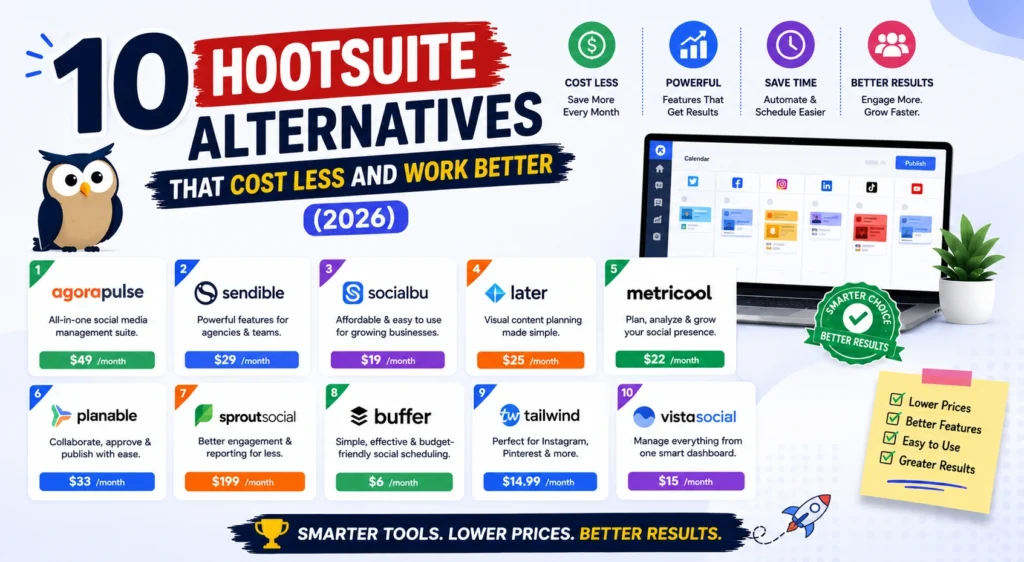
The 10 Best Hootsuite Alternatives in 2026
Prices reflect the cheapest paid tier, verified against current vendor pricing.
1. Publer
Best value all-rounder.
Pricing: Genuinely usable free plan for 3 accounts. Paid from around $5 per account or roughly $12 monthly flat.
What you get: Scheduling, bulk upload, post recycling, RSS auto-posting, auto-watermarking, AI assists, workspaces, and a link-in-bio page included on free.
Best for: Small businesses and creators who want maximum capability per dollar.
Where it falls short: The interface is dense and less polished than Buffer, and analytics are basic.
The strongest price-to-feature ratio on this list. If your reason for leaving is purely cost, start here.
2. Metricool
Best for analytics.
Pricing: Free plan covering one brand with a monthly post cap. Paid from around $22 to $25 monthly.
What you get: Scheduling across 11 platforms including Threads, Bluesky and Google Business Profile, genuinely strong analytics, competitor tracking, and paid ad reporting alongside organic in one dashboard.
Best for: Anyone leaving Hootsuite specifically because they wanted better reporting.
Where it falls short: The free plan excludes LinkedIn and X, which rules it out for B2B until you upgrade.
Per-brand pricing plus ad reporting in the same view is a combination nobody else at this price offers. Why these billing structures matter so much is covered in more depth in our breakdown of social media marketing tools and their pricing models.
3. Buffer
Cheapest entry point for few channels.
Pricing: Free for 3 channels with 10 queued posts each. Paid from around $5 to $6 per channel, rising to $10 per channel on Team.
What you get: Clean scheduling, per-channel analytics, AI caption assistance, engagement inbox, and a free link-in-bio page.
Best for: Solo operators running three or four channels.
Where it falls short: Per-channel pricing scales badly. At eight or more accounts you are back to Hootsuite-level costs, and there is no social listening at any tier.
The right answer for a small footprint and the wrong one for a large one. Count your channels before choosing it.
4. SocialPilot
Best flat-rate option for agencies.
Pricing: From around $30 monthly.
What you get: Bulk scheduling, client management, white-label reports, content curation, and a unified inbox across a generous account allowance.
Best for: Agencies and businesses running 10 to 25 accounts who are being punished by per-seat or per-channel models.
Where it falls short: Analytics depth sits below Metricool and Sprout at comparable tiers.
For anyone leaving Hootsuite over account volume rather than team size, this is usually the cheapest workable answer.
5. Agorapulse
Closest like-for-like replacement.
Pricing: From around $69 to $79 per seat.
What you get: The strongest unified inbox in the category, saved replies, approval workflows, ROI measurement with Google Analytics integration, and client-ready reporting.
Best for: Teams that liked Hootsuite’s inbox and reporting but wanted better usability.
Where it falls short: Still per-seat, so it does not solve the structural problem if team size was your issue. It also discontinued its free plan in July 2026, so many older recommendations are now out of date.
Choose this if community management is the core job and you can absorb per-seat pricing.
6. Sendible
Best for agency white-labelling.
Pricing: From around $29 monthly plus per-client additions.
What you get: White-label dashboards, client login access, per-client reporting, task assignment, and a unified inbox.
Best for: Agencies managing five or more client accounts who want the platform to carry their own branding.
Where it falls short: Overkill for non-agencies, and the white-label features that justify it sit on higher tiers.
7. SocialBee
Best for content recycling.
Pricing: From around $29 monthly for one workspace and five profiles, rising toward $99.
What you get: Category-based evergreen queues that republish a standing content library on a rotating schedule, plus AI content assistance and a concierge content service on higher plans.
Best for: Businesses with a library of evergreen content rather than only fresh posts.
Where it falls short: Profile limits are tight at entry level, and it is less suited to news-led or time-sensitive posting.
The evergreen recycling is genuinely distinctive. If half your calendar could be repeats of things that already worked, this saves real hours.
8. Vista Social
Cheapest full-featured option.
Pricing: Free plan for 3 profiles. Standard around $39 monthly.
What you get: Modern scheduling workflows, short-form video support, review and reputation management, listening, and reporting.
Best for: Businesses wanting the widest feature set without enterprise pricing.
Where it falls short: Smaller company with a lighter integration ecosystem than the established names.
Frequently cited as the cheapest tool that genuinely covers everything, and the review management is unusual at this price.
9. Pallyy
Cheapest option with a real social inbox.
Pricing: Around $25 monthly.
What you get: Scheduling with flat pricing regardless of profile count, a visual Instagram grid planner, bio link tool, unified inbox, and analytics.
Best for: Instagram-heavy businesses and small agencies.
Where it falls short: Instagram-centric by design, with a lighter integration list than the majors.
The cheapest way to keep an inbox after leaving Hootsuite, which is the feature most people miss when they downgrade to a pure scheduler.
10. Postiz or Mixpost
Free, if you can self-host.
Pricing: Free when self-hosted. Cloud plans available.
What you get: Open-source scheduling across all major platforms with no artificial account caps, team workspaces, and full data ownership.
Best for: Technically confident teams who want zero recurring cost and control of their own data.
Where it falls short: You own the server, updates, and API troubleshooting.
The only genuinely unlimited option here. You trade money for time, which suits some teams and nobody else.
What These Hootsuite Alternatives Actually Cost at Your Scale
Approximate monthly totals, since entry prices mislead.
| Your setup | Hootsuite | Cheapest good alternative | Saving |
| 1 user, 3 channels | ~$99 | Buffer or Publer free, $0 | ~$99 |
| 1 user, 6 channels | ~$99 | Publer ~$12, Metricool ~$22 | ~$77 to $87 |
| 2 users, 8 channels | ~$198 | SocialPilot ~$30 | ~$168 |
| 3 users, 15 accounts | ~$297 | SocialPilot or Vista Social, $30 to $45 | ~$250 |
| Agency, 5 clients | ~$297+ | Metricool ~$45, Sendible ~$29+ | Varies by client count |
The pattern is consistent: the more people or accounts you have, the more per-seat pricing costs you, and the larger the saving from switching to flat rate or per brand.
Free Ways to Replace Hootsuite Entirely
Worth checking before you pay anything.
If your presence is Facebook and Instagram only, Meta Business Suite covers scheduling, inbox, and insights free with no account limits. It is unlimited because Meta owns the platform, and it genuinely replaces a paid scheduler for a large share of local businesses.
If you need three channels or fewer, Buffer free, Publer free, or Vista Social free all cover it permanently.
If you post from Canva anyway, its free Content Planner schedules directly to social platforms, which most users never discover.
Between these three, a considerable number of businesses paying $99 monthly could be paying nothing.
Which of These Hootsuite Alternatives Fits Your Setup?
Matched to the reasons at the top of this page.
- Price is the only problem, small footprint: Publer or Buffer free.
- Price is the problem, many accounts: SocialPilot or Vista Social, flat rate.
- You wanted better analytics: Metricool.
- The inbox was the reason you stayed this long: Agorapulse if budget allows, Pallyy if not.
- You run client accounts: Sendible for white-label, Metricool for per-brand economics.
- You republish evergreen content: SocialBee.
- Facebook and Instagram only: Meta Business Suite, free.
- You want no subscription and have technical help: Postiz or Mixpost.
Where social software fits alongside the rest of your stack, and what each category costs, is covered in our comparison of the best digital marketing tools with real pricing.
What to Check Before You Switch
Three things that cause regret.
Export your data first. Historical analytics and post archives do not transfer between platforms. Pull your reporting before cancelling, because you cannot retrieve it afterwards.
Test with your real accounts and real volume for a week. Not a demo, not five sample posts. Connect everything you actually run and post at your normal frequency. Platform API quirks only surface under real use, and Instagram in particular behaves differently across tools.
Check the specific channels you need are supported on your tier. Metricool’s free plan excludes LinkedIn and X. Publer’s free tier excludes X. This is the single most common post-switch complaint and it is entirely avoidable.
What We Have Learned Testing Hootsuite Alternatives at Leemjaz
Patterns from moving clients off Hootsuite and onto other platforms.
Most businesses were paying for governance they never used. Approval workflows, role permissions, and team libraries are why Hootsuite costs what it does. On accounts where one person posts and nobody approves anything, that entire value proposition is dead weight, and a $12 tool does the same practical job.
Per-channel pricing surprises people twice. We have watched a business leave Hootsuite for Buffer, celebrate the saving, then add a founder’s LinkedIn, a second Instagram, and a YouTube channel and end up at a similar monthly figure. Count the channels you will run in twelve months, not today.
The inbox is what people actually miss. Scheduling is easy to replace. Managing comments and DMs across five platforms from one place is not, and businesses that downgrade to a pure scheduler usually come back looking for it. Budget for it upfront if engagement matters to your business.
We keep native analytics as the source of truth. Third-party dashboards estimate, platform insights measure. We schedule through the tool and report from native analytics, which avoids awkward conversations when two dashboards disagree.
Run the old and new tool in parallel for two weeks. It costs one extra month and catches the missing feature before you have cancelled. We do this on every migration, and it has saved more than one client from switching back. Where clients want the whole thing handled rather than managed in-house, that sits inside our social media marketing services.
Hootsuite Alternatives FAQs
What is the best alternative to Hootsuite?
Publer for most small businesses, since it offers a usable free plan and paid tiers from around $12 with a strong feature set. SocialPilot from about $30 is better if you run many accounts, because flat pricing avoids the per-seat and per-channel traps. Metricool is the pick if analytics were your reason for leaving.
Is there a free alternative to Hootsuite?
Yes. Meta Business Suite is free and unlimited for Facebook and Instagram. Buffer, Publer, and Vista Social all have permanent free tiers covering three channels or profiles. Self-hosted Postiz and Mixpost are free with no account caps if you have technical support available.
Why is Hootsuite so expensive?
Because it charges per user rather than per account, starting around $99 monthly for one seat. Adding a second team member doubles the cost before you connect any new channels. The price also covers enterprise features like approval workflows, governance, and listening, which most small teams never use.
Does Hootsuite still have a free plan?
No. Hootsuite discontinued its free tier, so the only way to test it is a trial. Buffer, Publer, Metricool, and Vista Social all maintain permanent free plans, and Agorapulse discontinued its own free plan in July 2026, so check any list recommending one.
Is Buffer cheaper than Hootsuite?
At small scale, considerably. Buffer’s free plan covers three channels and paid tiers start around $5 to $6 per channel against Hootsuite’s $99 per user. The saving narrows fast as channels multiply, since eight or more channels on Buffer approaches Hootsuite pricing. Flat-rate tools work out cheaper at that point.
What is the cheapest social media scheduler with a social inbox?
Pallyy at around $25 monthly, with flat pricing regardless of profile count. Sendible at around $29 includes an inbox plus agency features, and Agorapulse has the strongest inbox in the category but costs $69 to $79 per seat. Most cheaper schedulers omit the inbox entirely, which is the feature people miss most after downgrading.
Conclusion
The best of these Hootsuite alternatives is whichever one bills you in the shape your business actually is. Few people and many accounts, or many people and few accounts, both point to flat rate. Multiple clients points to per brand. Three channels points to free. Work out your shape, export your data, and run the new tool alongside the old one for two weeks before cancelling. Most businesses find they were paying three to eight times what their real usage required.