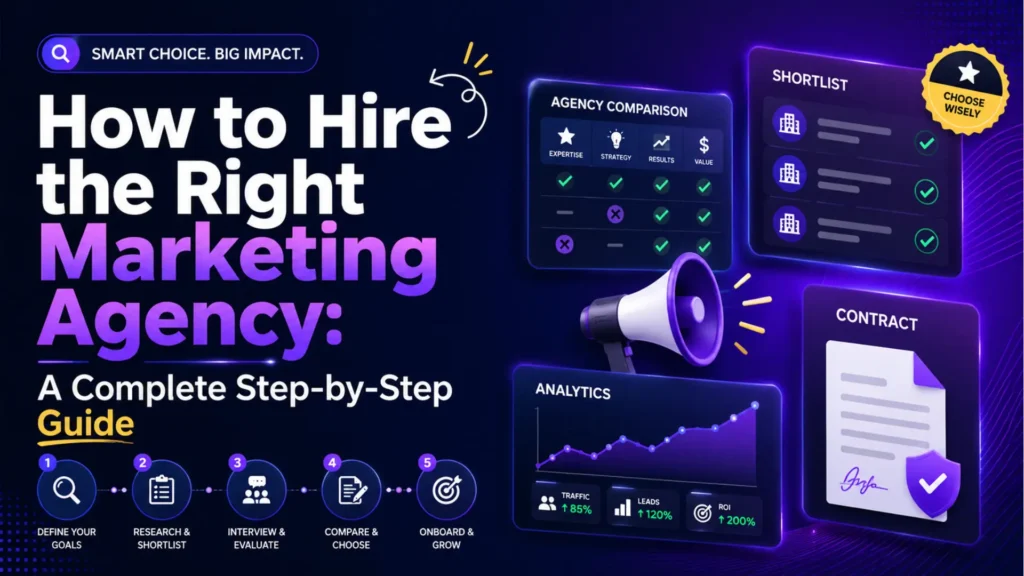
Most guides on how to hire the right marketing agency are written by agencies, which means they tell you to check case studies and trust your instincts, and skip the parts that actually cost you money. This one covers the parts they skip: what a retainer genuinely costs in 2026, how to verify an agency’s claims rather than admire them, which contract clauses protect your data, and how to tell within 90 days whether you made the right call.
We run an agency ourselves, so treat that as disclosure rather than a hidden bias. Where our interests and yours diverge, I have said so directly.
When to Hire a Marketing Agency (and When Not To)
Not every business should. Three situations genuinely justify it.
You have demand you cannot capture. People are searching for what you sell and finding competitors instead. This is the clearest case, because the ceiling is already proven.
You need several skills part-time. A functional marketing operation needs SEO, paid media, content, design, and analytics. Hiring five specialists is impossible for most businesses. An agency spreads those skills across one retainer.
Your in-house marketer is drowning in execution. One person cannot run strategy and produce all the work. Agencies are best used to absorb execution so your internal person can own strategy and brand.
Three situations where hiring is premature: you have no product-market fit and are hoping marketing will find it, your budget covers fees but not the ad spend or content production those fees are meant to manage, or nobody internally has time to approve work and answer questions. That last one kills more engagements than bad agencies do.
How Much Does It Cost to Hire a Marketing Agency in 2026?
Here are honest ranges. Prices vary by market, so treat these as the band to expect rather than a quote.
| Service | Small business | Mid-market | Competitive or national |
| SEO | $1,000 to $2,500 | $2,500 to $6,000 | $6,000 to $15,000 |
| PPC management | $1,000 to $2,000 or 10 to 20 percent of ad spend | $2,000 to $5,000 | $5,000 and above |
| Social media management | $800 to $2,000 | $2,000 to $5,000 | $5,000 and above |
| Content marketing | $1,500 to $3,000 | $3,000 to $8,000 | $8,000 and above |
| Full-service | $3,000 to $6,000 | $6,000 to $15,000 | $15,000 and above |
Three pricing models you will encounter:
- Monthly retainer. A fixed fee for an agreed scope. Most common and easiest to budget. Ask what happens to unused hours.
- Project-based. A one-off fee for a defined deliverable such as a website or a campaign. Best for testing an agency before committing.
- Percentage of ad spend. Typically 10 to 20 percent, common in PPC. The conflict of interest is obvious: the agency earns more when you spend more. Ask whether the percentage drops at higher spend tiers.
What drives the number. Agency pricing is mostly labour. A senior strategist costs an agency real money, so a suspiciously cheap retainer usually means a junior is running your account or the work is offshored without disclosure. Neither is automatically wrong. Both should be disclosed before you sign. Understanding how agencies structure and price their services makes it much easier to spot a proposal where the maths does not work.
Marketing Agency vs Freelancer vs In-House: Cost and Skill Comparison
The honest version, with costs.
Freelancer: $500 to $3,000 monthly for one specialism. Cheapest and most flexible. You get one skill, no cover during holidays or illness, and you manage them. Best when your need is narrow and well-defined, like content production. If writing is your gap specifically, hiring a freelance blog writer for your business often delivers better value than a full content retainer.
Agency: $2,000 to $15,000 monthly. You get several skills, process, tooling, and cover. You do not get someone who thinks about your business all day. Best when you need multiple channels working together.
In-house hire: $50,000 to $90,000 annually plus benefits, tools, and training, so realistically $6,000 to $9,000 monthly all-in for one person. You get dedicated focus and deep product knowledge. You get one skill set and a hiring risk. Best once marketing is a core function rather than a project.
The hybrid most growing businesses land on: one in-house marketer owning strategy and brand, plus an agency executing one or two channels. It costs roughly the same as two in-house hires and covers considerably more ground.
Step 1: Define Your Marketing Goals Before Contacting Agencies
The most common mistake is briefing an agency on tactics. “We need SEO” is a solution, not a problem, and it invites a generic proposal.
Brief on outcomes instead. “We need 40 qualified enquiries monthly from organic search within nine months, from a current base of 12.” That single sentence tells a competent agency whether the job is realistic, what channels to propose, and what budget it requires. It also gives you something measurable to hold them to.
Before you contact anyone, write down four things: your current monthly numbers, your target and the deadline, your total budget including ad spend and production, and who internally will approve work. Agencies that push back on unrealistic targets at this stage are the ones worth talking to.
Step 2: Choose Between a Full-Service and Specialist Marketing Agency
Full-service suits businesses needing three or more channels coordinated. The advantage is one point of contact and joined-up strategy. The risk is that every full-service agency has one or two channels it does well and the rest it staffs thinly. Ask which channel they are genuinely known for.
Specialist suits a single well-defined goal. A dedicated remarketing agency will beat a generalist on retargeting performance, because it is the only thing they do all day. The trade is coordination: you manage the relationships between specialists yourself.
Rough rule: under $5,000 monthly, go specialist, because a full-service retainer at that level spreads too thin to do anything well. Above $8,000, full-service starts making sense.
Step 3: Where to Find Marketing Agencies Worth Shortlisting
Ranked by quality of outcome:
- Referrals from businesses like yours. Ask specifically who they use and, more usefully, who they left and why.
- Agencies whose own marketing is working. If an SEO agency does not rank, that tells you something. If a social agency’s own accounts are dead, same.
- Clutch and G2. Reviews are verified through interviews, which makes them harder to fake than testimonials on an agency’s own site.
- LinkedIn. Look at who the agency’s employees are and how long they stay. High turnover means your account will change hands.
- Industry events and podcasts. People who teach publicly usually know the subject.
Shortlist three to five. More than five and you cannot evaluate properly. Fewer than three and you have no comparison.
Step 4: How to Vet a Marketing Agency Before You Hire
This is where most hiring processes fail, because people evaluate the pitch instead of the evidence. Six checks, in order of how much they reveal.
Verify one case study yourself. Pick a result they claim, find the client’s site, and check it independently. If they claim a ranking, search for it. If they claim traffic growth, check whether the pages they built are still live and indexed. Agencies rarely expect anyone to look.
Ask to speak to a client who left. Current clients are selected references. A former client will tell you why the relationship ended, and the reason is usually more informative than any success story. An agency that will not provide one is telling you something.
Find out who does the work. Ask for the name and LinkedIn profile of the person who will run your account day to day. Senior people pitch and juniors deliver at a lot of agencies. This is not disqualifying if disclosed, and it is a serious problem if it is not.
Check employee tenure on LinkedIn. If most staff have been there under a year, your account will be handed over repeatedly and continuity will suffer.
Ask them to critique your current marketing on the call. A good agency will have looked and will tell you something specific and slightly uncomfortable. A weak one will speak in generalities because they did not prepare.
Request a sample of real client reporting with the numbers redacted. You will learn more from how they present results than from anything they say about how they present results.
Step 5: How to Check an Agency’s AI Content and AI Search Capability
This section did not need to exist two years ago. It does now, and almost no hiring guide covers it.
Ask how they use AI in content production, and get a straight answer. AI-assisted drafting is normal and fine. Publishing unedited AI output under your brand is not, and it is increasingly easy for both readers and Google to detect. The right answer describes AI in research and drafting with human editing, subject expertise, and fact-checking layered on top. A defensive or vague answer means they are hiding volume production.
Ask what they are doing about AI Overviews and LLM citations. Google’s AI Overviews now answer many queries that used to send clicks, and buyers increasingly ask ChatGPT and Perplexity for recommendations. An agency with no view on this is selling you a 2022 strategy. You do not need them to have it fully solved. You need them to have noticed.
Ask how they will report on it. The honest answer is that attribution here is still imperfect, since AI-referred traffic often lands as direct or referral. An agency claiming precise measurement of AI traffic is overselling.
Step 6: Questions to Ask a Marketing Agency Before Hiring
Skip the generic list. These six force real answers.
- “Walk me through a campaign that failed and what you changed afterwards.” If they have never failed, they are inexperienced or dishonest. The recovery is what you are assessing.
- “What would make you tell me not to hire you?” A good agency can name the client profile they are wrong for. A sales-led one cannot.
- “What do you need from us, and what happens if you do not get it?” Tests whether they understand that engagements fail on client input as often as agency output.
- “Who owns the ad accounts, analytics, and content if we leave?” The only correct answer is you.
- “What does month one look like compared to month six?” You want front-loaded audit and setup, then compounding execution. A flat answer means no real plan.
- “How would you measure success if rankings and impressions were off the table?” Separates agencies that drive business outcomes from ones that report activity.
Step 7: How to Compare Marketing Agency Proposals
Compare on five things, in this order.
Scope specificity. “Content marketing” is not a deliverable. “Four 1,500-word articles monthly, keyword research included, two rounds of revision” is. Vague scope is where surprise invoices come from.
Who is assigned. Named people with named roles and rough hours. If the proposal does not say, ask before signing.
Measurement. Which metrics, measured how, reported how often. If success is defined as impressions or posts published, the proposal is measuring effort rather than results.
Timeline honesty. SEO takes three to six months to show movement and six to twelve for competitive terms. Paid can produce results in weeks. Any proposal promising fast organic results is either inexperienced or planning something risky.
What is excluded. Ad spend, production costs, tool licences, and stock imagery are frequently outside the retainer. Confirm the all-in number before comparing prices.
Step 8: What Your Marketing Agency Contract Must Include
Five clauses. Do not sign without them.
- Data and account ownership. You own the ad accounts, analytics properties, domain, content, and creative assets. The agency gets access, not possession. This is the single most important clause in the document.
- An exit clause. Thirty to sixty days notice is standard. Twelve-month lock-ins with no out are a structural red flag, because agencies confident in their work do not need to trap clients.
- Defined deliverables and revision rounds. Written into the contract, not left in the pitch deck.
- Scope change process. How additional work gets quoted and approved, so nothing appears on an invoice unannounced.
- Reporting cadence and format. Specify frequency and which metrics appear, so reporting cannot quietly narrow to whichever numbers look best.
Red Flags to Watch for When Hiring a Marketing Agency
Guaranteed rankings or guaranteed results
Nobody controls Google’s algorithm. Google itself states plainly in its guidance on hiring an SEO that no one can guarantee a number one ranking. An agency promising it is either uninformed or planning tactics that will eventually cost you.
No access to your own ad accounts
Withholding access to your own ad accounts and analytics is a retention tactic, not a security measure. You should hold admin rights on every property from day one.
Pricing far below market rate
A $500 monthly SEO retainer cannot fund senior time. Something is being cut, usually quality, disclosure, or both.
No named person on your account
If they cannot tell you who will run your account day to day, nobody has been assigned yet, and you are buying a promise rather than a team.
Reporting that shows only activity
Posts published, links built, hours logged. These are inputs. If nobody is reporting outputs, nobody is being held to them.
Every answer is yes
An agency that agrees your timeline is achievable, your budget is sufficient, and every channel is worth doing is selling, not advising.
What the First 90 Days With a Marketing Agency Should Look Like
Judge the hire early against this shape.
Weeks 1 to 3: Kickoff, access handover, audit of existing performance, and a documented baseline. If nobody has established what your numbers were before they started, nobody can prove improvement later. Insist on a written baseline.
Weeks 3 to 6: Strategy delivered and approved, quick wins shipped. Every account has fixable problems. Competent agencies find and fix several in the first month.
Weeks 6 to 12: Consistent execution, first reporting cycle with commentary rather than raw dashboards, and early leading indicators moving. For SEO that means impressions and long-tail positions. For paid it means cost per acquisition trending down.
The 90-day question: can they explain what they learned about your business that they did not know at the start? An agency genuinely working on your account will have specific answers. One running a template will not.
When to Switch Marketing Agencies
Four legitimate triggers: leading indicators flat after six months with no explanation, reporting that stops answering direct questions, your account passed to a third different manager, or you have outgrown their capability.
One illegitimate trigger worth naming: impatience at month three on an SEO engagement. Switching resets the clock and you pay for onboarding twice. Before you leave, put your concerns in writing and give 30 days. Good agencies respond to that. The ones that do not have answered your question.
When you do leave, remove agency access from all accounts on the final day, confirm you hold admin rights on every property, and export historical reporting before access ends.
How Leemjaz Works With Clients
Since this guide tells you to interrogate agencies, here is how we answer our own questions.
We audit before we propose. Every prospective client gets a review of their current performance before we quote, and we share the findings whether or not they hire us. If the audit shows the problem is not one we should be paid to solve, we say so. We have told businesses to fix their offer or their website before spending anything on traffic.
We name the person running your account. You know who does the work, and you can reach them directly rather than through an account manager relaying messages.
You own everything. Ad accounts, analytics, domains, and content are set up under your ownership from day one. If you leave, nothing needs handing back because it was never ours.
We work without lock-in. No long-term tie-in. We would rather earn the next month than contract for it, and that arrangement keeps us honest about results in a way a twelve-month contract does not.
We report on outcomes. Leads, conversions, cost per acquisition, and revenue where it can be tracked, with commentary explaining what changed and why. Activity summaries are available, but they are not the report.
We say no. We turn down work where the budget cannot deliver the target, where the timeline is unrealistic, or where the channel is wrong for the business. That is worth more to you than an agency that agrees with everything.
Marketing Agency Hiring FAQs
How much does it cost to hire a marketing agency?
Monthly retainers typically run $1,000 to $2,500 for a single service at small business scale, $2,500 to $6,000 for mid-market work, and $6,000 to $15,000 or more for competitive national campaigns. Full-service engagements usually start around $3,000 monthly. PPC is often priced at 10 to 20 percent of ad spend instead of a flat fee. Confirm whether ad spend, production, and tool licences sit inside or outside the retainer, since that changes the real cost substantially.
Is hiring a marketing agency worth it?
It is worth it when you have demand you cannot currently capture, when you need several marketing skills part-time rather than one full-time, or when your in-house marketer is stuck in execution. It is not worth it if you lack product-market fit, if your budget covers agency fees but not the spend and production those fees manage, or if nobody internally has time to approve work. That last constraint sinks more engagements than poor agency performance does.
How long does it take to see results from a marketing agency?
Paid advertising can show results within two to four weeks because you are buying traffic immediately. SEO typically takes three to six months for early movement and six to twelve months for competitive terms. Content and social compound over three to six months. Any agency promising fast organic results is either inexperienced or using tactics that create risk later.
What questions should I ask before hiring a marketing agency?
The most revealing are: walk me through a campaign that failed and what changed afterwards, what would make you tell me not to hire you, who specifically will run my account day to day, who owns the ad accounts and data if we leave, and how would you measure success if rankings and impressions were off the table. Generic questions get rehearsed answers. These force specifics.
Should I hire a marketing agency or an in-house marketer?
An in-house marketer costs roughly $6,000 to $9,000 monthly all-in once salary, benefits, and tools are counted, and gives you one skill set with dedicated focus. An agency costs $2,000 to $15,000 and gives you several skills with less depth of product knowledge. Most growing businesses end up with a hybrid: one in-house person owning strategy and brand, with an agency executing one or two channels.
What are the biggest red flags when hiring a marketing agency?
Guaranteed rankings or results, since nobody controls search algorithms. Reluctance to give you full access to your own ad accounts and analytics. Pricing far below market, which means senior time is not being funded. No named person assigned to your account. Reporting that shows only activity such as posts published or links built. And an agency that agrees with everything you propose, which means they are selling rather than advising.
Conclusion
Hiring the right marketing agency is less about finding the best agency and more about finding the right fit for your stage, budget, and internal capacity. The businesses that get this right do three things: they brief on outcomes rather than tactics, they verify claims instead of admiring pitches, and they protect data ownership in the contract before anything else. If you are partway through this process and want a second opinion on a proposal you have received, we are happy to look at it and tell you what we would ask before signing, whether or not the agency in question is us.