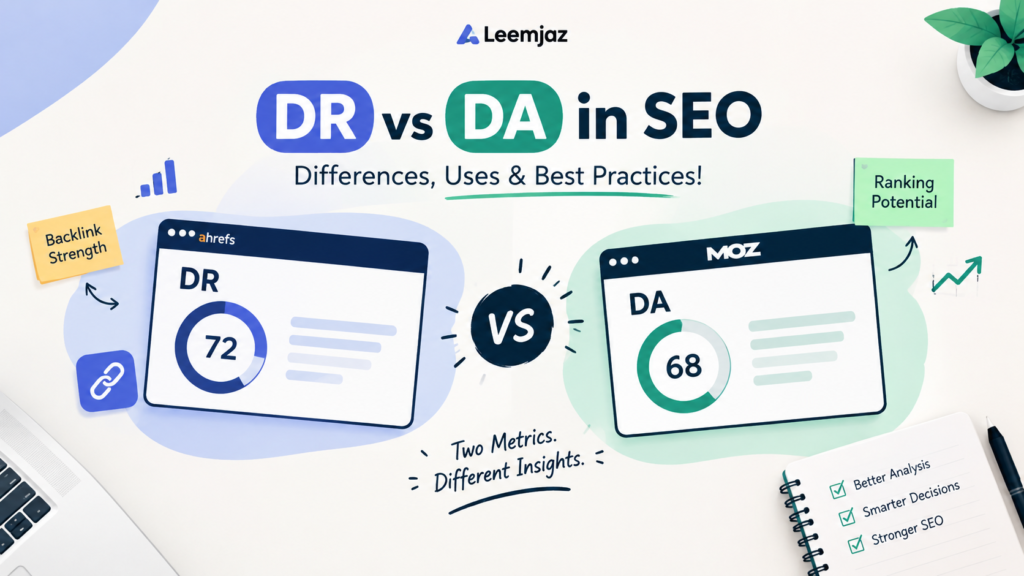
When comparing websites, two metrics often come up: Domain Rating (DR) and Domain Authority (DA). Both help SEO professionals understand a website’s backlink strength, but they measure it differently. Understanding DR vs DA in SEO can help you evaluate competitors, review backlink profiles, and make better decisions about link-building campaigns.
However, neither metric tells the complete story of a website’s SEO performance. A website with a high authority score may receive little organic traffic, while a smaller website may rank well for relevant keywords. The key is to understand what each metric measures and how to use it alongside other SEO data.
What Is the Difference Between DR vs DA in SEO?
The main difference between DR vs DA in SEO is the tool that calculates each score and the factors it evaluates.
Domain Rating (DR) is an Ahrefs metric that measures the strength of a website’s backlink profile. Domain Authority (DA) is a Moz metric that predicts how likely a website is to rank in search engine results compared with other websites.
Both metrics use a scale from 0 to 100. However, they use different data and calculation methods, so their scores are not directly interchangeable.
| Feature | Domain Rating (DR) | Domain Authority (DA) |
|---|---|---|
| SEO tool | Ahrefs | Moz |
| Main purpose | Measures backlink profile strength | Predicts relative ranking potential |
| Score range | 0–100 | 1–100 |
| Main focus | Backlink profile and referring domains | Multiple link-related signals |
| Best use | Evaluating backlink strength | Comparing potential ranking competitiveness |
For example, a website might have a DR of 45 and a DA of 32. This difference does not automatically mean Ahrefs or Moz is wrong. Each platform evaluates websites using its own data and methodology.
What Is Domain Rating (DR) in SEO?
Domain Rating is an Ahrefs metric that estimates the strength of a website’s backlink profile compared with other websites in its database. It considers factors such as the number of unique websites linking to a domain and the strength of those linking websites.
DR can help SEO professionals understand a website’s backlink profile. However, a higher score does not guarantee better rankings or more organic traffic.
How Ahrefs Calculates Domain Rating
Ahrefs considers several backlink-related factors when calculating DR. These include the number of unique domains linking to a website, the DR of those referring domains, and how they distribute their outgoing links.
A backlink from a strong website may contribute to your backlink profile, but the value depends on several factors. Relevance, link placement, and the overall quality of the referring page also matter when evaluating a backlink opportunity.
For a deeper explanation, read our guide to Ahrefs Domain Authority and what the score really means.
What Is Domain Authority (DA) in SEO?
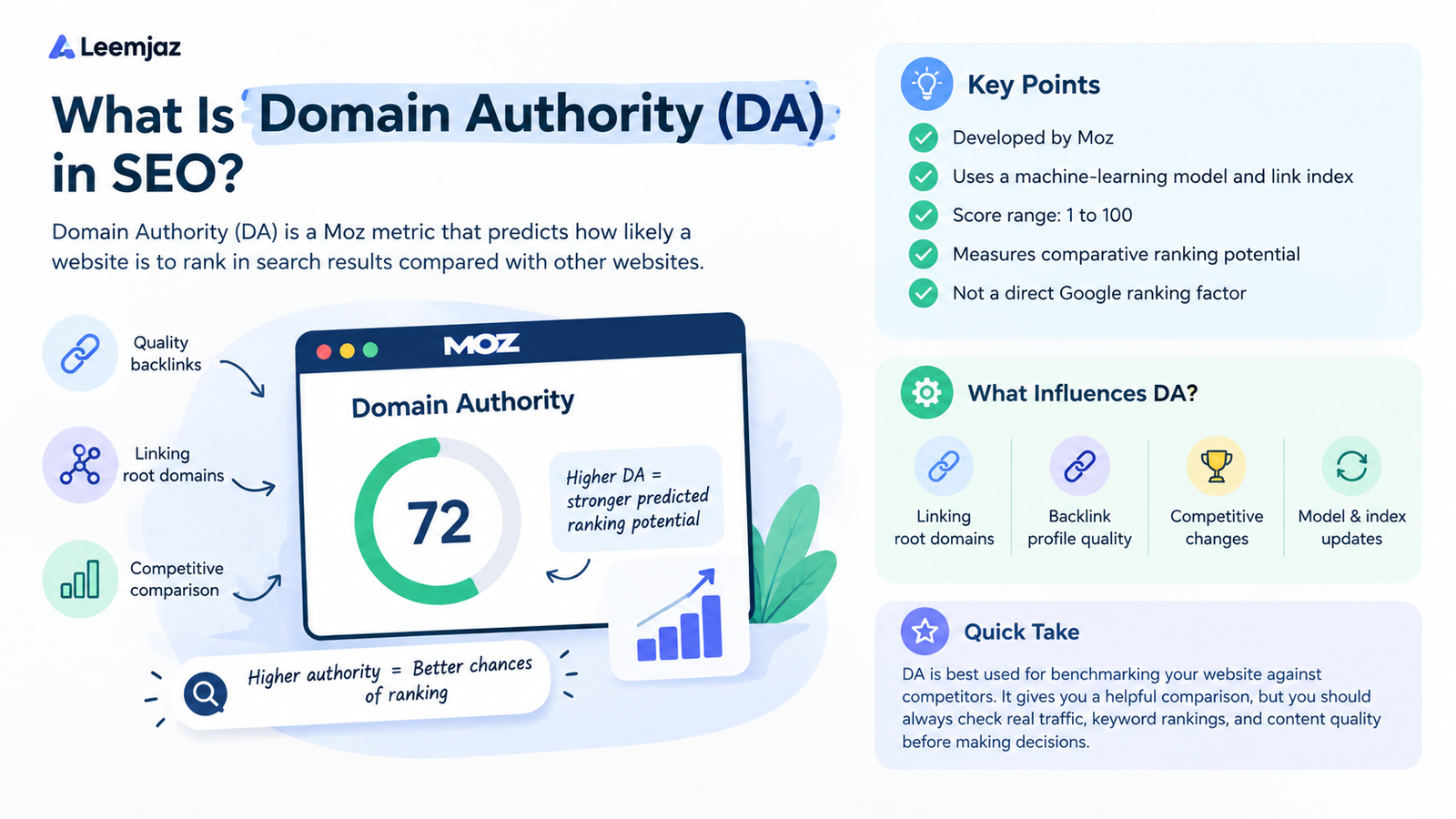
Domain Authority is a metric developed by Moz to predict how likely a website is to rank in search results compared with other websites. It uses a machine-learning model and multiple link-related signals to generate a score.
DA is useful for competitor research because it gives SEO professionals a consistent way to compare websites within a particular market. However, it is not a Google ranking score, and Google does not use Moz’s DA metric as a direct ranking factor.
How Moz Calculates Domain Authority
Moz uses its own link index and predictive model to calculate DA. The score can change as Moz updates its index, adjusts its model, or discovers new links.
DA is most useful when you compare similar websites using the same tool. For instance, comparing the DA scores of three competing digital marketing agencies may help you understand differences in their estimated authority.
Still, you should also review organic traffic, ranking keywords, content quality, and backlink relevance before deciding which competitor has the stronger SEO performance.
DR vs DA in SEO: Which Metric Should You Use?
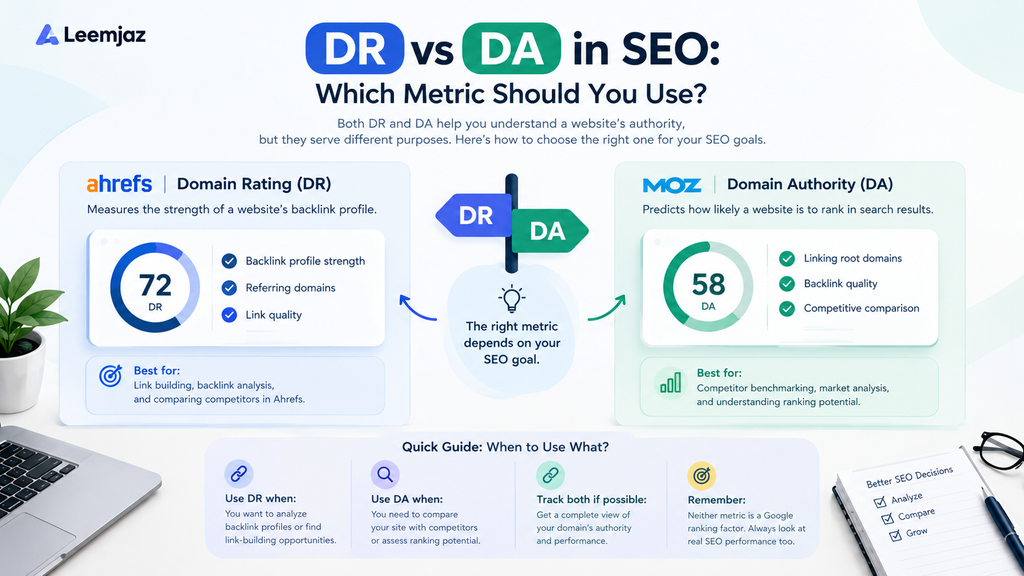
The right metric depends on your SEO goal. Neither DR nor DA is universally better because each offers a different perspective on website authority.
Use Domain Rating when you want to investigate backlink profiles in Ahrefs. It can help you compare referring domains and identify websites for further backlink analysis.
Use Domain Authority when you want to compare estimated ranking potential through Moz. It can provide another useful reference point during competitor research.
If you already use both tools, you do not need to choose only one. Review each score within its own platform, then compare the results with more meaningful performance indicators.
For example, if you are assessing a potential link-building website, do not accept it simply because it has a high DR or DA. Check whether it publishes relevant content, attracts genuine visitors, and has a backlink profile that looks natural.
How to Evaluate Backlinks Beyond DR and DA
DR and DA are useful starting points, but they should not determine your entire link-building strategy. A website can have a strong authority score and still be a poor fit for your business.
Before pursuing a backlink, consider these factors:
Topical relevance: Does the website cover subjects related to your industry? A relevant link may make more sense for your audience than a link from an unrelated website.
Organic traffic: Does the website appear to attract visitors from search engines? Review traffic estimates alongside the keywords for which the site ranks.
Referring domains: Look at the variety and quality of websites linking to the domain. A high number of backlinks does not necessarily indicate a healthy profile.
Content quality: Review the website’s articles, publishing standards, and usefulness to readers. Avoid sites filled with thin content or unrelated guest posts.
Link placement: A contextual link within a relevant article may be more useful to readers than a link placed randomly on a page.
Spam signals: Investigate suspicious anchor text, irrelevant outbound links, and unusual patterns in the backlink profile before making a decision.
At Leemjaz, backlink research should be considered alongside the wider SEO strategy rather than treated as a competition to increase authority scores. You can also explore our backlink-building strategy for more information on evaluating link opportunities.
A Practical Example of DR vs DA in SEO
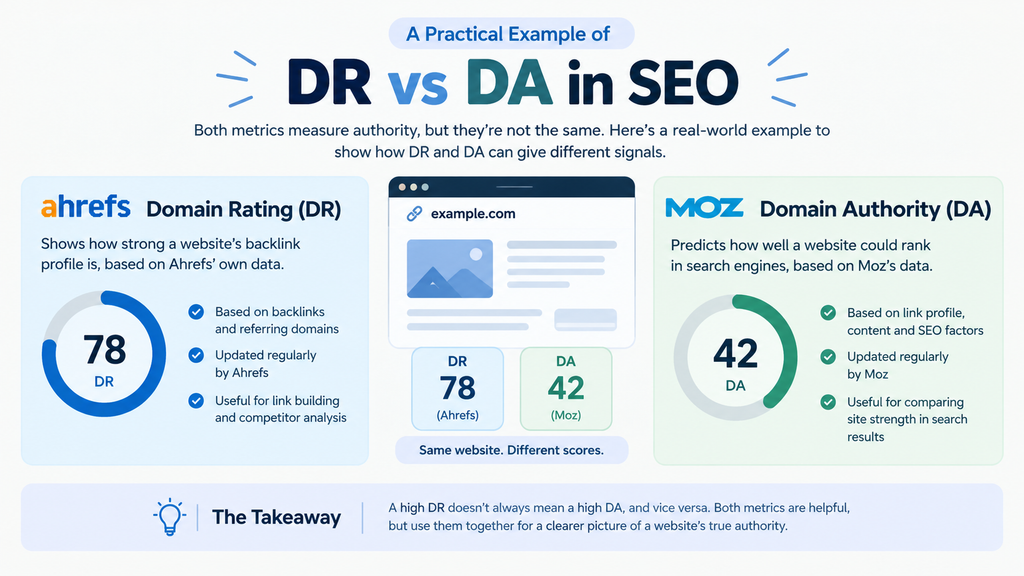
Imagine you are comparing two websites in the digital marketing industry.
Website A has a DR of 60 and a DA of 48. Website B has a DR of 38 and a DA of 42.
At first glance, Website A appears stronger according to DR, while Website B has a relatively closer DA score. But these numbers alone do not tell you which website performs better in search results.
Next, review their ranking keywords, estimated organic traffic, referring domains, and content relevance. You may find that Website B receives more relevant organic traffic and publishes more useful content for its target audience.
In that case, Website B could be a valuable competitor to study despite its lower DR.
This example illustrates why DR vs DA in SEO should be treated as a comparison of third-party metrics, not a final judgment about website quality. Always investigate the actual search performance and relevance of the websites you compare.
Does DR or DA Affect Google Rankings?
Neither Domain Rating nor Domain Authority is a direct Google ranking factor. Ahrefs and Moz developed these metrics to help users assess websites, not to represent Google’s own ranking system.
Google evaluates many signals when determining search results. These include relevance to the query, content usefulness, page experience, and links, among other systems and signals.
That means improving your DR or DA score alone will not guarantee higher rankings. A score may increase as your backlink profile changes, but your organic performance depends on many additional factors.
For official guidance, read Google’s documentation on how Search works.
Instead of focusing only on authority scores, work on publishing helpful content, improving technical SEO, earning relevant backlinks naturally, and matching search intent.
How to Improve Your Website’s Authority for SEO
If you want to strengthen your website’s backlink profile and improve its overall SEO performance, focus on sustainable practices instead of chasing a particular score.
Create useful content. Publish original guides, research, comparisons, and resources that answer questions your audience actually has. Useful content gives other websites a reason to reference your work.
Earn relevant backlinks. Build relationships with websites in your industry and look for legitimate opportunities to contribute valuable content. Avoid buying links intended to manipulate search rankings.
Improve internal linking. Connect related pages using clear, descriptive anchor text. Internal links help visitors discover relevant content and help search engines understand the relationship between your pages.
Update existing content. Review outdated information, improve weak sections, and add examples where they help readers. Regular content improvements can make pages more useful.
Monitor SEO performance. Track organic clicks, impressions, ranking keywords, and relevant conversions through tools such as Google Search Console and Google Analytics. These indicators help you understand whether your SEO work is producing results.
Review competitors regularly. Use DR and DA as supporting metrics, then investigate competitors’ content, keyword rankings, and referring domains to identify realistic opportunities.
If your business needs help with its wider search strategy, explore Leemjaz’s SEO services to learn more about its SEO offerings.
Frequently Asked Questions About DR vs DA in SEO
1. Is DR better than DA for SEO?
Neither metric is always better. DR focuses on backlink profile strength, while DA predicts relative ranking potential. Choose the metric that fits your research goal and evaluate other SEO indicators before making decisions.
2. What is a good DR or DA score?
There is no universal score that makes a website good or bad. Compare websites in the same industry and consider their organic traffic, content relevance, backlink quality, and ranking performance.
3. Can a website rank with low DR and DA?
Yes. A website can rank for relevant keywords even with low DR or DA scores. Search performance depends on many factors, including relevance, content quality, competition, and links.
4. Do DR and DA increase automatically over time?
No. Scores may rise or fall as backlink profiles change, tools update their databases, or calculation methods change. Simply waiting does not guarantee an increase.
5. Should I use DR and DA for backlink building?
Yes, but use them as initial screening metrics rather than the only selection criteria. Check the website’s relevance, traffic, content quality, and backlink profile before pursuing a link.
Conclusion
Understanding DR vs DA in SEO helps you interpret two popular third-party authority metrics without confusing them with Google’s ranking systems. DR is useful for reviewing backlink profile strength, while DA helps estimate relative ranking potential.
Neither score tells the complete story. For better SEO decisions, combine these metrics with organic traffic, keyword rankings, referring domains, content relevance, and backlink quality.
For Leemjaz and other businesses, the goal should not be to achieve the highest authority score at any cost. It should be to build a useful website, earn relevant links, and improve visibility for the searches that matter to the business.