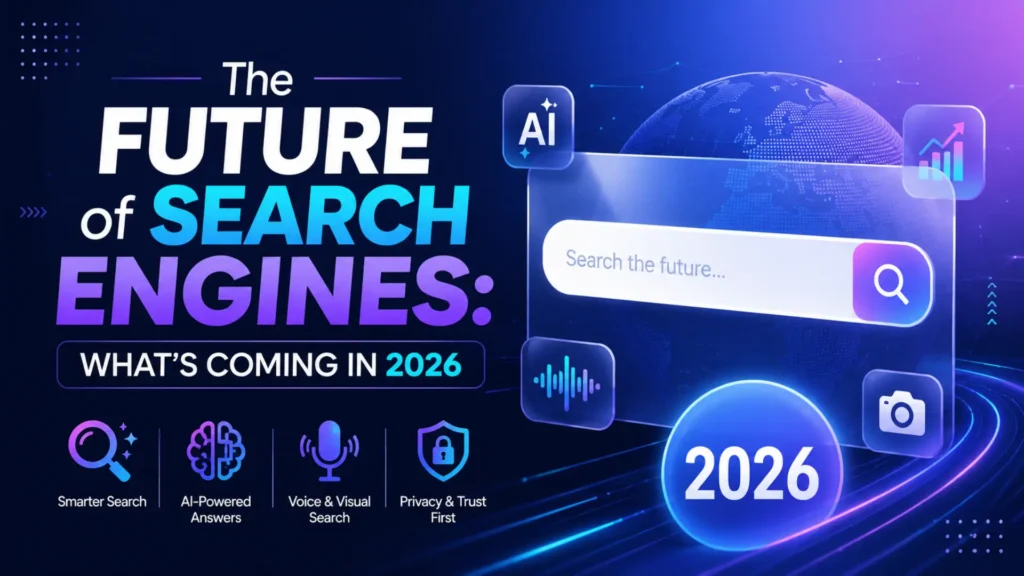
The future of search engines is not some far off science fiction idea anymore. It is happening right now, and it is moving faster than almost anyone predicted. Just think about how you searched two years ago versus today. Back then you typed a few keywords and clicked through a list of blue links. Today you ask a full question and get a written answer, often without clicking anything at all. Google’s AI Mode passed one billion monthly users in 2026, ChatGPT now handles roughly 17 percent of all search style queries, and Google even rebuilt its search box for the first time in over 25 years. If you run a website, a business, or just want to understand where all this is heading, this guide breaks down the future of search engines in plain language, backed by real 2026 data, not guesswork.
The future of search engines is shifting from typing keywords and clicking links to asking questions and getting direct AI answers. In 2026, Google’s AI Mode passed one billion monthly users, AI Overviews now answer queries directly (linked to a 58 percent drop in click through rates), and search is becoming conversational, multimodal, and agentic (meaning AI can now act on your behalf, not just answer). Traditional search is not dying, but it is being joined by AI search engines like ChatGPT, Perplexity, and Gemini. For businesses, the future means optimizing to be cited inside AI answers, not just ranking in blue links.
How Search Has Already Changed
Before we look forward, it helps to see how far we have already come, because the change has been dramatic.
For over two decades, search worked the same way. You typed keywords, Google showed you ten blue links, and you clicked through to find your answer. That model held steady from the late 1990s all the way through the early 2020s.
Then generative AI arrived and broke the pattern. Google launched AI Overviews, which now sit at the top of most search results and answer your question directly. ChatGPT added live web search. Perplexity built an entire search engine around cited AI answers. And in 2024, something happened that had not happened since 2015: Google’s search market share dropped below 90 percent for the first time in nearly a decade.
The way search engines actually find and organize information still runs on the same foundation, which the breakdown of how a search engine works explains in full. What changed is the layer on top: how the answers get delivered to you.
The 6 Biggest Shifts Shaping the Future of Search Engines
Here are the six changes actually driving the future of search engines in 2026, each backed by real data.
1. Answers Are Replacing Links
The single biggest shift is that search engines now give you answers instead of just links. Google’s AI Overviews summarize information at the top of the page, so you often get what you need without clicking anything. This is called zero click search, and it is growing fast. One February 2026 study found that search results with an AI Overview were linked to a 58 percent lower click through rate, up sharply from 34.5 percent just ten months earlier.
2. Search Is Becoming a Conversation
The old way was one query at a time. The new way is a back and forth conversation. You ask something, get an answer, then ask a follow up without repeating yourself, because the search engine remembers the context. Google’s AI Mode and ChatGPT both work this way now, and it feels far more like talking to a knowledgeable friend than using a search box.
3. Search Is Going Multimodal
Search is no longer just about text. You can now search with your camera, your voice, an image, a video, or even a screenshot. Point your phone at a plant and search it. Take a photo of a product and find where to buy it. At Google I/O in 2026, Google announced you can now search using text, images, files, videos, or even Chrome tabs as inputs, all at once.
4. Queries Are Getting Longer and More Natural
People used to search “pizza near me.” Now they type or speak whole paragraphs like “find me a quiet pizza place with outdoor seating that opens before 6 PM.” Search engines built on AI understand this natural language far better than the old keyword systems did, which changes how content needs to be written.
5. The Market Is Fragmenting
For 20 years, search meant Google. Now it means Google, ChatGPT, Perplexity, Microsoft Copilot, Gemini, and more. ChatGPT alone reached an estimated 17 percent of digital queries by the end of 2025, while Google held around 78 percent. People now bounce between several search tools depending on what they need.
6. Search Is Becoming Agentic
This is the newest and biggest shift. Search engines are starting to act on your behalf, not just answer questions. Google introduced Search agents in 2026, which run in the background, monitor information for you, and notify you when something changes. More on this below, because it is a genuine game changer.
Will AI Replace Traditional Search Engines?
This is the question everyone asks, so let me give you the honest answer: no, but it is complicated.
Google is not being replaced. In fact, Google is leading the AI search charge with AI Mode, AI Overviews, and Gemini powered features. What is happening instead is that traditional search and AI search are merging into one experience. When you use Google in 2026, you get AI answers and blue links on the same page.
At the same time, dedicated AI tools like ChatGPT and Perplexity have carved out real space. They are not replacing Google, but they have permanently ended the era where Google was the only front door to the internet. The future of search engines is not one winner. It is an ecosystem where people use different tools for different jobs, and the smart move is being visible across all of them.
The full comparison of how these AI answers work alongside traditional results is broken down in the guide on AI Overviews vs Featured Snippets, which shows exactly how the two systems now share the top of the page.
The Rise of Agentic Search (AI That Acts For You)
If you only pay attention to one part of this guide, make it this one, because agentic search is where the future is heading fastest.
Until now, a search engine answered your question and stopped there. Agentic search goes further. It actually does things for you. Google described it at their 2026 I/O event with a great example: if you are apartment hunting, you can tell your search agent exactly what you want, and it will keep scanning listings around the clock, then notify you the moment something matches.
Think about what that means. The search engine is no longer a tool you use once and close. It becomes an assistant that works in the background 24/7, watching for what you care about. SEO experts are already predicting that agentic AI will soon handle entire tasks, like finding a product, applying a coupon, and completing the checkout, all inside the conversation without you visiting a single website.
This is the biggest change to how search works since Google launched, and it is arriving now, not in some distant future.
What the Future of Search Engines Means for Everyday Users
For regular people just trying to find things online, the future of search engines is mostly good news.
You get answers faster. No more clicking through five websites to find one fact. The answer comes to you directly.
Searching feels natural. You can ask full questions, speak instead of type, or search with a photo. No more guessing the right keywords.
Your searches get smarter over time. Conversational search remembers context, so each follow up gets more relevant.
AI does more of the work. Agentic search means your search tool can handle tasks for you, from monitoring prices to booking things.
The one downside worth knowing: because AI answers pull from many sources and rewrite them, it is worth double checking important facts against the original source. AI can occasionally get things wrong or mix up details, so a quick verification on anything that really matters is still smart.
What It Means for Businesses and Website Owners
Here is where the future of search engines gets serious, because the changes hit businesses hard.
For 20 years, the goal was simple: rank at the top of Google. That single goal is no longer enough. When AI Overviews answer questions directly, fewer people click through to websites, which means the traffic businesses relied on for two decades is shrinking. That 58 percent drop in click through rate on AI Overview results is not a small problem. It is a fundamental shift in how people reach businesses.
The new goal is being cited inside the AI answer, not just ranking below it. This is called answer engine optimization, and it works differently from traditional SEO. AI engines favor content that is clearly structured, factually precise, genuinely helpful, and backed by real authority and trust. Backlinks still matter, but clarity, expertise, and being mentioned across trusted sources matter more than ever.
The businesses that adapt early will own the future of discovery. The ones still chasing 2022 style keyword rankings will slowly go invisible, because the whole game moved while they were not looking. The full hierarchy of what actually earns visibility now is broken down in the search engine ranking factors guide.
How to Prepare Your Website for the Future of Search
You do not need to panic, but you do need to adapt. Here is what actually works in 2026.
Write genuinely helpful content. AI systems are built to find content that truly answers the question. Thin, keyword stuffed pages lose. Deep, useful, original content wins.
Structure content clearly. Use clear headings, short paragraphs, bullet points, and direct answers near the top. AI engines pull from content that is easy to parse.
Answer real questions. Write the way people actually ask, in full natural questions, not just short keywords.
Build real authority. Get mentioned across trusted sources, earn quality links, and show genuine expertise. AI engines cite brands they trust.
Make everything machine readable. Add schema markup, transcribe videos, add alt text to images. If AI cannot read it, it cannot cite it.
Optimize for multiple platforms. Do not just optimize for Google. Make sure your content works for ChatGPT, Perplexity, Copilot, and Gemini too.
A Real Look at How We Adapted at Leemjaz
Let me show you how this played out for us, because living through the shift taught us more than any prediction could.
When Leemjaz first built our content around how search engines work, we optimized the traditional way: keywords, structure, internal links, technical SEO. It worked, and the pages ranked on Google. But as AI Overviews and AI search grew through 2025 and into 2026, we noticed something. Our Google click through rates on informational pages were slipping, even though our rankings held steady. People were getting their answers from the AI summary without clicking.
So we adapted. We restructured every post to lead with a clear, direct answer at the top. Specific data and sources went into each one. Then we built deeper topical authority by connecting our posts into a tight cluster. And we started tracking a new metric: how often our content got cited inside AI answers, using Bing’s AI Performance report.
The result surprised us. While click through from traditional search softened, our content started appearing as a cited source inside Microsoft Copilot and ChatGPT answers. And here is the interesting part: the traffic that did come through from AI citations converted at roughly twice the rate of regular Google traffic, because those users arrived already trusting us, since an AI had just recommended us.
The lesson was clear. The future of search engines is not about fighting the change. It is about adapting to it early. If your business is watching its search traffic shift and you are not sure how to respond, the SEO team at Leemjaz helps businesses build visibility across both traditional search and AI answer engines, so you stay found no matter how people search.
Frequently Asked Questions
1. What is the future of search engines?
The future of search engines is a shift from typing keywords and clicking links to asking questions and getting direct AI answers. Search is becoming conversational, multimodal (voice, image, video), and agentic (AI that acts for you). Traditional search like Google will coexist with AI search engines like ChatGPT and Perplexity, giving users more ways to find information than ever.
2. Will AI replace Google search?
No, AI is not replacing Google, but it is transforming it. Google has integrated AI directly into search through AI Mode and AI Overviews, which passed one billion monthly users in 2026. Instead of being replaced, Google is merging traditional search with AI. Dedicated AI tools like ChatGPT and Perplexity coexist alongside it rather than fully replacing it.
3. Are search engines dying because of AI?
Search engines are not dying, they are evolving. People are actually searching more than ever, with Google reporting all time high query volumes in 2026. What is changing is how answers get delivered. The shift toward AI answers means fewer clicks to websites, which affects businesses, but overall search activity is growing, not shrinking.
4. What is agentic search?
Agentic search is when a search engine acts on your behalf instead of just answering questions. For example, Google’s Search agents can monitor apartment listings around the clock and notify you when one matches your needs. In the near future, agentic AI is expected to complete full tasks, like finding a product, applying a discount, and checking out, all within the conversation.
5. How do I optimize my website for AI search?
Write genuinely helpful, well structured content that answers real questions clearly. Add schema markup, transcribe videos, and use alt text so AI can read your content. Build real authority through quality mentions and links across trusted sources. Optimize for multiple platforms including ChatGPT, Perplexity, and Copilot, not just Google, since AI engines cite content they can trust and easily parse.
6. What is the difference between SEO and AI search optimization?
Traditional SEO focuses on ranking your pages in Google’s blue links using keywords, backlinks, and technical signals. AI search optimization (also called answer engine optimization) focuses on getting your content cited inside AI generated answers from ChatGPT, Perplexity, and Google AI Overviews. It prioritizes clear structure, factual accuracy, and brand trust over keyword targeting alone.
Conclusion
The future of search engines is not something to fear, but it is something to understand. Search is becoming faster, more conversational, more visual, and increasingly able to act on your behalf. Google is not going anywhere, but it now shares the stage with ChatGPT, Perplexity, Gemini, and Copilot, and the whole experience is shifting from “here are some links” to “here is your answer.” For everyday users, this means getting what you need quicker and more naturally than ever. For businesses, it means adapting fast, because the old playbook of chasing keyword rankings is being replaced by the new goal of becoming the trusted answer AI engines cite. The change is already here, the data proves it, and the smartest move anyone can make is to stop searching the way we did in 2020 and start building for the way search actually works now.