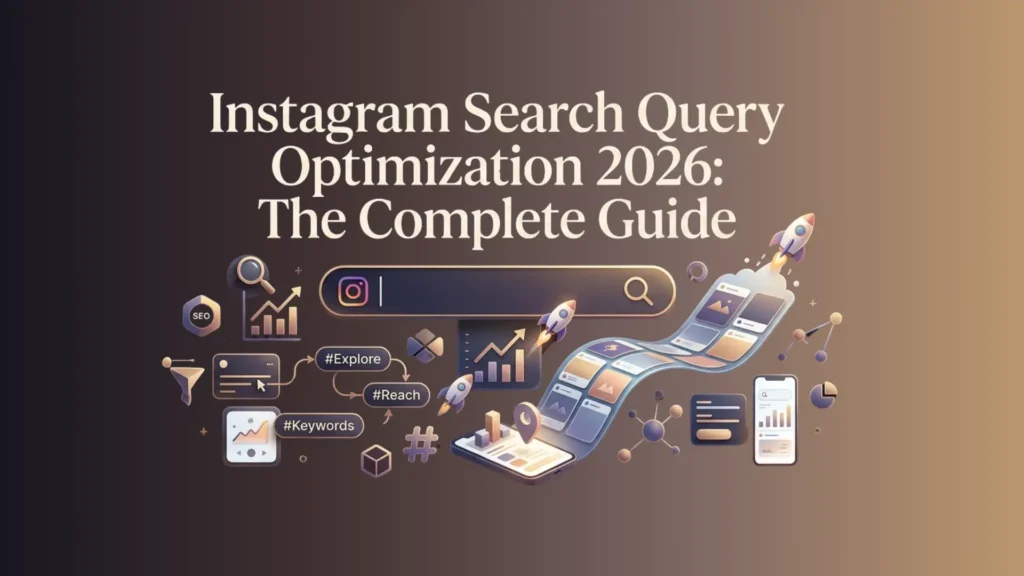
Instagram search query optimization is no longer a nice-to-have. It is the single most important growth lever for brands and creators in 2026. Over two billion Instagram users now use the search bar to find products, recipes, services, and creators every single day, and a recent Sprout Social Pulse Survey confirmed that social search is now the number one discovery channel for Gen Z, ahead of Google. If your profile and posts are not built for that search bar, you are invisible to the most motivated audience on the planet.
This guide covers everything you need: the four ranking factors Instagram actually uses, a 12-step optimization checklist, the difference between Instagram search and Google search, advanced tactics for Reels and carousels, and a clear FAQ section answering what marketers ask most. By the end, you will know exactly how to make Instagram surface your content on demand.
What Is Instagram Search Query Optimization?
Instagram search query optimization is the process of structuring your profile, captions, alt text, and content signals so Instagram’s algorithm matches your account with the keywords users type into the search bar. Think of it as classic SEO applied to a closed social platform: you are giving Instagram the context it needs to surface your posts when someone searches a relevant term.
In simple terms, when a user types “home workout for beginners” into Instagram, the algorithm scans millions of accounts, captions, and Reels in milliseconds. It picks the top results based on four core signals (which we will break down below). Instagram search query optimization is how you stack those signals in your favour.
This is different from old-school Instagram growth tactics that relied on follower count, hashtags, and posting frequency. In 2026, the algorithm prioritises relevance and intent. A creator with 3,000 engaged followers regularly outranks a creator with 50,000 followers because their content matches what people are actually searching for.
Why Instagram Search Query Optimization Matters More in 2026
Three big shifts have made search optimization mission-critical this year:
- Instagram is now indexed by Google. Public Instagram content from professional accounts now appears in Google search results. That means a single optimized Reel can rank both inside Instagram and on Google’s SERP, doubling your organic reach.
- Younger users search Instagram before Google. According to Sprout Social, the majority of Gen Z users open Instagram or TikTok first when looking for restaurants, products, or recommendations. Google itself has acknowledged this shift in multiple public statements.
- AI search is reshaping discovery. Tools like ChatGPT, Perplexity, and Google AI Overviews now pull from social platforms when answering questions. Instagram-optimised content is increasingly cited as a source.
If your brand is not running proper Instagram search query optimization in 2026, you are losing visibility on three fronts at once: Instagram itself, Google, and AI assistants.
The 4 Ranking Factors Instagram Actually Uses for Search
Instagram has confirmed (through its Adam Mosseri blog posts and developer documentation) that four core signals determine search rankings.
1. Search Text Match
This is the most direct signal. When a user types a query, Instagram first looks for that exact phrase or close variations in usernames, display names, bios, captions, and alt text. Profiles that include the keyword in their username or display name get a significant boost. This is why fitness coaches name themselves “Sara | Beginner Yoga Coach” instead of just “Sara.”
2. User Activity Signals
Instagram weights results based on what the searching user has previously engaged with. If a user regularly likes, saves, or comments on travel content, the algorithm pushes travel-related search results higher for that user. This means your content needs strong engagement signals from your existing audience to rank well for new searchers.
3. Popularity Signals
Saves, shares, comments, and watch time all factor in. Saves are weighted highest because they signal that a piece of content was useful enough to bookmark. Reels with high completion rates and carousels with deep swipe engagement also rank higher. Likes, surprisingly, are the weakest of the popularity signals in 2026.
4. Information Signals (Content Context)
This covers metadata: posting frequency, account category, location tags, audio used in Reels, and whether content has alt text. The algorithm also reads on-screen text in Reels and stories using OCR (optical character recognition) to extract context.
Instagram Search vs Google Search: Key Differences
Many marketers treat Instagram SEO and Google SEO as the same discipline. They are not. Here is how they compare side by side.
| Factor | Instagram Search | Google Search |
| Primary ranking signal | User engagement and saves | Backlinks and content quality |
| Keyword placement | Username, bio, captions, alt text | Title, headings, body, meta tags |
| Content lifespan | 24 to 72 hours peak, then long tail | Months to years |
| Personalisation | Very high (per user history) | Moderate (location, history) |
| Visual signals | Critical (image, video, on-screen text) | Secondary (image alt only) |
| Hashtag impact | Moderate, declining in 2026 | None |
| Typical query length | 1 to 3 words | 3 to 8 words |
| Best content type | Reels and carousels | Long-form articles |
The takeaway: optimise for both, but use different playbooks. Captions written for Instagram should still feel native. Captions stuffed with Google-style keywords get demoted by Instagram’s algorithm.
12-Step Instagram Search Query Optimization Checklist
Run through this checklist on every account and post. Each step compounds. Skip none.
Profile-Level Optimization
- Add your primary keyword to your display name (the bold name under your handle). This is the single highest-impact change you can make.
- Include 2 to 3 supporting keywords in your bio. Treat the first line like an SEO title.
- Set your profile category accurately. Instagram uses category as a filter for vertical-specific searches.
- Switch to a Professional account (Business or Creator). Personal accounts are deprioritised in search.
- Add a location to your profile if you serve a local market.
Content-Level Optimization
- Write descriptive captions that include your target search phrase naturally in the first 125 characters.
- Add alt text to every single image. Use 8 to 12 words describing the image with at least one keyword.
- Use on-screen text in Reels with your keyword in the first three seconds. Instagram’s OCR reads it.
- Use 5 to 7 highly relevant hashtags only. Hashtag stuffing now hurts ranking in 2026.
- Caption your videos with closed captions or auto-captions. The algorithm extracts spoken keywords.
Engagement-Level Optimization
- Reply to every comment within the first hour. Engagement velocity in the first 60 minutes is a critical ranking signal.
- Encourage saves directly. A simple “Save this for later” line in your caption can lift save rates by 30 percent or more.
Advanced Instagram Search Query Optimization Tactics for 2026
Once the checklist is in place, these advanced moves separate top-ranking accounts from average ones.
Map Search Intent to Content Format
Different queries demand different formats. “Quick dinner recipes” is a Reels query because the user wants to see motion. “Mediterranean diet guide” is a carousel query because the user wants to save and study. Match your format to intent or your content will get clicked but not engaged with, which kills future rankings.
Reverse-Engineer Your Top Search Sources
Instagram Insights shows you which posts are getting traffic from Search and Explore separately. Filter your top 10 posts of the last 90 days by Impressions from Search and study what they share. Common patterns reveal your ranking sweet spots.
Leverage the First Three Seconds
Instagram has confirmed that watch time on Reels in the first three seconds is a major ranking signal. Lead with your keyword on screen, your strongest visual hook, and a verbal callout of the topic. Talking heads with no visual payoff in those first three seconds get demoted.
Build Topical Authority Through Series
Posting eight to ten Reels around a single topic over four weeks signals to Instagram that your account is an authority on that subject. Topical authority lifts your entire profile in search rankings, not just the individual posts.
Cross-Optimize for Google
Now that Instagram content is indexed by Google, write captions that satisfy both algorithms. Use your primary keyword once in the first sentence of the caption (Instagram-friendly), then provide context-rich descriptions that Google can crawl. We covered the full Google indexing strategy in our Instagram SEO 2026 guide.
5 Common Instagram Search Query Optimization Mistakes to Avoid
- Keyword stuffing in captions. If your caption reads like a robot wrote it, Instagram demotes it. Write for humans first.
- Skipping alt text. Most accounts ignore alt text completely. Adding it puts you ahead of 80 percent of competitors instantly.
- Using vague display names. “Maria’s Page” is invisible. “Maria | Vegan Recipes” gets found.
- Posting inconsistently. Instagram rewards posting consistency more than volume. Three quality posts a week beats ten random posts.
- Ignoring saves. Saves are the strongest ranking signal in 2026. Every post should give the audience a clear reason to save it.
How to Track Your Instagram Search Query Optimization Results
Instagram does not give you a clean search analytics dashboard, but you can track results with three free tools.
- Instagram Insights. Open any post, tap View Insights, and check Impressions from Search. This is the most direct measure of search optimization performance.
- Profile reach by source. Your Insights tab breaks down profile visits by Followers and Non-Followers. Rising Non-Follower visits indicate stronger search visibility.
- Google Search Console. Now that Instagram content appears in Google results, you can monitor which Instagram URLs are driving traffic via Search Console.
Should Brands Hire an Agency for Instagram Search Optimization?
If Instagram is more than 20 percent of your customer acquisition channel, the answer is almost always yes. Most brands lose six months trying to figure out search ranking factors on their own. A specialised social SEO agency can reverse-engineer your competitors, audit your profile signals, and deploy a content strategy that ranks within weeks.
This is exactly what we do at Leemjaz for our retail, e-commerce, and service-based clients. Our social media marketing services cover full Instagram search query optimization including profile audits, keyword research, content production, and monthly ranking reports. If you want a free audit of where your Instagram brand currently ranks for your target keywords, book a free consultation with our team. For deeper context on AI-powered search and how it ties into Instagram, also read our AI SEO Guide 2026 and our roundup of Instagram Reels ideas that drive search visibility.
The Future of Instagram Search Query Optimization
Three trends will shape Instagram search through 2027:
- AI-generated alt text. Instagram will auto-generate alt text from images, but custom alt text will still rank higher. Manual optimization remains the edge.
- Voice search inside the app. Instagram is testing voice search in select markets. This will reward natural-language captions over keyword-stuffed ones even more strongly.
- Deeper Google partnership. Expect more Instagram content types (carousels, threads, stories highlights) to become Google-indexable. Cross-platform optimization will become standard.
The brands that win in 2027 are the ones doing the work in 2026.
Frequently Asked Questions
What is Instagram search query optimization?
Instagram search query optimization is the practice of structuring your profile, captions, alt text, and content so Instagram’s algorithm surfaces your account when users search relevant keywords. It is the Instagram equivalent of traditional SEO.
How long does Instagram search query optimization take to work?
Profile-level changes (display name, bio, category) can show results in 7 to 14 days. Content-level changes typically take 30 to 60 days as Instagram needs to gather engagement signals on new posts. Topical authority for competitive keywords can take 90 days or more.
Do hashtags still matter for Instagram search in 2026?
Yes, but their weight has dropped significantly. Five to seven highly relevant hashtags are now optimal. Stuffing 30 hashtags actively hurts ranking in 2026 because Instagram interprets it as spam behaviour.
What is the most important Instagram search ranking factor?
Save rate is the single highest-weighted signal in 2026. A save tells Instagram the content was valuable enough to bookmark for later, which is the strongest possible engagement signal. Every post should encourage saves explicitly.
How do I find the right keywords for Instagram search?
Type seed keywords into the Instagram search bar and study the autocomplete suggestions. Those are the actual searches users perform. Cross-reference with Google Trends and tools like Hashtagify or Keyhole. Combine high-volume keywords with niche long-tail variations.
Does posting time affect Instagram search rankings?
Indirectly, yes. Posting when your audience is most active drives faster engagement velocity, which boosts your post in search rankings. Instagram Insights shows your audience’s most active hours under the Total Followers tab.
Can businesses rank on Instagram without paying for ads?
Absolutely. Instagram search query optimization is the primary organic growth channel for most successful brands on the platform. Many top-ranking accounts spend zero on paid ads and rely entirely on search visibility, saves, and shares.
conclusion: Master Instagram Search or Lose to Those Who Do
Instagram search query optimization is not optional in 2026. With over two billion daily searches, Google indexing of Instagram content, and AI tools pulling from social platforms, the brands that show up in search results win. The brands that do not, slowly fade.
If you only act on three things from this guide today, do these:
- Add your primary keyword to your display name.
- Add alt text to your last 20 posts.
- Rewrite your three most recent captions to include your target search phrase naturally.
Those three moves alone will lift your search visibility within two weeks.
If you want a complete Instagram search query optimization strategy executed for your brand, the team at Leemjaz builds custom playbooks that combine search SEO, social SEO, and AI search optimization. Book your free consultation today and we will map out exactly where your brand can win on Instagram in 2026.