In 2026, AI Overviews appear in roughly 50-60% of US Google searches. Click-through rates on the top organic result have collapsed by an average of 34.5% on those queries. Meanwhile, more than 800 million people now use ChatGPT every week, many of them asking the same questions they used to type into Google.
If your SEO strategy still ends at “rank in the top 10,” you’ve already lost half the visibility that matters.
AI SEO is the discipline of being the source AI systems cite when they answer a user’s question, across Google AI Overviews, ChatGPT, Perplexity, and every other AI-powered surface. Traditional SEO isn’t dead, but the rules have fundamentally shifted, and the playbook that worked in 2023 doesn’t work now.
This guide is built for marketers, agency owners, and small business founders who don’t want theory, they want to know exactly what to ship next week. By the end, you’ll have a 30-day implementation plan, copy-paste schema templates, real ChatGPT prompts, and a clear understanding of what’s getting cited (and what’s getting penalized) in 2026.
We’ve spent the last six months stress-testing these tactics across our clients’ sites. What’s in this guide is what’s actually moving the needle right now, not what’s trending on Twitter.
| TL;DR AI SEO is optimization for AI-generated answers across Google AI Overviews, ChatGPT, Perplexity, and Claude, not just for traditional blue-link rankings. Why now: AI Overviews appear in 50–60% of US searches; cited pages see 18%+ higher click-through rates. What changed: Domain authority matters less, content extractability matters more, and brand mentions now outweigh backlinks for AI citation. Start with: Question-first keyword research, schema markup, and 134–167 word self-contained answer blocks at the top of every important page. |
What Is AI SEO?
AI SEO is the practice of optimizing your content so that AI-powered search systems, including Google AI Overviews, Google AI Mode, ChatGPT Search, Perplexity, and Claude, discover, extract, and cite your pages when answering user questions.
It’s not a replacement for traditional SEO. It’s a layer on top of it. The technical fundamentals (crawlability, page speed, internal linking, quality content) still matter. What’s changed is what “ranking” now means and which signals matter most.
AI SEO is an umbrella term that includes three closely related disciplines:
- AEO (Answer Engine Optimization): Structuring content to directly answer questions, similar to optimizing for featured snippets but specifically for AI-generated responses.
- GEO (Generative Engine Optimization): A research-backed methodology, pioneered by teams at Princeton, Georgia Tech, and the Allen Institute for AI, focused on optimizing how AI systems retrieve and cite sources when generating responses.
- LLM SEO: Specifically optimizing to be cited by large language models like ChatGPT, Claude, and Gemini in their conversational outputs.
These overlap heavily. For most teams, you don’t need to overthink the distinction, you just need to understand that ranking on Google’s blue links is now one tactic in a larger strategy. If you only optimize for traditional Google rankings in 2026, you’re missing where 50%+ of users now find their answers.
Why AI SEO Matters Right Now (The 2026 Reality Check)
The statistics tell the story better than any argument:
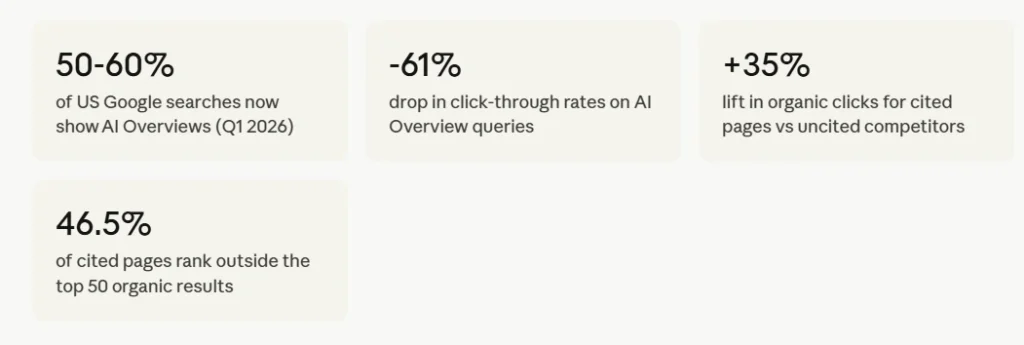
of cited pages rank outside the top 50 organic results
- Domain authority correlation with AI citations dropped to r=0.18. Small sites with structured, expert content can compete with enterprise sites.
- Industry trigger rates vary wildly: Education (83%), B2B technology (82%), health/wellness (70%+), e-commerce (4%), local search (7%).
Translation: if you’re in an informational, B2B, or expertise-driven space, AI Overviews are reshaping your traffic right now. If you’re in pure e-commerce or local services, the impact is smaller, but it’s coming.
There’s also a counterintuitive opportunity here. While AI Overviews reduce clicks for the average page, they dramatically increase quality of clicks for cited pages. Users who click after reading an AI summary have already understood the basic answer, they’re clicking specifically because they want depth from your source. Conversion rates on this traffic typically run 2-3x higher than cold organic.
The window to win is small. Most agencies and SMBs still have no AI SEO strategy. By the end of 2026, this space will be saturated. The teams shipping now will compound for years.
AI SEO vs Traditional SEO (What Actually Changed)
Traditional SEO isn’t dead. But four things fundamentally shifted, and pretending they didn’t will quietly kill your traffic over the next 12 months.
| Factor | Traditional SEO | AI SEO |
|---|---|---|
| Primary success metric | Top 10 ranking position | Citation in AI-generated answers |
| Content format | Comprehensive long-form articles | Structured, extractable passages |
| Keyword strategy | Head terms + supporting variations | Questions + conversational queries |
| Content depth signal | Word count + topical breadth | Semantic completeness + originality |
| Freshness importance | Moderate | Critical, AI prefers recent updates |
| Schema markup | Helpful for rich results | Essential for citation extraction |
| Backlink importance | Primary authority signal | Secondary to brand mentions |
| Author signals (E-E-A-T) | Important | Mission-critical |
What still works from traditional SEO
- Technical fundamentals (Core Web Vitals, crawlability, mobile)
- High-quality original content
- Earned backlinks from authoritative sites
- Internal linking structure
- Search intent matching
What no longer works
- Keyword stuffing or density obsession
- Mass-published AI content with no human editing (heavily penalized after the March 2026 Google core update)
- Ranking purely on domain authority without depth
- Generic “ultimate guide” content with no original data
- Ignoring AI surfaces beyond Google
The 4 Layers of AI Search You Must Optimize For
If you only think about Google, you’re optimizing for half the playing field. Here are the four AI search layers worth your attention in 2026, in order of traffic impact for most businesses.
Google AI Overviews (Gemini-powered)
AI Overviews are AI-generated summary boxes that appear at the top of Google search results, synthesizing information from 8-13 sources and citing them with linked references. They appear in 50-60% of US searches, and that percentage is climbing.
Unlike featured snippets, which pull a single block from one page, AI Overviews assemble answers from multiple pages. This means you don’t need to be the #1 result to be cited. You need to have the most extractable, trustworthy answer to the specific sub-question Google’s AI is trying to fill.
Google AI Mode
AI Mode is Google’s conversational interface, a fully chatbot-style experience that lets users ask multi-part questions and follow up with refinements. Google has called it “the future of search.”
The critical difference for SEO: AI Mode breaks complex queries into sub-questions, then synthesizes answers from across sources for each sub-question. This means a single piece of content can be cited multiple times within one conversation. Pages that cover topics with depth and clear sub-section structure get pulled into more answers.
ChatGPT Search & SearchGPT
ChatGPT now has more than 800 million weekly users, and a meaningful share of them use it for queries they used to send to Google. SearchGPT specifically pulls live web sources and cites them, turning ChatGPT into a search engine in its own right.
The citation logic is different from Google’s. ChatGPT favors:
- Reddit threads (heavily, OpenAI has a content partnership)
- Wikipedia
- Established industry publications
- Recent, well-structured content
- Brand mentions across the web
Perplexity, Claude, and other answer engines
Perplexity has built a smaller but high-intent user base, particularly among researchers, B2B buyers, and technical professionals. Claude is increasingly used inside enterprise workflows. Both cite sources directly, and both reward content with strong entity recognition and unique, primary-source data.
For B2B SaaS, professional services, and technical niches, optimizing for these surfaces often produces better ROI than chasing additional Google rankings, the users who arrive from AI chatbot citations convert at notably higher rates.
How AI Decides What to Cite (The 7 Ranking Factors)
This is where most guides hand-wave. Here are the actual factors, ranked by their measurable impact on AI citation rates.
Factor 1
Semantic Completeness (The #1 Factor)
Research from Princeton and Georgia Tech, formalized in the GEO framework, identifies semantic completeness as the strongest single predictor of AI citation. Their analysis of 15,847 AI Overview results found that content scoring 8.5/10+ on semantic completeness is 4.2x more likely to be cited. Every important paragraph should be a self-contained “information island” of roughly 134-167 words.
Factor 2
Extractable Structure
AI systems parse heading hierarchies, bullet lists, numbered steps, and tables far more easily than dense prose. Walls of text get skipped in favor of structured competitors. Use clear H2/H3 hierarchies that mirror the questions readers actually ask.
Factor 3
Brand Entity & Mentions
Multiple 2025-2026 studies have found that brand mentions across the web correlate more strongly with AI citation than traditional backlink signals. Every time your brand appears in a Reddit thread, a Substack newsletter, a podcast transcript, or an industry publication, you’re strengthening the entity signal AI systems rely on.
Factor 4
E-E-A-T Signals
Experience, Expertise, Authoritativeness, and Trustworthiness apply directly to AI citation decisions. The March 2026 core update specifically rewarded sites with strong E-E-A-T signals while penalizing scaled, generic AI content. Every important page should have a visible author byline, a detailed bio with credentials, and links to their external presence.
Factor 5
Schema Markup
Properly structured content with schema markup sees a 73% higher AI citation rate than unmarked content. The schemas that matter most for AI search are FAQ, HowTo, Article (with author Person markup), and Organization. Schema isn’t a nice-to-have anymore, it’s how you explicitly tell AI systems what’s on your page.
Factor 6
Multimodal Content
Pages combining text + images + video + structured data see 156% higher AI selection rates, and full multimodal integration with schema delivers up to 317% more citations. For “how to” queries especially, YouTube videos with VideoObject schema are often the primary cited source.
Factor 7
Freshness & Update Cadence
AI systems weight publication and last-updated dates heavily when evaluating sources. A piece published in 2024 loses to a competitor’s 2026 piece on the same topic, even if the older version is more thorough. Establish a 60-day refresh cycle for your top AI-targeted pages.
The 5-Step AI SEO Workflow (What to Do Every Week)
This is the operational core. If you do nothing else from this guide, run this workflow weekly.
Step 1, Question-first keyword research
Stop researching keywords. Start researching questions. Use this tool stack each week:
- AlsoAsked to map “People Also Ask” relationships for your seed topics
- AnswerThePublic for question-cluster discovery
- ChatGPT or Claude to generate 20-30 sub-questions a buyer in your niche would ask
- Google’s “People also ask” boxes (manual SERP scraping)
- Reddit search in your niche subreddits, these are the unfiltered questions real users actually ask
The 5-minute exercise: pick one head term you want to own. Generate 25 questions around it. Cluster them into 4-5 themes. Each theme becomes an H2 in your next piece.
Step 2, Content structuring for extraction
Three rules for every piece you publish:
- Question-mirror H2s. If the user types “how to rank in AI Overviews,” your H2 should literally be “How to Rank in AI Overviews,” not “Strategies for AI Visibility.”
- Answer first, explain second. The first 1-2 sentences under each H2 should fully answer the heading. Expand and add context after.
- 134-167 word information islands. Every paragraph that you want cited should hit this range and be self-contained.
Step 3, Schema implementation
Add these schemas to every important page:
- Article schema with author Person markup, for blog and guide content
- FAQPage schema, for any page with a Q&A section
- HowTo schema, for tutorials and step-by-step content
- Organization schema (site-wide), for entity recognition
Step 4, E-E-A-T layering
Three concrete actions per piece:
- Author bio with credentials at the top and bottom of every post, name, photo, role, credentials, LinkedIn link.
- Original data, even small. Three methods that work for SMBs: (a) survey 30 of your customers and publish the results, (b) audit 50 SERPs in your niche manually and publish the patterns, (c) document a real client case study with anonymized numbers.
- External authority citations, link to 3-5 reputable sources per piece (.gov, .edu, peer-reviewed, top industry pubs).
Step 5, AI visibility tracking
Traditional rank tracking doesn’t measure AI visibility. You need new tools:
- Profound, Peec.ai, or Otterly.ai for tracking citations across ChatGPT, Perplexity, and Google AI Overviews
- Google Search Console filtered for high-impression, low-CTR pages, these are often your AI Overview citations
- Manual SERP checks in Incognito for your top 20 priority queries, screenshot weekly and document changes
How to Optimize for Google AI Overviews Specifically
The 134-167 word passage rule
AI Overviews extract passages, not pages. Analysis of citation patterns shows the typical extracted block runs 134-167 words, long enough to contain context and evidence, short enough to be self-contained. Include the question’s answer in the first sentence, then evidence and detail in the following 4-6 sentences.
Question-mirror headings
AI systems heavily weight headings that closely match the user’s query. If users search “how to add schema markup to WordPress,” your H2 should be “How to Add Schema Markup to WordPress,” not “Schema Markup Implementation Guide.” Audit your existing top pages and rewrite at least 3 H2s on each to mirror real queries from People Also Ask boxes.
FAQ schema for AI Overviews
Pages with FAQPage schema see substantially higher citation rates because AI systems can extract Q&A pairs cleanly. Add an FAQ section to every important page with 5-8 questions pulled directly from People Also Ask. Apply FAQPage schema to it. Verify in Google’s Rich Results Test.
How to Rank in ChatGPT, Perplexity & Claude
This is the layer almost no competing guide covers properly. With 800M+ weekly ChatGPT users, ignoring AI chatbot visibility means leaving a fast-growing audience completely off the table.
Why LLMs cite different sources than Google
Google’s AI Overviews lean heavily on existing search rankings, pages cited tend to (but don’t always) rank in the top 10 organically. ChatGPT and Perplexity have different retrieval mechanisms. They pull from training data, partner content (Reddit, AP, certain publishers), and live web search results in different ratios.
The practical result: a page that ranks #25 on Google can be the #1 cited source on ChatGPT for the same query, if it has stronger structural and entity signals.
The Reddit & Wikipedia citation effect
OpenAI has a content partnership with Reddit. Reddit threads now appear as cited sources in ChatGPT outputs at disproportionately high rates. Wikipedia is the other heavily-cited source.
Practical implications:
- Build a real presence in 2-3 niche subreddits relevant to your business. Comment helpfully, get upvoted, occasionally link back to your content where genuinely useful.
- If your brand has a credible Wikipedia entry, AI systems treat your name as a verified entity, citation rates rise substantially.
- Get quoted in Reddit threads where your expertise is relevant. AMAs, expert roundups, and industry discussions all build citation surface.
Building brand mentions that AI notices
The single most effective long-term tactic for AI chatbot visibility is distributed brand mentions across high-trust sources. This isn’t link building, it’s mention building. Target sources:
- Industry publications (guest posts, expert quotes via HARO/Connectively/Qwoted)
- Podcast appearances (transcripts get indexed and cited)
- Substack newsletters in your niche
- Course content and educational platforms
- Wikipedia (for established brands only, don’t try to game this)
- LinkedIn long-form posts that get reshared
Aim for 5-10 quality brand mentions per month across these sources. Within 6 months, AI citation rates compound.
Tracking your AI chatbot visibility
- Profound, comprehensive AI visibility platform across ChatGPT, Perplexity, Gemini
- Peec.ai, focused on share-of-voice tracking in AI responses
- Otterly.ai, affordable option for SMBs
Run the same 20-30 priority queries through ChatGPT, Perplexity, and Claude weekly. Document which sources get cited. Patterns emerge fast.
Schema Markup Templates You Can Copy-Paste
Schema is the most underutilized AI SEO lever. Here are four ready-to-use JSON-LD templates. Drop these into the <head> of the relevant pages, replace the bracketed placeholders, and verify with Google’s Rich Results Test.
FAQPage Schema
| <script type=”application/ld+json”>{ “@context”: “https://schema.org”, “@type”: “FAQPage”, “mainEntity”: [{ “@type”: “Question”, “name”: “What is AI SEO?”, “acceptedAnswer”: { “@type”: “Answer”, “text”: “AI SEO is the practice of optimizing content so that AI-powered search systems including Google AI Overviews, ChatGPT, and Perplexity discover, extract, and cite your pages when answering user questions.” } },{ “@type”: “Question”, “name”: “Is AI SEO different from traditional SEO?”, “acceptedAnswer”: { “@type”: “Answer”, “text”: “AI SEO builds on traditional SEO fundamentals but emphasizes content extractability, semantic completeness, brand mentions, and schema markup over pure backlink and keyword signals.” } }]}</script> |
HowTo Schema
| <script type=”application/ld+json”>{ “@context”: “https://schema.org”, “@type”: “HowTo”, “name”: “How to Implement AI SEO in 30 Days”, “step”: [{ “@type”: “HowToStep”, “name”: “Audit Existing Content”, “text”: “Identify top 10 pages by organic traffic and audit them for question-mirror headings, FAQ sections, and schema markup.” },{ “@type”: “HowToStep”, “name”: “Add Schema Markup”, “text”: “Implement Article, FAQPage, and HowTo schema on priority pages and verify with Google Rich Results Test.” },{ “@type”: “HowToStep”, “name”: “Restructure for Extraction”, “text”: “Rewrite top H2s to mirror user queries and add 134-167 word answer blocks at the top of each important section.” }]}</script> |
Article Schema with Author
| <script type=”application/ld+json”>{ “@context”: “https://schema.org”, “@type”: “Article”, “headline”: “[Your Article Title]”, “datePublished”: “2026-04-27”, “dateModified”: “2026-04-27”, “author”: { “@type”: “Person”, “name”: “[Author Name]”, “url”: “[Author profile URL]”, “jobTitle”: “[Author Role]”, “sameAs”: [ “[LinkedIn URL]”, “[Twitter URL]” ] }, “publisher”: { “@type”: “Organization”, “name”: “Leemjaz”, “logo”: { “@type”: “ImageObject”, “url”: “https://leemjaz.com/logo.png” } }}</script> |
Organization Schema (Site-Wide)
| <script type=”application/ld+json”>{ “@context”: “https://schema.org”, “@type”: “Organization”, “name”: “Leemjaz”, “url”: “https://leemjaz.com”, “logo”: “https://leemjaz.com/logo.png”, “description”: “Digital marketing agency specializing in SEO, social media, email, and AI-powered marketing for businesses in the US, UK, and Canada.”, “sameAs”: [ “[LinkedIn URL]”, “[Twitter URL]”, “[Facebook URL]” ]}</script> |
The fastest implementation method: install a schema management plugin like RankMath or Schema Pro on WordPress, or add via Google Tag Manager for non-WordPress sites. Verify everything in the Rich Results Test before publishing.
Best AI SEO Tools in 2026 (Categorized)
There are hundreds of “AI SEO tools”, most are noise. Here are the ones that consistently produce results, organized by what they actually do.
AI content optimization
- Surfer AI, generates briefs and full drafts optimized for SERP patterns. Best for teams scaling content production with on-page optimization built in.
- Frase, strong for question discovery, content briefs, and AI Overview tracking. Good middle ground for small teams.
- Clearscope, premium content optimization with the cleanest scoring system. Worth the price for high-stakes pillar content.
AI visibility tracking
- Profound, the most comprehensive platform for tracking AI citations across ChatGPT, Perplexity, Gemini, and Google AI Overviews. Best for agencies and serious in-house teams.
- Peec.ai, focused on AI share-of-voice metrics. Strong for benchmarking against competitors.
- Otterly.ai, affordable AI visibility tracking for SMBs. Good entry point.
Question discovery
- AlsoAsked, maps “People Also Ask” relationships visually. Essential for building question-cluster content.
- AnswerThePublic, long-tail question discovery. Best for the brainstorm phase.
- AlsoAI, newer entrant focused specifically on AI-search-relevant question patterns.
General-purpose AI for SEO
- ChatGPT (GPT-4 / GPT-5), content briefs, FAQ generation, schema generation, internal linking suggestions.
- Claude, strong for long-form content drafting and editing with a more natural voice.
- Gemini, useful specifically for understanding what Google’s own AI is likely to favor.
The honest answer on tool stacks: most teams overbuy. Start with one content optimization tool + one visibility tracker + ChatGPT. Add more only when you’ve outgrown the basics.
How to Use ChatGPT in Your SEO Workflow (10 Real Prompts)
Prompt quality determines output quality. Here are 10 prompts we use in actual client work, copy them, adapt them, and they’ll save you hours per week, especially if you’re learning how to make a ChatGPT undetectable.
01 Keyword cluster generation
Act as a senior SEO strategist. For the seed keyword “[your topic],” generate 5 keyword clusters. For each cluster, list: 1 head term, 5 supporting long-tail keywords (in question form where possible), and the buyer-funnel stage (TOFU/MOFU/BOFU). Output as a markdown table.
02 Content brief creation
Create a comprehensive content brief for an article targeting the keyword “[your keyword]”. Include: target word count, recommended H1, 8-10 H2 sections with brief descriptions, primary search intent, 3 competitor pages to study, and 5 questions from People Also Ask to address.
03 Meta title and description generation
Generate 5 SEO-optimized meta title and meta description pairs for an article about [topic]. Title must be under 60 characters and include the primary keyword “[keyword]”. Description must be 140-155 characters and include a benefit-driven CTA. Format as a numbered list.
04 FAQ generation from a target keyword
Generate 8 frequently asked questions about “[your topic]” that real users would search. For each, write a 50-80 word answer that fully addresses the question in the first sentence. Use a clear, authoritative tone. Format the output as ready-to-use FAQPage schema JSON-LD.
05 Internal linking suggestions
Here is a list of my published articles: [paste URLs and titles]. I’m publishing a new piece titled “[new article title]” covering [brief description]. Recommend 8 internal links: 4 outbound from the new piece to existing content, and 4 inbound from existing content to the new piece. Suggest descriptive anchor text for each.
06 SERP intent analysis
For the keyword “[keyword]”, analyze the dominant search intent. Categorize the likely top 10 pages as: informational, commercial-investigation, transactional, or navigational. Identify what content format dominates (listicle, ultimate guide, comparison, tutorial, tool page). Recommend the optimal format for a new piece targeting this query.
07 Schema markup generation
Generate ready-to-use JSON-LD schema markup for the following page: [paste page details, type of content, author info, publish date, FAQ if applicable]. Include Article schema with author Person markup, FAQPage schema if relevant, and BreadcrumbList. Output the complete code in a code block.
08 Content gap analysis vs competitors
I’m targeting the keyword “[keyword]”. Here are the top 5 ranking pages: [paste URLs or summarize their H2s]. Identify: (1) topics every competitor covers (table stakes), (2) gaps no one covers (differentiation opportunities), (3) format choices (which competitors use videos, tables, original data). Recommend my unique angle.
09 AI Overview answer block generation
Write a 134-167 word answer block for the question “[your target question]” optimized for Google AI Overview citation. Lead with a direct, complete answer in the first sentence. Follow with 4-6 supporting sentences containing context, evidence, and one specific data point. Tone: authoritative, direct, no fluff.
10 Content refresh prompt
I’m refreshing this article: [paste article]. The article is from [original publish date] and currently ranks position [X] for “[keyword]”. Recommend: (1) sections to update with 2026 data, (2) new H2s to add for completeness, (3) outdated claims to remove or rewrite, (4) new internal links to add. Prioritize changes by impact.
Adapt the bracketed placeholders to your specifics. Save these in a personal prompt library, you’ll use them constantly.
AI SEO Mistakes That Will Get You Penalized
The March 2026 Google core update specifically targeted scaled, low-quality AI content. Sites that ignored these principles saw 40-80% traffic drops. Don’t repeat them.
Mistake 1
Mass-publishing AI content without editing. Generating 50 articles a week with ChatGPT and publishing them raw is the fastest way to get hit. Google’s quality systems now actively detect this pattern. Volume without quality control is a penalty waiting to happen.
Mistake 2
Skipping the human review layer. Even good AI drafts contain hallucinated stats, broken claims, and logic errors. Every AI-assisted piece needs a human editor who fact-checks claims, verifies links, and adjusts tone.
Mistake 3
Optimizing only for Google, ignoring ChatGPT. If your strategy doesn’t include AI chatbot visibility tracking and brand-mention building, you’re optimizing for an increasingly smaller share of total search traffic.
Mistake 4
Generic content with no original data. AI systems heavily favor sources that contribute new information to the web. Pure synthesis content increasingly fails to get cited. Original data, even small (a 30-person survey, a 50-SERP audit, a real case study) dramatically increases citation rates.
Mistake 5
No author E-E-A-T signals. Anonymous content increasingly fails to rank or get cited. Every important page needs a visible author with credentials, a photo, a detailed bio, and external authority signals. This is non-negotiable in 2026.
Your First 30 Days (Implementation Calendar)
Here’s exactly what to do in the next 30 days, in order. Run this and you’ll have a defensible AI SEO foundation.
Week 1
Audit + Foundational Fixes
- Identify your top 10 pages by organic traffic
- Audit each for: question-mirror H1, 134-167 word answer block at top, FAQ section, last-updated date, author bio
- Run all 10 through Google’s Rich Results Test
- Document baseline metrics (rankings, traffic, AI Overview appearances)
- Set up free accounts on AlsoAsked and a basic AI visibility tracker
Week 2
Schema + Content Restructuring
- Implement Article, FAQPage, and Organization schema on top 10 pages
- Rewrite top H2s on 5 priority pages to mirror real queries
- Add 134-167 word answer blocks at the top of each priority page
- Add full author bios (top + bottom) on every important post
- Update “last modified” dates in both UI and schema
Week 3
AI Overview Targeting on 5 Priority Pages
- Pick 5 highest-opportunity pages (ranking 5-15, AI Overviews triggering)
- Add an FAQ section with 6-8 questions per page (pull from People Also Ask)
- Apply FAQPage schema and verify
- Add 2-3 multimodal elements per page (original image, video, or data table)
- Cite 3-5 external authority sources per page
Week 4
Tracking Setup + Measure Baseline
- Set up systematic AI visibility tracking (Profound, Peec.ai, or Otterly.ai)
- Run your top 30 priority queries through ChatGPT, Perplexity, and Google manually
- Document baseline citation rates
- Set up a weekly 30-minute review block on your calendar
- Create a content refresh schedule (60-day cycle for top performers)
Is AI Replacing SEO?
No, but it’s fundamentally changing what “ranking” means.
Traditional blue-link rankings still exist and still drive significant traffic. What’s changed is that ranking #1 organically no longer guarantees the click. AI Overviews, ChatGPT, and Perplexity now sit between users and your content, synthesizing answers before users ever see your link.
The discipline of SEO isn’t disappearing. It’s expanding. Modern SEO includes traditional ranking, AI Overview citation, AI chatbot visibility, brand entity building, and structured-data optimization, all at once. Teams that adapt to this expanded definition will dominate. Teams that keep optimizing for blue links alone will quietly bleed traffic for years.
Frequently Asked Questions
What is AI SEO in simple terms?
AI SEO is the practice of optimizing your content so that AI-powered search systems like Google AI Overviews, ChatGPT, Perplexity, and Claude discover, extract, and cite your pages when answering user questions. It builds on traditional SEO but emphasizes content structure, brand mentions, and schema markup over pure keyword and backlink signals.
Is AI SEO different from traditional SEO?
Yes, but it’s an extension rather than a replacement. Traditional SEO targets blue-link rankings on Google. AI SEO additionally targets citation in AI-generated answers across multiple platforms. The technical fundamentals overlap heavily, but content structure, freshness, and brand entity signals carry far more weight in AI SEO.
How do I rank in Google AI Overviews?
Rank in AI Overviews by: (1) writing question-mirror headings that match real search queries, (2) including 134-167 word answer blocks at the top of important sections, (3) implementing FAQPage and Article schema markup, (4) demonstrating clear E-E-A-T signals through author bios and credentials, and (5) keeping content updated with current statistics and a recent “last modified” date. Notably, you don’t need to rank in the top 10 organically, 46.5% of cited pages rank below position 50.
Will AI replace SEO?
No. AI is changing how SEO works, not eliminating it. The fundamentals, quality content, technical health, authority, still matter. What’s changed is the additional surfaces (AI Overviews, ChatGPT, Perplexity) that now require optimization, and the increased weight of structural signals like schema markup, semantic completeness, and brand mentions.
What’s the best AI tool for SEO?
There’s no single best tool. For most teams, the right starter stack is: one content optimization tool (Surfer AI, Frase, or Clearscope), one AI visibility tracker (Profound, Peec.ai, or Otterly.ai), and ChatGPT or Claude for general-purpose SEO tasks. Add specialized tools only as you outgrow the basics.
How do I optimize my content for ChatGPT search?
Optimize for ChatGPT by: building brand mentions across high-trust sources (Reddit, Wikipedia, industry publications), using clear extractable content structure, ensuring your brand has a consistent entity footprint across the web, and getting cited in podcasts, newsletters, and expert roundups. ChatGPT favors well-structured, recently updated, mention-rich sources, often different from what Google ranks highest.
Does Google penalize AI-generated content?
Google penalizes low-quality content regardless of how it’s produced. AI-assisted content with proper human editing, original insights, and clear E-E-A-T signals performs well. The March 2026 core update specifically penalized mass-produced AI content with no editorial layer. The rule: AI as draft tool, yes. AI as final publisher with no human review, no.
How long does AI SEO take to show results?
Most teams see meaningful AI Overview citations within 60-90 days of implementing the workflow in this guide. Significant traffic gains compound over 4-6 months. ChatGPT and Perplexity visibility takes longer (6-9 months typically) because brand mention building is slower. Quick wins are possible, a single well-structured FAQ section can earn AI Overview citations within weeks.
Conclusion
AI SEO in 2026 isn’t a tactical adjustment. It’s a structural expansion of what search optimization means. The teams winning right now aren’t using more tools or chasing more keywords, they’re shipping content with cleaner structure, stronger E-E-A-T, and better extractability than their competitors.
The three things that matter most: write content that AI systems can extract cleanly, build brand mentions that AI systems trust, and ship a real workflow weekly instead of chasing every algorithm update.
The window to win this is small. Most agencies and SMBs still don’t have an AI SEO strategy. By the end of 2026, this space will look completely different.
Ready to implement? If you want help implementing this end-to-end, our team builds AI SEO systems for businesses ready to compound traffic and leads. Talk to our SEO team about AI SEO services for your business.