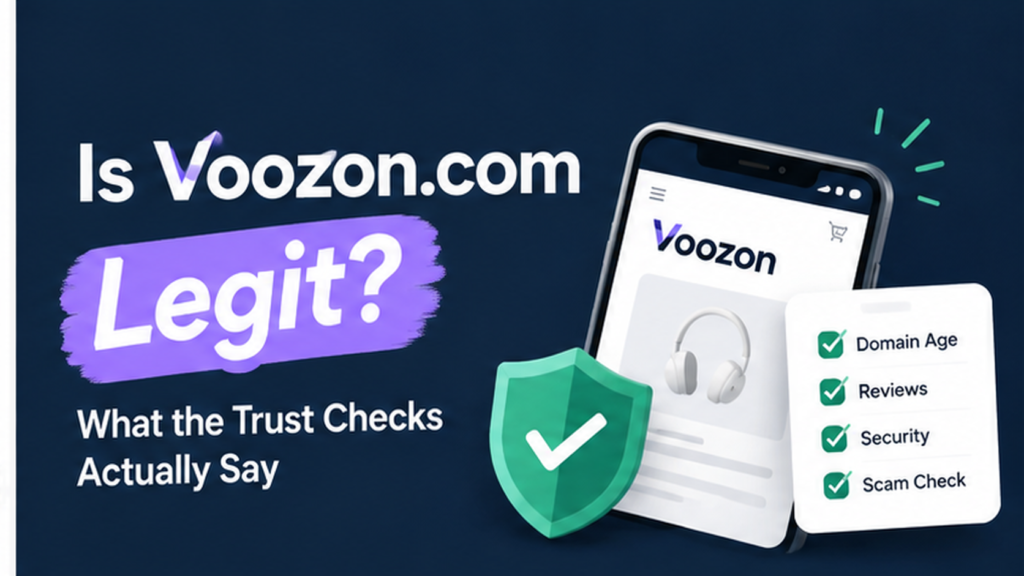
Ask whether Voozon.com is legit and you get three different answers, depending on which service you ask. ScamAdviser calls it very likely safe. Gridinsoft scores it 79 out of 100. The Scam Detector flags it as suspicious.
They cannot all be right, and understanding why they disagree tells you more than any single score.
This guide separates the four different questions hiding inside the word “legit,” reports what each checker actually found, and explains which answer matters for your situation. We are an SEO agency with no affiliate or reseller relationship with Voozon.com.
Is Voozon.com Legit? The Short Answer
Is it a scam? No. Nothing in the public record indicates fraud, and the site delivers what it describes.
Is it safe to visit? Yes, with ordinary caution. Valid SSL, HTTPS throughout, and a clean Google Safe Browsing record.
Is it a transparent business? No. Ownership is hidden, pricing is unpublished, editorial guidelines do not exist publicly, and the contact email does not run on its own domain.
Is it legitimate for SEO purposes? That is the expensive question, and the answer is different again. It sits further down this page.
Why “Legit” Means Four Different Things Here
People searching this phrase want one of four answers, and the confusion comes from treating them as one question.
Will I lose money? A fraud question. Relevant if you are about to pay for a guest post placement.
Will my device get infected? A security question. Answered by malware and phishing scans.
Is there a real company behind this? A transparency question. Answered by ownership records and published terms.
Will this actually work for what I want? An effectiveness question. Automated trust scores do not measure this at all, and for anyone buying a backlink it is the only question that matters.
A site can pass the first three and fail the fourth completely. That is roughly where Voozon.com sits, which is why asking whether Voozon.com is legit produces such inconsistent answers.
What the Trust Checkers Found
| Service | Verdict | What it cited |
| ScamAdviser | Very likely safe | Valid SSL certificate, domain established years ago, DNSFilter labels it safe |
| Gridinsoft | 79 out of 100 | No major malware or phishing detections, domain age of 18.6 years, strong independent trust signals |
| Scam Detector | Suspicious, low score | Risk factors related to spam, blacklisting, and proximity to suspicious websites |
The caveat buried inside the positive verdict. ScamAdviser states that it reduced the site’s score because the registrar is also used by many websites with low to very low review scores. Its own wording acknowledges this may be bad luck, but the reduction stands. Pages reporting “very likely safe” without that qualifier are quoting half the finding.
Other confirmed signals. The domain was registered on 16 January 2008 with registration extending to 2034. It runs HTTPS throughout. One audit found a clean Google Safe Browsing record. Tranco rank is low, indicating modest traffic.
Why Automated Trust Scores Disagree
Worth understanding, because it applies to every site you ever check this way.
They measure different things. ScamAdviser and Gridinsoft weight infrastructure heavily: SSL validity, domain age, registration length, and malware detections. Scam Detector weights behavioural and network signals: blacklist appearances, spam patterns, and what other sites share the same neighbourhood.
A site can genuinely score well on one and badly on the other. Old domain, valid certificate, no malware, and simultaneously sitting on infrastructure shared with low-quality sites while publishing patterns that trigger spam heuristics. Both readings are accurate. They are describing different layers.
What none of them measure. Whether the content is accurate. Whether anyone reads it. Whether a link from it helps you. Whether the business behind it is accountable. Automated tools answer “will this hurt my computer,” not “is this worth my money.”
The practical rule. Treat a high trust score as evidence of technical safety and nothing more. Treat a low one as a prompt to look harder rather than a verdict. And never let either substitute for checking what the site actually does.
Is Voozon.com Legit as a Business? The Transparency Gaps
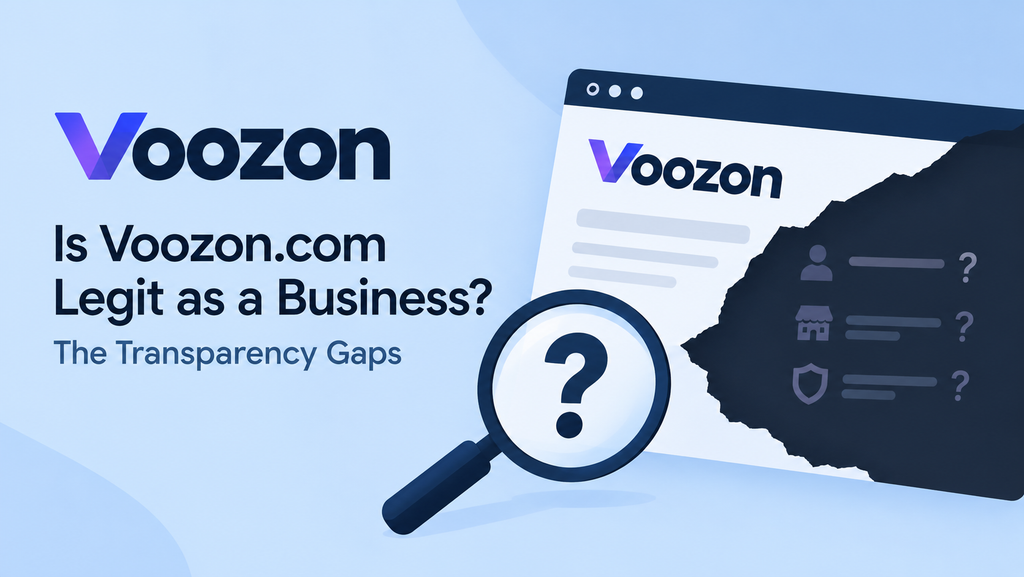
Four absences, significant together rather than individually.
Ownership is hidden. WHOIS records do not identify the owner, which is common and legal. It also means nobody is publicly accountable for what gets published.
The contact email does not use the site’s own domain. A business operating at scale from its own domain generally has email on that domain. This detail appears in independent analysis and is worth noting.
No editorial guidelines are published. No submission standards, no rejection criteria, no named editors. Nothing indicates a filter on what appears.
No pricing is published. Guest post costs circulate through resellers rather than a public rate card, which means two buyers can pay very different amounts for the same placement.
On the domain age argument. You will see the 2008 registration cited as proof of credibility. Google has stated repeatedly that domain age is not a ranking factor, and a registration date well before the content history usually indicates a domain acquired rather than a publication built. Age tells you when someone bought an address, not whether anyone reads it.
Is Voozon.com Safe to Visit?
Yes, for ordinary reading.
Valid SSL, HTTPS throughout, no malware or phishing detections across multiple scans, and a clean Google Safe Browsing record. Opening the site and reading an article carries no identified risk.
Two sensible precautions anyway.
The site publishes contributed content containing external links the operator did not vet. Treat outbound links as unverified, and never enter credentials or payment details on a page you reached through one.
Check the exact address you are on. Several similarly named domains exist, including voozon.us and thevoozons.com, with at least one stating plainly that it is not official. Read the address bar character by character before entering anything.
One distinction worth holding onto. Safe to open is not the same as accurate. No editorial team, author credentials, or fact-checking process is publicly disclosed, so verify anything consequential against a primary source.
Is Voozon.com Legit for SEO?
This is where the answer changes, and it is the question most people searching the term actually have.
The site is legitimate in the sense that it does what it advertises. It accepts guest posts, publishes them, and includes the links. Nobody takes your money and disappears.
The link is a different matter. Voozon.com advertises backlinks in its own homepage metadata, describing itself as a platform where you can publish articles and get high-quality backlinks instantly. A link acquired instantly, on request, in exchange for payment is not editorially earned, and Google’s link spam policies cover exactly that category: paid links, links exchanged for goods or services, and excessive guest posting with keyword-rich anchor text.
What typically happens. Google neutralises the link. It stays visible in your backlink tool, appears in your reporting, and passes no value. The transaction was legitimate. The outcome was nothing.
Two further problems. The site spans fifteen or more unrelated categories, which means it sends no coherent topical signal in any direction. And independent analysis found its traffic concentrates on the homepage rather than article pages, so a guest post sits somewhere very few people reach.
Our fuller Voozon.com review covers the traffic finding, the reseller pricing, and what the placement is actually worth in detail.
So the honest answer to the SEO question. Legitimate as a transaction, weak as an investment. It is a brand mention on an indexed page. Treat it as that and nothing more. If you are weighing guest post placements more broadly, our breakdown of off-page SEO services covers what earned links cost and why they outlast purchased ones.
Is Voozon.com Legit, or Are You Looking for the Voozon App?
Separate products, frequently confused.
A social networking app named Voozon exists on Google Play, published under a different name, offering a feed, messaging, and content sharing. Independent reviews state that no verified relationship between the app and voozon.com has been established.
If you are trying to install an app, the website is not related. If you are evaluating a publishing platform, the app is irrelevant.
How to Check Any Website Yourself
Six steps, applicable to anything unfamiliar, and more reliable than a single trust score.
One: run two checkers, not one. When they disagree, read what each one cited rather than averaging the numbers.
Two: check WHOIS for ownership. Hidden ownership is legal and common. It still means nobody is publicly accountable.
Three: look at the contact email domain. A business email on the site’s own domain indicates permanence. A free-mail or off-domain address indicates something smaller or less established.
Four: look for named people. No masthead means nobody takes responsibility for content.
Five: check whether it ranks for anything but its own name. A site whose visibility comes entirely from brand searches has no topical audience. Any free rank checker answers this quickly, and our guide to the best free SEO tools for beginners covers which ones show it without a subscription.
Six: read the outbound links in a few articles. Commercial links to unrelated businesses throughout informational content tells you what the site is for.
Is Voozon.com Legit FAQs
Is Voozon.com legit?
It is a real, active website that publishes content and genuinely accepts guest posts, so it is not a scam. Reputation services disagree on its trust level: ScamAdviser calls it very likely safe, Gridinsoft scores it 79 out of 100, and Scam Detector flags it as suspicious. The word legit means different things here, and the answer depends which one you mean.
Is Voozon.com safe to visit?
Yes, with ordinary caution. It runs HTTPS with a valid SSL certificate, multiple scans found no malware or phishing, and one audit found a clean Google Safe Browsing record. Treat outbound links in contributed articles as unverified, and never enter credentials or payment details on pages reached through them.
Why do trust scores for Voozon.com disagree?
Because they measure different things. ScamAdviser and Gridinsoft weight infrastructure signals such as SSL validity, domain age, and malware detections. Scam Detector weights behavioural signals including blacklist appearances, spam patterns, and neighbouring sites. Both readings can be accurate at once.
Who owns Voozon.com?
Ownership is not publicly disclosed. WHOIS records hide the registrant, and the contact page uses an email address that does not run on the voozon.com domain. The site publishes no named editors, no company details, and no editorial guidelines.
Is Voozon.com a scam?
Nothing in the public record indicates fraud. The site is live, publishes content, and delivers the guest post placements it advertises. The valid criticisms concern transparency and SEO value rather than dishonesty.
Is a link from Voozon.com safe for my site?
It is unlikely to help and carries some risk. The site advertises instant backlinks, which Google’s link spam policies cover directly, so such links usually pass no value. The fifteen-category spread removes any relevance signal. Treat it as a brand mention rather than an authority link.
Conclusion
Asking whether Voozon.com is legit produces a clearer answer once you separate the questions. It is not a scam, it is safe to read, it is not a transparent business, and it is a weak investment for SEO. The most useful thing here is not the verdict on one site. It is that automated trust scores measure technical safety rather than whether something is worth your money. A green badge tells you a certificate is valid. It tells you nothing about whether anyone reads the articles you are about to pay to appear in.