Organic search engine optimization services help businesses improve their visibility in unpaid search results, attract relevant website visitors, and turn search demand into qualified leads and sales. Instead of paying for every click, businesses invest in their website, content, technical performance, and online authority to build sustainable organic growth.
However, not every SEO campaign delivers the same value. Some focus on rankings without considering conversions, while others publish content without fixing the technical problems that prevent search engines from discovering it.
The right organic SEO strategy connects keyword research, technical improvements, useful content, and authority building with clear business objectives. This guide explains what these services include, how they work, what affects their cost, and how to choose a provider that fits your goals.
What Are Organic Search Engine Optimization ?
Organic search engine optimization services improve a website’s ability to appear in unpaid search engine results for relevant queries. SEO professionals analyze how people search, identify opportunities to improve website pages, resolve technical issues, and create content that answers users’ questions.
Unlike paid search advertising, organic SEO does not require businesses to pay for each click generated by an organic listing. However, SEO still requires investment in expertise, content, development, research, and ongoing optimization.
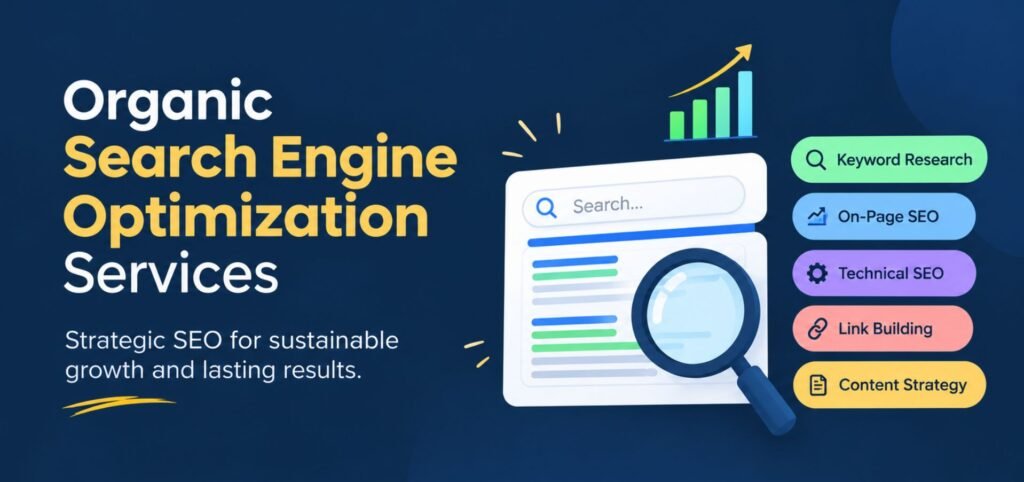
A comprehensive organic SEO campaign typically covers five areas:
- Keyword research: Identify relevant search terms, user intent, and realistic ranking opportunities.
- Technical SEO: Help search engines crawl, render, and index important pages.
- On-page SEO: Improve titles, headings, internal links, page structure, and content relevance.
- Content optimization: Create or improve pages that answer genuine customer questions.
- Authority building: Earn relevant backlinks and strengthen the website’s credibility through useful resources and legitimate outreach.
These activities work together. Strong content cannot reach its full potential if search engines cannot access the page, and technically sound pages may struggle to attract customers if they do not address the right search intent.
What Do Organic SEO Services Include?
A useful SEO engagement should explain what the provider will do, why each activity matters, and how the team will measure progress.
1. Keyword Research and Search Intent Analysis
Keyword research identifies the phrases your potential customers use when searching for products, services, solutions, and information.
An effective process goes beyond search volume. It evaluates search intent, competition, relevance to your offerings, and the likelihood that a visitor will become a customer.
For example, someone searching for “what is technical SEO” probably wants an explanation. Someone searching for “technical SEO services for ecommerce” may be evaluating service providers.
Your keyword strategy should account for both.
A professional SEO team typically. For a broader overview of what a provider may deliver, see Leemjaz’s search engine optimization services guide.
- Groups related keywords into relevant topic clusters.
- Maps primary and secondary keywords to appropriate pages.
- Identifies gaps in existing content.
- Evaluates competitors’ ranking pages and content coverage.
- Prioritizes opportunities based on business value and ranking feasibility.
This process helps prevent keyword cannibalization, where multiple pages compete for similar search queries without serving distinct purposes.
2. Technical SEO and Website Audits
Technical SEO helps search engines discover, understand, and index your website. It also helps users navigate pages and access content without unnecessary friction.
A technical SEO audit may examine:
- Crawlability and indexability.
- Robots.txt rules and XML sitemaps.
- Canonical tags and duplicate URLs.
- Broken internal links and redirect chains.
- Mobile usability and page performance.
- JavaScript rendering and access to important content.
- Structured data implementation.
- Core Web Vitals and other page experience issues.
Not every website needs every technical fix. A small service website may need help resolving indexing problems and improving its site architecture, while a large ecommerce store may require more extensive work on faceted navigation, duplicate product URLs, and crawl efficiency.
The priority should always be to resolve issues that affect important pages, search visibility, and the user experience.
3. On-Page SEO Optimization
On-page SEO helps search engines and visitors understand what each page offers.
An SEO specialist reviews important pages and improves their structure, relevance, and clarity without sacrificing readability.
Typical activities include:
- Writing descriptive SEO titles and meta descriptions.
- Organizing content with clear H1, H2, and H3 headings.
- Using target and related keywords naturally.
- Improving introductory paragraphs and content depth.
- Adding relevant internal links with descriptive anchor text.
- Optimizing image filenames, dimensions, and alt text.
- Strengthening calls to action and page navigation.
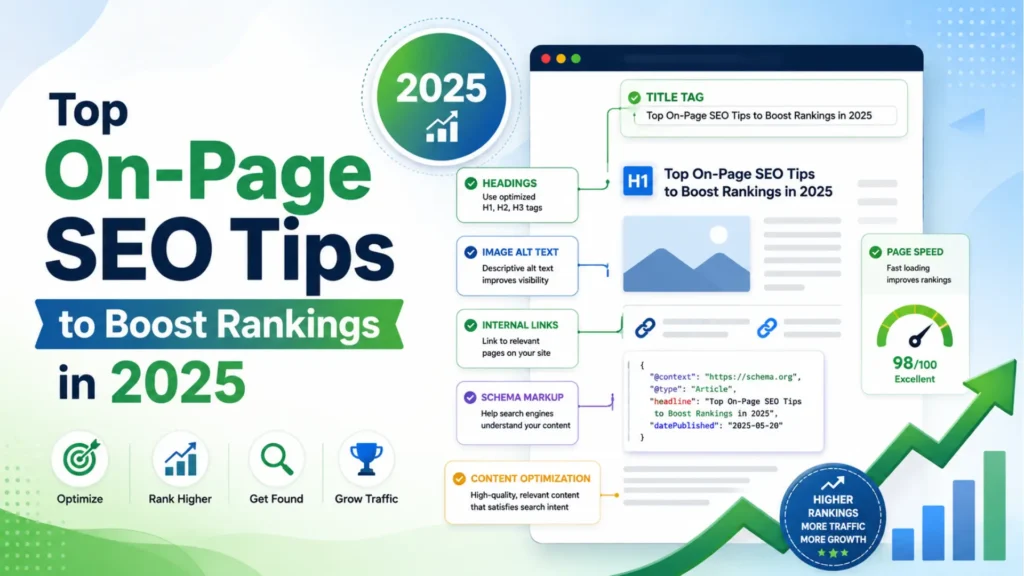
For example, a page targeting organic search optimization services should explain the service, its deliverables, the problems it solves, and the outcomes customers can reasonably expect. For more practical advice, review these on-page SEO tips from Leemjaz.
Simply inserting a keyword into every heading will not create a useful page. Each heading should introduce a distinct question, decision, or topic that matters to the reader.
4. Content Strategy and Content Optimization
Content SEO helps a website meet the needs of people at different stages of the buying journey.
Some visitors need educational articles. Others want to compare providers, understand pricing, evaluate a product, or contact a service business.
A content strategy should connect these needs rather than publish articles solely to increase website traffic.
An SEO content program may include:
- Service pages targeting commercial keywords.
- Educational blog posts answering customer questions.
- Comparison pages helping users evaluate alternatives.
- Case studies demonstrating verified results.
- Industry-specific landing pages where genuine differences justify them.
- Content updates that improve accuracy, usefulness, and search intent alignment.
Content optimization also involves reviewing existing URLs before publishing new pages. A page that already receives impressions may benefit more from improved coverage, stronger internal links, or a clearer value proposition than an entirely new article.
The objective is to build a useful library of content that supports discovery, evaluation, and conversion.
5. Link Building and Website Authority
Link building aims to earn backlinks from relevant websites that can help people discover your content and provide useful context about your business.
A responsible strategy focuses on relevance, editorial value, and genuine relationships rather than simply accumulating links.
Common activities include:
- Creating original resources that other websites may reference.
- Conducting relevant publisher outreach.
- Contributing useful expert commentary.
- Earning editorial mentions and citations.
- Recovering legitimate unlinked brand mentions.
- Analyzing competitor backlink profiles for realistic opportunities.
Evaluate links based on their relevance, editorial standards, placement, and potential to reach an appropriate audience. A large number of unrelated backlinks does not automatically create a stronger website.
Avoid providers that promise guaranteed rankings through bulk links, private link networks, or manipulative link schemes. Such tactics can create unnecessary risk. You can also read Leemjaz’s guide to off-page SEO services and responsible link building.
6. Local SEO and Business Visibility
Local SEO helps businesses reach customers searching for services in a particular city, region, or service area.
Depending on your business model, local SEO services may include Google Business Profile optimization, local landing pages, accurate business information, review management guidance, and relevant local citations.
A business that serves several locations should create useful location pages only when it can provide meaningful information about each area. Publishing dozens of nearly identical city pages adds little value to customers.
Local SEO is especially useful for service businesses that depend on geographic demand, including contractors, clinics, professional firms, and local agencies.
How Organic SEO Services Generate Business Growth
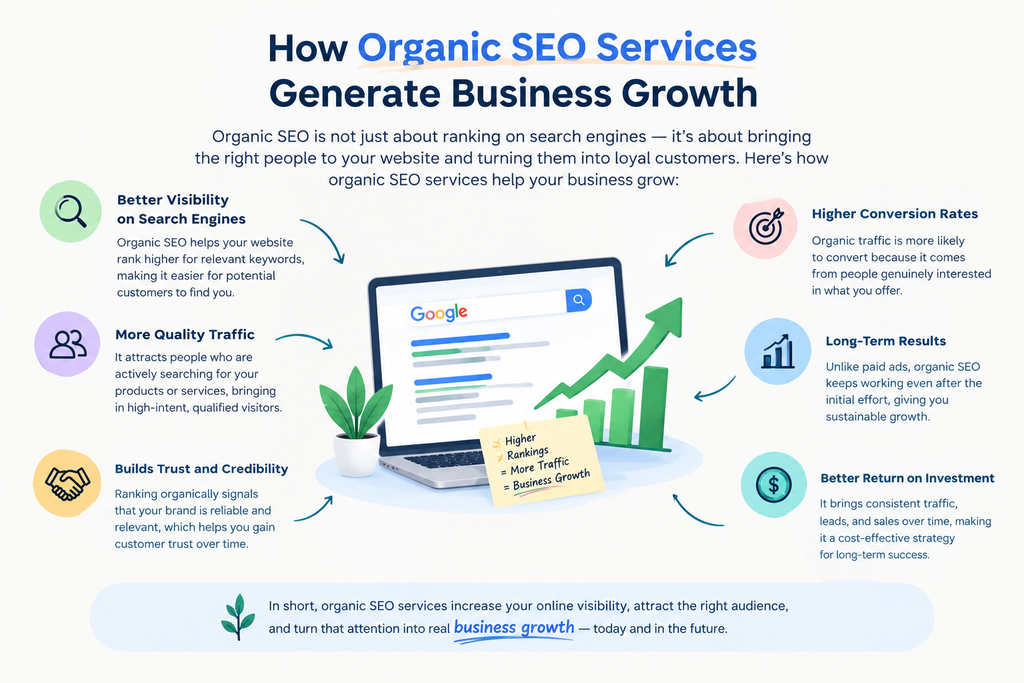
Organic search growth becomes more valuable when it supports a clear commercial objective.
The process generally follows this sequence:
- Discover demand: Research what potential customers search for and identify relevant opportunities.
- Improve visibility: Optimize existing pages and create content that addresses those searches.
- Attract relevant visitors: Help people find the pages that match their needs.
- Build confidence: Provide useful information, credible evidence, clear pricing where appropriate, and a strong user experience.
- Convert demand: Guide qualified visitors toward an inquiry, purchase, booking, or other meaningful action.
- Measure and improve: Analyze performance and invest in the pages and activities that produce the greatest business value.
Consider a B2B software company that receives organic visits to an educational article but few product inquiries. The problem may not be insufficient traffic. The article might attract the wrong audience, fail to explain the product’s relevance, or lack a useful next step.
An effective SEO strategy investigates the full journey instead of treating every additional visit as a success.
Organic SEO vs. Paid Search: Which Should You Choose?
Organic SEO and paid search both help businesses appear in search results, but they serve different purposes.
| Factor | Organic SEO | Paid search |
|---|---|---|
| Placement | Unpaid search listings | Sponsored listings |
| Cost structure | Investment in ongoing SEO work | Advertising spend and campaign management |
| Speed | Usually develops over time | Can generate visibility soon after launch |
| Long-term value | Strong pages can continue attracting visitors | Traffic generally depends on continued ad delivery |
| Testing | Useful for discovering durable content and demand opportunities | Useful for testing offers, audiences, and landing pages |
| Main challenge | Competition, implementation, and uncertain timelines | Budget efficiency and ongoing advertising costs |
Neither channel is universally better. Paid search can help a business test demand or generate leads while organic visibility develops. Organic SEO can build a lasting source of relevant traffic without charging for each organic click.
Many businesses benefit from using both channels according to their budgets, timelines, and customer acquisition goals.
How Much Do Organic Search Engine Optimization Services Cost?
The cost of organic SEO services depends on the website’s condition, competition, target market, required deliverables, and the amount of work needed each month.
Common pricing models include:
- Monthly retainers: Ongoing technical SEO, content planning, optimization, reporting, and authority-building activities.
- Project-based pricing: A defined engagement, such as a technical audit, website migration review, or content audit.
- Hourly consulting: Specialist advice, strategic reviews, or support for an internal marketing team.
- Customized engagements: SEO programs designed for large websites, complex ecommerce platforms, or businesses operating across multiple markets.
A low monthly price may cover only a limited number of activities, while a more comprehensive engagement may include technical implementation, content production, development support, and digital PR.
Instead of comparing quotes by price alone, ask each provider to specify the work included, the people responsible, the expected output, and how the team will measure success.
Request a clear explanation of additional costs, including development work, content production, and third-party tools.
A reliable provider should help you understand what your budget can realistically accomplish rather than promise a specific ranking in exchange for a fixed fee.
How Long Does Organic SEO Take to Show Results?
Organic SEO does not follow a universal timeline. Results depend on the website’s current condition, competition, content quality, technical barriers, implementation speed, and the resources available.
Some improvements can produce early signs of progress, such as better indexing or increased impressions for existing pages. Competitive keywords may require much longer to produce meaningful ranking and conversion gains.
A practical campaign evaluates progress in stages:
- Initial assessment: Establish a baseline for organic traffic, conversions, rankings, indexing, and technical health.
- Early implementation: Resolve priority technical issues and optimize existing opportunities.
- Ongoing development: Publish useful content, strengthen internal links, and implement relevant authority-building activities.
- Performance refinement: Analyze which pages and queries attract qualified visitors and improve underperforming areas.
Track actual results instead of relying on a fixed promise that every website will rank within a specific number of weeks.
A provider should also explain what happens when the data does not support the original strategy. SEO requires continuous learning and adjustment, not just completing a predefined checklist.
How to Measure the Performance of Organic SEO Services
Rankings matter, but they do not tell the entire story. An effective reporting process connects search visibility with traffic quality and business outcomes.
Use Google Search Console, Google Analytics, and relevant CRM or sales data to evaluate the following metrics.
| Metric | What it tells you |
|---|---|
| Organic clicks | How many visits arrive through organic Google results |
| Search impressions | How often your pages appear in search results |
| Click-through rate | How frequently impressions produce clicks |
| Keyword rankings | Where your pages appear for selected queries |
| Organic conversions | How many organic visitors complete a desired action |
| Qualified leads | Whether organic visitors match your target customer profile |
| Revenue or pipeline | The commercial value associated with organic acquisition |
| Landing page performance | Which pages attract visitors and encourage action |
Compare results over appropriate periods and account for seasonality, changes in demand, and tracking limitations.
For example, rising impressions with flat clicks may indicate that a page appears for more searches but needs a stronger title, better relevance, or a more competitive search position. Rising traffic without additional leads may indicate an audience mismatch or a weak conversion path.
These patterns are diagnostic clues, not automatic proof of a particular problem. Review the underlying queries, landing pages, and conversion data before making changes.
How to Choose the Right Organic SEO Agency
The right SEO partner should understand your business model, explain its methodology, and prioritize work that supports your objectives.
Use this checklist before signing a contract.
1. Check relevant experience. Ask whether the agency has worked with websites, industries, and business models similar to yours. Request examples that demonstrate its actual contribution.
2. Review the proposed strategy. A useful proposal should identify the main problems, target opportunities, planned activities, and reasons for prioritizing them.
3. Understand the deliverables. Confirm what the team will complete each month, including audits, content, optimization, link building, and reporting.
4. Ask about implementation. Determine whether the agency will make changes directly or provide recommendations for your developers and content team.
5. Evaluate reporting quality. Look for reports that connect work with visibility, qualified traffic, conversions, and business outcomes.
6. Check communication and accountability. Establish who manages the account, how often you will receive updates, and how the agency handles delays or underperforming campaigns.
7. Watch for unrealistic guarantees. No agency can honestly guarantee a specific organic ranking or a precise amount of future traffic.
You can also compare providers through independent directories such as Clutch. Consider verified reviews, relevant case studies, service specialization, and the details behind each provider’s claims rather than relying on ratings alone.
What Makes an Organic SEO Strategy Effective in AI Search?
Google’s AI Overviews and AI Mode create additional ways for people to discover useful websites. However, Google states that established SEO fundamentals remain relevant and that no special AI markup or separate optimization technique guarantees inclusion. Google’s official SEO Starter Guide is a useful reference for foundational best practices. Pages must meet the relevant technical requirements and remain eligible to appear in Google Search.
To strengthen your visibility in traditional and AI-powered search, focus on the following practices.
Answer important questions directly
Give readers a concise, accurate answer near the beginning of each relevant section. Follow it with the explanation, evidence, examples, or steps they need to understand the topic.
For instance, explain what an organic SEO service includes before discussing the finer details of each deliverable.
Add original information and practical evidence
Avoid publishing another generic definition of SEO. Include original analysis, documented case studies, practical examples, real implementation details, and insights drawn from relevant experience.
If you publish performance claims, explain the measurement period, starting point, work completed, and limitations. Never invent client results or attribute changes to SEO without sufficient evidence.
Use clear headings and descriptive language
Organize the page around meaningful questions and related concepts. Use headings that accurately describe the section, natural keyword variations, descriptive internal links, and readable paragraphs.
This structure helps users navigate the page and gives search systems clearer context about the information each section provides.
Maintain technical accessibility
Make sure important content is available as readable text, the page can be crawled and indexed, internal links help discovery, and mobile visitors can use the website comfortably.
Use structured data only when it accurately represents visible content and meets the relevant guidelines. Do not add unnecessary schema simply because the page targets AI search.
Keep information accurate and trustworthy
Identify the author where appropriate, explain the basis for recommendations, link to authoritative resources, and update claims when circumstances change.
For a service page, clearly describe the provider’s expertise, process, scope, and verifiable results. For an educational article, prioritize accuracy and useful explanations over unsupported claims.
These practices improve the quality and clarity of your content, but they cannot guarantee an AI Overview citation or an answer from another AI platform.
Why Choose Professional Organic SEO Services?
Professional SEO support can help businesses turn an unclear collection of optimization tasks into a coordinated growth strategy.
An experienced provider should identify which issues matter most, explain the trade-offs, coordinate technical and content improvements, and use performance data to refine the campaign.
The value does not come from publishing a certain number of articles or acquiring a predetermined number of backlinks. It comes from making the right improvements for your audience, website, and business objectives.
Before committing to an engagement, look for a partner that offers a clear plan, transparent deliverables, realistic expectations, and reporting that connects SEO activity with measurable progress.
Get Started With an Organic SEO Strategy
If your website struggles to attract relevant search traffic, start by identifying the biggest barriers to growth.
Review your current organic performance, identify pages with commercial potential, examine technical issues, and compare your content with the questions your customers need answered.
Then prioritize the work that offers the strongest combination of relevance, feasibility, and business value.
Looking for organic search engine optimization services? Choose a strategy built around your goals, your customers, and measurable results rather than rankings alone. A clear plan can help you make better SEO decisions and build a stronger foundation for long-term organic growth.
Frequently Asked Questions
1. What are organic search engine optimization services?
Organic search engine optimization services improve a website’s visibility in unpaid search results through keyword research, technical SEO, on-page optimization, content development, internal linking, and legitimate authority building. Their purpose is to attract relevant visitors and support business goals.
2. How much do organic SEO services cost?
Costs vary according to website complexity, competition, deliverables, and the provider’s pricing model. Agencies may charge monthly retainers, project fees, or hourly consulting rates. Request an itemized proposal to understand exactly what the price covers.
3. How long does organic SEO take to work?
The timeline varies by website, competition, technical condition, and implementation quality. Some websites show early improvements in indexing or impressions, while meaningful gains for competitive searches may take considerably longer. Review progress using traffic, rankings, conversions, and business data.
4. What is the difference between organic SEO and paid search?
Organic SEO improves visibility in unpaid search results through website and content optimization. Paid search purchases advertising placements. Organic SEO requires ongoing investment but can generate traffic without a charge for each organic click, while paid campaigns can provide faster visibility when budgets are available.
5. How do I choose the best organic SEO agency?
Evaluate relevant experience, strategy, deliverables, implementation support, reporting, communication, and verified results. Ask how the agency measures qualified leads and revenue, and avoid providers that guarantee specific rankings or rely on manipulative link-building tactics.
Conclusion
Organic search engine optimization services help businesses improve their search visibility, attract relevant visitors, and build long-term online growth. From keyword research and technical SEO to content optimization and link building, every activity plays a role in creating a stronger website.
However, successful SEO requires more than improving rankings. Businesses need a clear strategy, useful content, a positive user experience, and regular performance tracking. Choosing the right SEO provider can help you identify opportunities, address website issues, and focus on activities that support your business goals.
Start by evaluating your website’s current performance, understanding your audience, and identifying areas that need improvement. With consistent effort and the right organic SEO strategy, you can build a stronger online presence and attract potential customers over time.