We have no affiliate relationship with GoHighLevel, no referral link on this page, and nothing to gain from your decision either way. That matters more on this topic than on almost any other software review, and the next section explains why. This GoHighLevel review covers what the platform genuinely does well, the seven complaints that appear consistently across independent sources, what it actually costs once usage fees are counted, and the specific profiles of business that should not buy it. The goal is to help you decide correctly, including deciding against it.
Why Almost Every GoHighLevel Review Is Written by an Affiliate
Worth understanding before you read anything on this topic, including this page.
GoHighLevel runs one of the more generous affiliate programmes in SaaS, paying 40 percent recurring commissions plus a 5 percent tier-two bonus. On a $297 monthly plan that is roughly $119 a month, every month, for as long as the referral stays subscribed. Reviews describe affiliates earning $100 to $200 monthly per referral.
That creates an unusually strong incentive to write favourably. Users notice it. One review quotes a real customer observing that every agency guru seems to be affiliated with it somehow, and that it is hard to find a review that does not come from someone with a referral link.
How to read any GoHighLevel review, including this one. Check whether the page carries an affiliate disclosure, which is usually near the top or in the footer. Check whether the reviewer has a commercial relationship with the platform, such as an agency that builds GHL systems for clients. Then weigh the criticism sections more heavily than the praise, because criticism is what an incentivised writer has a reason to soften.
We earn nothing here. The trade-off is that we are also not power users of the platform, so this assessment is built from documented user reports, published ratings, and what we have seen in client accounts rather than from years of daily use.
What the Ratings Actually Say, and Why Trustpilot Reads High
The aggregate picture, with an important caveat.
Published ratings: G2 sits around 4.5 from 350+ reviews, Capterra around 4.7 from 150+, and GetApp around 4.7 from 140+. One analysis puts the cross-platform aggregate near 4.6 from 2,300+ reviews.
The Trustpilot anomaly. One source reports 4.6 from 1,800+ Trustpilot reviews. Another reports 4.9 from 14,471, and notes directly that this score is inflated by solicited post-support reviews. That is the likely explanation for the gap: if a platform prompts customers to review immediately after a successfully resolved support ticket, the sample skews toward people in a good mood at a good moment.
What this means practically. Treat the 4.9 as a customer-satisfaction-after-support metric rather than a product quality score. The G2 and Capterra figures, collected differently, are the more useful numbers, and they still land in the 4.5 to 4.7 range. This is a well-regarded product. It is not a 4.9-out-of-five product, and you can verify the current distribution yourself on Trustpilot by reading the one and two-star reviews rather than the headline score.
Scale for context. GoHighLevel reports over one million active users, with 90,000+ agency accounts and hundreds of thousands of sub-accounts. This is a real, large production platform rather than a fragile startup product.
What GoHighLevel Actually Is
An all-in-one platform for agencies and service businesses, replacing a stack of separate tools under one login.
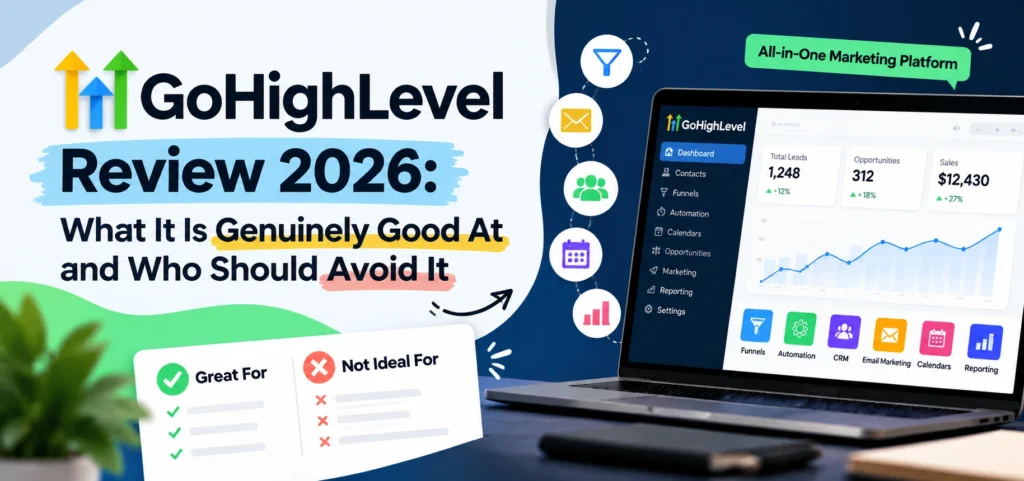
What it bundles: CRM and pipelines, funnel and website building, email and SMS marketing, calendar and booking, workflow automation, reputation and review management, course hosting, and a white-label SaaS resale mode.
The core pitch. Instead of paying for a CRM, a funnel builder, an email platform, a scheduler, and an SMS provider separately, you pay one subscription and get sub-accounts for each client. For an agency, this consolidates the stack and turns the platform into something you can resell.
There is a 14-day free trial on all plans. Our guide to the GoHighLevel free trial covers what to test during it and the setup delays that waste days if you do not plan for them.
What GoHighLevel Is Genuinely Good At
Four things it does better than anything at comparable pricing.
Sub-account architecture. Each client gets an isolated environment with their own contacts, funnels, and automations, managed from one agency dashboard. For an agency at three or more clients, this is the single strongest argument for the platform and nothing else at $297 matches it.
White-label and SaaS resale. You can rebrand the platform, set your own pricing, and sell it as your own software. This is a genuine business model rather than a marketing feature, and it is unique in this price range.
Consolidation economics. Replacing five subscriptions with one usually saves money and definitely removes integration headaches. Reviewers migrating from stitched-together stacks frequently cite this as the main win.
Automation breadth. Workflows spanning SMS, email, calls, pipeline stages, and calendar bookings in one builder, without connecting three tools through Zapier.
GoHighLevel Pricing Plans and What They Really Cost
GoHighLevel pricing plans compared
| Plan | Price | What it includes |
| Starter | $97/mo | Up to 3 sub-accounts, core features, unlimited contacts and users, 24/7 support |
| Unlimited | $297/mo | Unlimited sub-accounts, phone and email rebilling at no markup |
| Agency / SaaS Pro | $497/mo | SaaS mode resale, white-label, advanced agency features |
A 14-day free trial applies to all plans, and annual billing is offered at a discount.
The costs billed on top
| Component | How it bills |
| SMS and calls (Twilio) | Usage-based |
| Email (Mailgun) | Usage-based |
| AI features | Billed separately |
The plan price is roughly half the story. An agency on the Unlimited plan running moderate SMS and email volume across several client sub-accounts should budget meaningfully above $297. How far above depends entirely on messaging volume, which is why modelling it against your actual send volume before signing up is worth the twenty minutes.
Where the maths works. Replacing a CRM, funnel builder, email platform, scheduler, and SMS provider that collectively cost $400 to $800 monthly with a $297 plan plus usage is a clear win, and it is the scenario the platform is built for.
Where it does not. Paying $97 to use one feature well is poor value when a dedicated tool at $30 does that one thing better.
The Seven Real Complaints
These appear consistently across independent reviews, Reddit threads, and rating platforms. Every one is documented rather than speculative.
1. The learning curve is steep, and it is the most common complaint by a wide margin
Reviewers describe two to four weeks before the platform clicks, with the count in one 51-review analysis putting it at 12 out of 51 as the leading criticism. The platform carries 40+ major features, and the density that makes it powerful makes onboarding overwhelming. If you want something that works on day one, this is not it. Budget real setup time or a consultant.
2. Email deliverability requires expert configuration
GoHighLevel sends email through Mailgun, branded as LC Email, on shared infrastructure. Users migrating from dedicated platforms like ActiveCampaign or Mailchimp frequently report inbox placement dropping. Agencies that properly warm a dedicated sending domain and configure SPF, DKIM, and DMARC report acceptable deliverability, so it is fixable. But it is not fixed out of the box, and shared IP reputation across a large base of agencies sending high-volume campaigns is the underlying cause. If email is your primary channel and deliverability is critical, this is the biggest single risk factor.
3. Support quality is inconsistent
Simple questions get fast answers. Anything requiring engineering can take days, and reviewers describe the quality as hit and miss. There is no phone support. This gets worse during peak periods.
4. Usage costs are billed on top of the plan
The subscription is not the bill. SMS, calls, and email are usage-based, and AI features are billed separately. Heavy use adds a meaningful amount monthly. Model this before committing rather than discovering it in month two.
5. Platform stability has rough patches
One detailed assessment describes minor outages or feature regressions roughly every two to four weeks, lasting 15 minutes to four hours. Typical manifestations: a workflow stops executing for an hour, the conversation inbox goes read-only, calendar sync to Google fails, or a deployment breaks something previously working. One reviewer reported being unable to log in for roughly three weeks in mid-2026, which appears to be an outlier rather than typical.
The honest framing: this is normal for a platform at this scale, not evidence of a broken product. But if your business stops when a workflow stops, know the cadence going in.
6. Individual features lack polish against dedicated tools
The funnel builder works but is less refined than ClickFunnels. The CRM is functional but less intuitive than Pipedrive. The email editor is basic compared with ActiveCampaign. This is the inherent trade of any all-in-one: many jobs done adequately rather than one done brilliantly. If you want to compare the funnel side specifically, our breakdown of the ClickFunnels free trial covers where that platform is stronger.
7. Cancellation and billing friction
A repeated one-star theme across reviews, appearing in 4 out of 51 in one analysis. Understand the cancellation process before you subscribe rather than when you want to leave.
One more worth flagging, since it is a legal rather than product issue. The platform can send SMS and email at scale, and compliance is entirely on you. TCPA requires prior express written consent for marketing messages, and SMS stops working without A2P 10DLC registration. Use it for consented contacts and inbound follow-up, not cold outreach.
Who GoHighLevel Is For
Four profiles where it is an easy recommendation.
- Marketing agencies with three or more clients. The sub-account architecture and unlimited scaling at $297 is genuinely hard to beat.
- Agencies wanting to resell software. SaaS mode at $497 turns the platform into a product with recurring revenue attached.
- Service businesses using most of the stack. Home services, clinics, gyms, real estate, and similar businesses where lead capture, follow-up, booking, and review generation all matter.
- Teams willing to invest the setup time. Two to four weeks of real learning, or the budget for a consultant to configure it.
Who Should Avoid GoHighLevel
Equally important, and rarely stated plainly.
You only need one feature. If you want a scheduler, an email platform, or a funnel builder, a dedicated tool will be simpler, more polished, and cheaper. Buying GoHighLevel for one job is buying a toolbox when you need a screwdriver.
Email deliverability is mission-critical. If your business runs on email and inbox placement directly drives revenue, the shared-infrastructure risk is real. Either budget properly for domain warm-up and authentication, or use a dedicated email platform alongside.
You want it working on day one. The learning curve is the most documented complaint on the platform. There is no version of this where you log in and are productive that afternoon.
You have one or two clients. For solo consultants at that scale, reviewers frequently suggest alternatives like Keap or ActiveCampaign offer better value. The sub-account economics only pay off with volume.
You plan to do cold outreach. Compliance sits entirely with you, TCPA requires prior express written consent, and the platform’s scale makes it attractive to people who ignore that. Do not be one of them.
Nobody on your team is technical. SPF, DKIM, DMARC, 10DLC registration, and workflow logic are all things someone has to handle. Without that capability internally or through a consultant, the platform underdelivers regardless of how good it is.
GoHighLevel vs the Alternatives
By what you are actually replacing.
Against ClickFunnels: ClickFunnels has the better funnel builder, checkout, and upsell handling. GoHighLevel has the CRM, SMS, and pipeline management. Funnel-led businesses lean ClickFunnels, client-management-led businesses lean GoHighLevel.
Against HubSpot: HubSpot is more polished and considerably more expensive at equivalent capability. GoHighLevel wins on price and agency architecture, HubSpot wins on ease of use and ecosystem.
Against a composable stack: Separate best-in-class tools beat GoHighLevel on every individual feature and lose on integration and cost. The comparison is convenience versus polish. Our comparison of marketing automation tools for small business covers what $10 to $80 monthly buys in that direction.
Against Keap or ActiveCampaign: Better fits for solo consultants and small lists, particularly where email is the primary channel and deliverability matters more than breadth.
What We Would Tell a Client Considering It
From assessing platforms like this for clients.
Count your sub-accounts before anything else. At one or two clients, the maths does not work and a composable stack is cheaper and better. At five or more, it is difficult to beat. That single number decides most of the question.
Model the usage costs properly. Take your actual monthly SMS and email volume and price it. We have seen businesses compare $297 against a competitor’s subscription without adding Twilio and Mailgun on either side, then be surprised by the real invoice.
Treat deliverability as a setup project, not a setting. Dedicated sending domain, full authentication, and a warm-up period before any volume. Businesses that skip this conclude the platform is broken when the actual issue is configuration, and it is the most avoidable failure we see.
Test the thing you will use daily. During the trial, build your most complex existing workflow rather than the impressive demo features. If it handles that, the rest follows.
Accept the learning curve or budget for help. The two-to-four-week ramp is real and consistently documented. Businesses that plan for it succeed. Businesses that expect it to work immediately churn in month two and write the one-star reviews.
GoHighLevel Review FAQs
Is GoHighLevel worth it in 2026?
For agencies with three or more clients and service businesses using most of the stack, yes, and at its price point it is difficult to beat. It holds ratings around 4.5 to 4.7 on G2 and Capterra across hundreds of reviews. It is poor value if you need one feature, want something working immediately, or run email as your primary channel.
What are the biggest problems with GoHighLevel?
The steep learning curve is the most common complaint by a wide margin, with reviewers describing two to four weeks before productivity. Email deliverability requires expert domain and authentication setup. Support is inconsistent on technical issues with no phone line. Usage fees for SMS, calls, and AI are billed on top of the plan, and minor platform issues occur roughly every two to four weeks.
Is GoHighLevel a scam or an MLM?
No. It is a legitimate SaaS platform with over a million active users and 90,000+ agency accounts. The confusion comes from its affiliate programme, which pays 40 percent recurring commissions plus a 5 percent tier-two bonus. That generates heavy promotional content and gives the marketing an MLM-adjacent feel, but the product and business model are conventional SaaS.
Why is GoHighLevel’s Trustpilot score so high?
Reported Trustpilot figures range from 4.6 across 1,800+ reviews to 4.9 across 14,471, and at least one analysis notes the higher score is inflated by solicited post-support reviews. Prompting customers to review immediately after a resolved ticket skews the sample. The G2 and Capterra scores of 4.5 to 4.7 are collected differently and are the more useful reference.
How much does GoHighLevel really cost per month?
Plans are $97, $297, and $497 monthly, but SMS, calls, email, and AI features are all billed on usage on top. An agency on the $297 plan running moderate messaging across several sub-accounts should budget meaningfully above that. Model your actual send volume before subscribing rather than assuming the plan price is the bill.
Is GoHighLevel good for email marketing?
It is adequate rather than strong. It sends through Mailgun on shared infrastructure, and users migrating from ActiveCampaign or Mailchimp frequently report inbox placement dropping. With a dedicated sending domain, full SPF, DKIM, and DMARC configuration, and proper warm-up, deliverability is reported as acceptable. If email drives your revenue, use a dedicated platform alongside it.
Conclusion
The honest summary of this GoHighLevel review is that the platform is very good at the specific thing it was built for and mediocre at everything outside that. Agencies managing several client accounts get genuine value. Businesses buying it for one feature get an expensive, complicated version of something simpler. Before you decide, count your sub-accounts, model your messaging costs, and ask whether anyone on your team can handle domain authentication. Those three answers will tell you more than any review, including the ones written by people earning 40 percent of your subscription.