What is Instagram SEO?
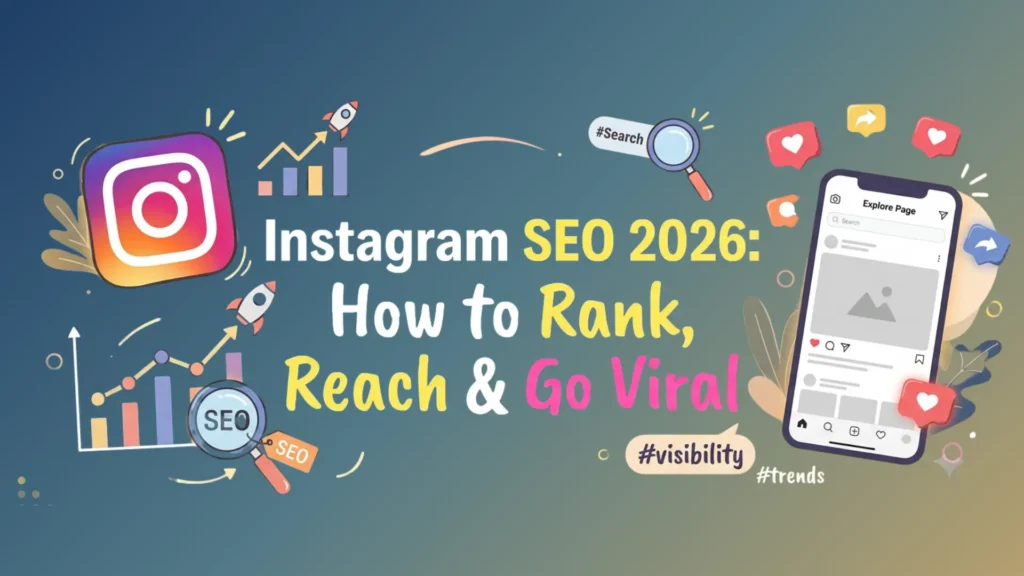
Instagram SEO is the process of optimizing your profile, captions, and content so Instagram’s search and discovery algorithm shows your account to people searching in your niche. In 2026, Instagram works less like a hashtag feed and more like a search engine. Your handle, name field, bio, captions, alt text, and engagement signals all decide whether you appear in search results and on the Explore page.
In short, Instagram SEO is what gets you found by people who do not already follow you.
Why Instagram SEO matters in 2026
For years, the playbook was simple. Stuff 30 hashtags into every post. However, that era is over. Adam Mosseri, the head of Instagram, has confirmed that search now reads keywords inside captions, bios, and on-screen text. As a result, the discovery surface has shifted toward intent-based search.
Here is what changed recently:
- Instagram now indexes the full text of captions for search.
- The Explore page weighs topical relevance over raw popularity.
- Reels surface through keyword-matched audio transcripts and on-screen text.
- Profiles missing a clear category or keyword-rich name field rank lower.
- Public Instagram posts are now indexed by Google, too, which expands your visibility beyond the app.
Therefore, ignoring Instagram SEO leaves your discovery to luck. And luck does not scale. For a deeper view of how organic search works across platforms, our SEO services overview breaks down the principles that apply on Google, Instagram, and AI search engines.
How Instagram’s search algorithm works
Instagram’s algorithm is actually a stack of ranking systems. Each surface (Feed, Stories, Reels, Explore, Search) uses its own logic. Instagram SEO mainly affects Explore and Search.
Here is what the system measures when ranking your account:
Keyword match across text fields. Username, name field, bio, captions, alt text, and on-screen text in Reels are all scanned. Closer matches rank higher.
Account quality signals. Posting consistency, profile completeness, and DM response rates all matter. In addition, accounts flagged for spam or fake engagement get downranked.
Engagement velocity. How fast a post earns saves, shares, and comments in its first hour matters most. Furthermore, saves and shares now outweigh likes by a wide margin.
Behavioral relevance. If users who engage with your content also engage with content about a topic, Instagram associates your account with that topic.
Originality. Reposted or watermark-stamped content gets downranked. On the other hand, native original media gets a visible push.
To rank, you need both the right words and the right engagement. SEO without engagement is invisible. Engagement without SEO is unscalable.
The Instagram SEO checklist (do these in order)
This is the exact order I recommend. Skipping early steps wastes effort on later ones.
1. Do Instagram-specific keyword research
First, Google keyword tools will steer you wrong here. Instagram users search differently. They use shorter, more visual phrases without modifiers like “best” or “near me.”
Here is how to do it:
- Open Instagram and tap the search bar.
- Start typing a seed keyword for your niche, for example, “vegan recipes.”
- Note the auto-suggestions. Each one is a real, ranked search query.
- Tap into the top results and study the top three accounts. Then check the words in their handles, names, and bios.
- Build a list of 10 to 15 primary keywords and 20 to 30 secondary ones.
Finally, keep one document with two columns: terms you want to rank for, and the existing top-ranking accounts for each. That document becomes your competitive map.
2. Optimize your handle and name field
Your handle (@username) and your name field are the two most heavily weighted text fields on the platform. The name field is the bold line under your profile picture. Most people waste it by repeating their handle.
Instead, use it for your primary keyword.
Examples that work:
- Handle:
@mariascakes/ Name:Maria, Custom Cake Designer NYC - Handle:
@leemjaz/ Name:Leemjaz, Digital Marketing Agency
The name field accepts up to 30 characters and is fully searchable. Additionally, if your business is local, include the city. If your niche is broad, narrow it with a category. This single change produces more search visibility lifts than almost any other Instagram SEO tactic for accounts under 10,000 followers.
While you are reviewing your handle, our Instagram username ideas guide covers strong, keyword-friendly options.
3. Write a keyword-rich bio that still sounds human
You have 150 characters. Use them like prime real estate.
A strong bio answers three questions:
- Who are you?
- Who do you help?
- What should they do next?
Layer in two or three target keywords naturally. However, avoid stuffing. Instagram’s algorithm now flags unnatural keyword density and downranks profiles that look spammy.
Here is a bio for a hypothetical local bakery:
Custom celebration cakes in Manchester. Birthdays, weddings, corporate orders. Order via DM or the website below.
That bio carries five searchable terms in 23 words. Yet it still reads as if a human wrote it.
4. Optimize captions for search
Most accounts fall behind here. Treat the first sentence of every caption like a meta description on Google. Specifically, the first 125 characters appear in the feed before the “more” button. Get the keyword in there.
Caption SEO rules I would not break:
- Lead with the topic. State what the post is about within the first line.
- Write at least 100 to 150 words for posts you want to rank in search.
- Use natural language, not keyword spam. Write the way someone would search.
- Add a clear call to action at the end. For example, save this, comment your favorite, or share with a friend who needs this.
- Include 3 to 5 highly relevant hashtags. The 30-hashtag wall is dead.
If your business serves local customers, weave in city names and area-specific terms. Our Instagram content ideas for local businesses cover this angle in more depth.
5. Use alt text on every single post
Instagram lets you write custom alt text for every image. Almost no one does it. Therefore, this is your edge.
When you upload a post, before publishing, tap “Advanced settings” and then “Write alt text.” You get up to 100 characters. Use them to describe the image with your target keyword included naturally.
Why does this matter? Instagram uses alt text as a primary signal for both accessibility and search. Moreover, it helps your content appear in Google image results when your post is publicly indexable.
Bad alt text: photo of cake Good alt text: Three-tier red velvet wedding cake with gold leaf decoration in Manchester
Apply this habit consistently for 30 days, and the effect on search ranking is measurable.
6. Optimize Reels for search
Reels are where most discovery happens in 2026. They get indexed differently from static posts.
Three optimizations that compound:
- On-screen text with keywords. Instagram’s OCR reads text overlays. Place your primary keyword on the first frame.
- Spoken keywords. The platform transcribes audio. If you say your keyword out loud in the first three seconds, the signal strengthens.
- Caption matched to the topic. Repeat the topic phrase from the on-screen text in the caption.
Finally, pin your three best Reels to the top of your profile. Pinned content carries disproportionate weight in profile-level search.
7. Use location tags strategically
Every post and Reel can carry a location tag. However, local businesses skip this and lose discovery on Place pages and city-specific searches.
If you serve a city, tag the city. If you serve a neighborhood, tag the neighborhood. If your shop has a specific address, tag the venue. Multiple posts at the same location strengthen your association with that area in Instagram’s index.
8. Treat hashtags as a secondary signal
Hashtags still help. However, their weight has dropped sharply since 2023. Use 3 to 5 highly relevant hashtags per post. Mix one large, one medium, and one to three small or niche hashtags. Furthermore, avoid banned or shadowbanned tags. A quick search inside Instagram tells you if a tag is restricted.
The shift to keyword-led discovery is a natural progression. After all, hashtags were always a workaround for a search system that did not understand language. The system understands language now.
Best free Instagram SEO tools in 2026
You do not need to pay for Instagram SEO. The most useful tools are free, and the platform itself gives you the strongest signals if you know where to look. Here are the ones worth using.
| Tool | Best For | Price |
|---|---|---|
| Instagram’s own search bar | Real keyword data straight from the platform | Free |
| Google Trends | Cross-checking what is rising in your niche | Free |
| Hootsuite caption generator | Quick AI-written captions | Free |
| Metricool free plan | Hashtag research and basic analytics | Free |
| Keyword Tool dot io | Long-tail keyword ideas at scale | Free basic version |
Most paid tools focus on a single feature, such as caption generation or hashtag research. However, real Instagram SEO needs the full stack working together: keyword research, profile optimization, caption work, alt text, and engagement. No tool replaces the strategy. The strategy is what this guide gives you.
If you would rather skip the manual lift entirely, our social media marketing services include profile audits, keyword strategy, and full content calendars built around Instagram SEO.
How long does Instagram SEO take to work?
Based on the campaigns we have run for clients across the UK, US, and Canada since 2018, here is the typical timeline:
- Days 7 to 14. Early ranking shifts after optimizing your handle, name field, and bio.
- Weeks 4 to 8. Caption and alt text changes show measurable effects with consistent posting.
- Days 60 to 90. Account-level lifts in Explore reach.
If you have been on Instagram for years without optimization, expect a delayed surge. Many accounts report a sudden jump in week 6 or 7 due to Instagram updating its internal classification.
The 7 most common Instagram SEO mistakes
Avoiding these puts you ahead of most of your competitors immediately.
- Leaving the name field as a duplicate of the username. Instant lost ground.
- Treating the bio as a personality statement instead of a search-ready summary.
- Posting captions under 50 words and expecting search visibility.
- Skipping alt text. Every. Single. Time.
- Posting 30 hashtags. The algorithm reads it as spam.
- Recycling Reels from TikTok with the watermark visible. Originality is now a ranking factor.
- Inconsistent posting cadence. Two posts a week beats five posts in week one and silence in week two.
How Instagram SEO connects to your wider marketing strategy
Instagram does not exist in isolation. The strongest results come when your Instagram SEO compounds with your broader strategy.
Three integrations worth setting up:
- Cross-link your blog and Instagram. Drop your top-performing blog post URLs into your Instagram bio link rotation. In addition, feature your Instagram content as embeds inside your blog posts.
- Pair Instagram with email. Capture Instagram followers into an email list using lead magnets in your bio. Email marketing remains the highest-ROI channel in digital, with returns averaging $42 for every dollar spent. Our email marketing services page outlines how to build that funnel correctly.
- Layer paid amplification on top of organic SEO. Once a post earns strong organic engagement and ranks for its target keywords, pour a small ad budget behind it. Consequently, the algorithm rewards posts that already perform well.
Want to build the whole engine from scratch? Our guide on how to start a digital marketing agency in 2026 walks through the full stack of services and how they fit together.
Final word from the team
Instagram SEO is not a one-time fix. It is a posture. Once you treat every field, caption, and Reel as a chance to be discovered, your account compounds in ways that hashtag spam never could.
Start with your name field today. Then rewrite your bio this week. Finally, add alt text to your next 10 posts. That alone shifts more accounts than any clever growth hack you read about online.
If you want help building a full Instagram SEO strategy from scratch, including keyword research, profile audits, content calendars, and Reels optimization, we do this every day for our clients. Contact Leemjaz, and we will put a custom plan together for your brand.
Frequently asked questions about Instagram SEO
Does Instagram SEO actually work?
Yes. Instagram has confirmed publicly that search now relies on keyword matching across captions, bios, and metadata. As a result, accounts that optimize correctly see measurable lifts in non-follower reach within weeks.
How is Instagram SEO different from Google SEO?
Both use keyword relevance. However, Instagram weighs engagement velocity, profile completeness, and visual signals like alt text and on-screen text. Google focuses on backlinks, page authority, and content depth. The principles overlap. The mechanics differ.
Do hashtags still matter in 2026?
Yes, but only as a secondary signal. Use 3 to 5 highly relevant hashtags per post. Hashtag stuffing is over.
What is the most important field to optimize first?
The name field under your handle. It is searchable, weighted heavily, and most accounts waste it. Add your primary keyword and location if relevant.
How often should I post for Instagram SEO?
Consistency outranks frequency. Two well-optimized posts per week beat seven rushed posts. Aim for at least three pieces of content per week, mixing Reels, carousels, and single images.
Can I use the same keywords on Instagram as on Google?
Use them as a starting point. However, always validate against Instagram’s autosuggest. Instagram users phrase searches differently, and your real opportunity often hides in shorter, more visual phrasing.
Does my account size affect Instagram SEO?
Account size matters less than relevance and engagement quality. Smaller accounts with tight niche focus often outrank larger accounts with diluted positioning.
Should I hire an agency for Instagram SEO?
If your time is more valuable than the learning curve, yes. Agencies move faster because they have already tested what works across multiple accounts and niches. Our team at Leemjaz works with brands that want predictable organic growth without managing it in-house.