Here is an uncomfortable truth from inside the industry: agencies rehearse for your discovery call. The case studies are pre-selected, the deck is polished, and the weaknesses stay hidden until month four of your contract. We run a marketing agency ourselves, we sit on the other side of those calls every week, and this guide breaks down how to choose a social media marketing agency properly: the questions that reveal real capability, the answers you should hear, fair pricing, and the red flags that predict a wasted budget. A wrong agency choice quietly costs six months and five figures before most businesses admit it. The framework below makes the difference visible in one call instead of one contract.
To choose a social media marketing agency in 2026, define your revenue goal first, then run every candidate through seven steps: shortlist by specialty, audit their own social presence, demand proof from businesses like yours, inspect a real client report, test their strategic thinking, check contract exit terms, and run a 90-day pilot with milestones. Ask the five insider questions below, expect to pay $1,500 to $5,000 monthly for serious small business scope, and walk away from anyone guaranteeing follower counts, selling identical packages, or reporting engagement without business outcomes.
What Should You Define Before Contacting Any Agency?
Agencies shape proposals around whatever you tell them, so walking in vague guarantees a vague engagement. Nail down three things before the first call.
The business outcome. Not “grow our Instagram.” Something measurable like “20 qualified leads per month” or “double online orders by Q4.” An agency can only be judged against a target you actually set.
Your full budget, including ad spend. Management fees and ad budgets are separate lines. Knowing both prevents the classic surprise where a $2,500 retainer arrives with a “recommended” $3,000 ad budget you never planned.
Your involvement level. Weekly content input or quarterly summaries? Mismatched expectations here kill more agency relationships than bad results do.
It also helps to know what a complete engagement should contain before you compare candidates, and the full breakdown of professional social media marketing services covers the six components (strategy, content, community, paid, influencer work, reporting) that any serious proposal should account for.
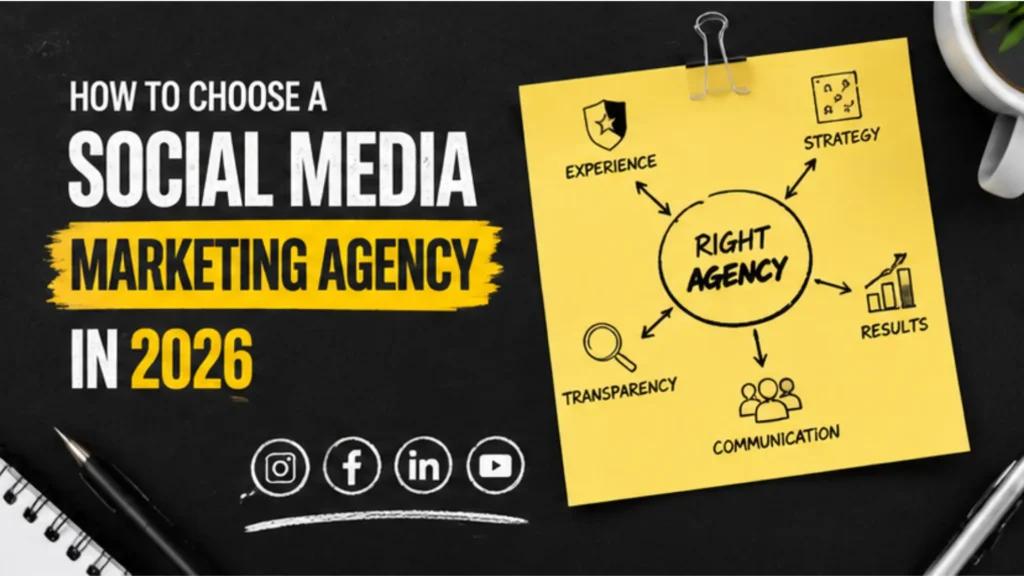
How to Choose a Social Media Marketing Agency: The 7-Step Framework
This is the process we would use if we were the ones hiring, knowing everything we know from the inside.
Step 1: Shortlist by Specialty, Not Size
Match the agency’s genuine strength to your need: paid social performance, creative production, B2B LinkedIn, local business growth. A brilliant ecommerce agency can be mediocre at B2B. Three well-matched candidates beat ten generalists.
Step 2: Audit Their Own Presence
An agency that cannot grow its own accounts will not grow yours. Check their profiles for consistency, video quality, and engagement that looks human rather than purchased.
Step 3: Demand Relevant Proof
Ask for results from businesses like yours: similar size, industry, or model. Then ask what specifically drove those results. Practitioners answer in specifics; salespeople answer in adjectives.
Step 4: Inspect a Real Report
Request an anonymized client report. If it leads with follower growth and impressions, the agency sells activity. If it leads with cost per lead, conversions, and revenue influence, it sells outcomes.
Step 5: Test the Strategy Thinking
Give every finalist the same brief and compare responses. The right agency asks about your customers and margins before proposing content. Anyone opening with “you need to be on TikTok” before understanding your buyer has a template, not a strategy.
Step 6: Check the Contract Exit
Month-to-month after an initial period is healthy. Twelve-month locks with no performance clauses protect the agency, not you.
Step 7: Run the 90-Day Pilot Properly
Confident agencies accept pilots because they expect to earn the renewal. Set milestones upfront: strategy and setup by day 30, content rhythm and early signals by day 60, measurable movement on your defined outcome by day 90. Judge trajectory, not perfection.
How to Choose a Social Media Marketing Agency: Questions to Ask Before Hiring
These are the five questions that expose real capability in one call, with the answer a good agency gives and the answer that should worry you.
“How will you measure success for us specifically?” Good answer: they turn it back to your business goal and propose metrics tied to it (cost per lead, booked calls, revenue per channel). Bad answer: reach, impressions, and follower milestones.
“Who exactly works on our account?” Good answer: named roles, including who creates content and who runs ads. Bad answer: vagueness, which usually means junior staff or outsourcing behind a senior salesperson.
“Show me a campaign that failed. What did you do?” Good answer: a real story with the fix. Every honest agency has failures. Bad answer: claiming they have none, which means they hide problems from clients too.
“How do organic and paid work together in your approach?” Good answer: organic proves what resonates, paid scales the winners. Bad answer: treating them as separate products with no connection.
“What happens in the handover if we leave?” Good answer: you keep your accounts, ad accounts, creative files, and data, documented in the contract. Bad answer: hesitation, which predicts hostage-taking later. Almost nobody asks this one, and it exposes more about an agency’s character than any case study.
Which Red Flags Mean You Should Walk Away?
Five warnings that predict wasted budget, and the green flags that predict the opposite.
Guaranteed follower or ranking numbers. Nobody controls platform algorithms. Guarantees signal either bought followers or planned excuses.
The same package for every client. A dental clinic and a streetwear brand should never receive identical strategies. Templates scale the agency’s margin, not your results.
Reporting that stops at engagement. Likes do not pay invoices. If business outcomes are missing from the sample report, they will be missing from yours.
Pressure to sign long contracts today. Discount-for-commitment pressure on the first call protects future underperformance.
No questions about your business. An agency that pitches before asking about your customers, margins, and goals is selling inventory, not strategy.
Green flags worth trusting: they ask about revenue before reach, show real client video work, offer pilot terms, name the humans on your account, and admit what they are not good at. That last one is rarer and more valuable than any award.
How Much Should a Social Media Marketing Agency Cost?
Real 2026 US numbers by scope, so you can judge every quote against the market.
| Scope | Monthly Cost | What It Covers |
| Starter (1 to 2 platforms, organic) | $500 to $1,500 | Content, posting, light engagement |
| Small business full package | $1,500 to $5,000 | Strategy, video content, management, light paid |
| Growth (organic + paid together) | $5,000 to $10,000 | Full content engine, ad management, reporting |
| Enterprise / multi-brand | $10,000 to $15,000+ | Dedicated team, influencer programs, attribution |
| Ad spend (always separate) | $1,000 to $50,000+ | Paid budget on top of management |
Two pricing rules from inside the industry: anything under $500 monthly means recycled templates the algorithms suppress, and price should map to deliverables you can count (videos produced, campaigns managed, reports delivered). An agency that cannot list its deliverables is charging for presence, not performance. For context, one senior in-house hire runs $75,000 to $95,000 in salary before overhead, which is why a well-chosen agency retainer usually wins the math for small and growth-stage businesses.
What Should a 2026-Ready Agency Be Able to Tell You?
Three evaluation criteria that did not exist a few years ago now separate current agencies from those running an old playbook at new prices.
They can explain the social-to-search journey. Buyers discover brands on social, then verify on Google and increasingly through AI assistants before purchasing, a multi-touch pattern Google’s own consumer research at Think with Google has documented for years. An agency blind to what happens after the social click loses the sales its content earned.
They can show original video with real humans. Generic AI-generated content flooded every feed and became invisible. The differentiation now lives in authentic video, real brand voice, and creative judgment, so ask to see original video work from actual clients, not stock-assembled reels.
They talk honestly about attribution. Privacy changes broke easy tracking. Competent agencies work with first-party data and platform-native conversion tools, and they tell you plainly what can and cannot be measured. Inflated dashboard certainty is its own red flag.
Raise these three topics in your calls. Agencies that engage confidently are operating in 2026. Agencies that deflect are not.
How Leemjaz Answers Its Own Framework
Publishing an interrogation framework means being ready to face it, so here is how Leemjaz answers.
We measure success against client-defined revenue outcomes, and our reporting leads with cost per lead and bookings, because that is what we would demand as buyers. Our strongest documented pattern comes from connecting social to the rest of the funnel: a US food client came to us with strong social ads leaking into a broken local presence, and after we fixed the foundation and reconnected the channels through our search engine optimization services, the same ad budget produced roughly double the bookings within three months.
We also tell prospects what we are not: we are not a celebrity influencer brokerage, and businesses needing that get pointed elsewhere. If you want to run your shortlist questions against us, the social media marketing team at Leemjaz takes those calls with real answers, pilot-friendly terms, and the reports we would demand ourselves.
Key Takeaways
- Define the revenue outcome, total budget, and your involvement level before contacting any agency.
- Run the 7-step framework: specialty match, their own presence, relevant proof, real reports, strategy testing, exit terms, and a milestone-based 90-day pilot.
- Ask the five insider questions, especially “show me a failure” and “what happens if we leave.”
- Expect $1,500 to $5,000 monthly for serious small business scope, ad spend always separate, price mapped to countable deliverables.
- Walk away from guarantees, identical packages, engagement-only reporting, pressure contracts, and pitches that arrive before questions.
- Test for 2026 readiness: the social-to-search journey, original video capability, and honest attribution.
Frequently Asked Questions
1. How do I choose a social media marketing agency?
Define your revenue goal first, then shortlist agencies by specialty match, audit their own social presence, demand results from businesses like yours, review a real client report, test their strategic thinking with a brief, check contract exit terms, and run a 90-day pilot with milestone expectations before committing long term.
2. How much does a social media marketing agency cost?
US agencies typically charge $500 to $1,500 monthly for starter organic packages, $1,500 to $5,000 for full small business scope, and $5,000 to $15,000+ for growth and enterprise programs. Ad spend runs separately on top of management fees. Packages under $500 monthly usually signal templated content that platforms suppress.
3. What questions should I ask a social media marketing agency?
Ask how they will measure success for your specific business, who exactly works on your account, how organic and paid work together, what happens in the handover if you leave, and ask them to describe a campaign that failed and what they did. The failure question is the fastest honesty test in the industry.
4. What are the red flags when hiring a social media agency?
The five biggest red flags are guaranteed follower or ranking numbers, identical packages for every client, reporting that stops at engagement metrics, pressure to sign long contracts on the first call, and pitching before asking about your business. Any one of them predicts a wasted budget.
5. How long should I give a social media agency to show results?
Ninety days is the fair evaluation window: strategy and setup by day 30, consistent content and early engagement signals by day 60, and measurable movement on your defined business outcome by day 90. Paid campaigns show signals within weeks, organic compounds over months, so judge trajectory rather than perfection.
6. Should a social media agency handle both organic and paid?
Ideally yes, because organic proves what resonates and paid scales the winners, and agencies running both together consistently outperform split setups. Verify they have distinct specialists for each, since one generalist stretched across organic content and paid optimization usually does neither well.
Conclusion
Knowing how to choose a social media marketing agency comes down to refusing to be sold. Define the outcome before the first call, interrogate instead of interview, demand reports that speak in revenue, test strategic thinking against your real business, and let a 90-day pilot prove what the pitch promised. The market splits cleanly in 2026: agencies with genuine video capability, integrated organic and paid, and honest attribution, and agencies running an old playbook at new prices. The framework in this guide makes the difference visible in one call instead of one contract. Use it on every candidate, including us, because the agencies worth hiring are the ones that welcome the hard questions.