If you have ever wondered how Google decides which website to show you first, or why some pages rank on top while others stay invisible, the answer lives in something most people never bother to learn: search engine basics. These are the fundamental ideas behind how Google, Bing, and even AI search engines like ChatGPT decide what you see when you type a query. Understanding search engine basics is no longer just for SEO professionals in 2026, because every business owner, content creator, and marketer now competes for the same visibility, and the rules have changed faster in the last 18 months than in the previous 10 years combined. This guide explains exactly what a search engine is, how it works in plain language, the three stages every search runs through, the ranking signals that matter most in 2026, and a real Leemjaz case study showing what happens when you actually apply these basics.
Search engine basics describe how search engines like Google, Bing, and AI engines find, organize, and rank web content. Every search engine works in three core stages: crawling (discovering pages with bots), indexing (storing them in a massive database), and ranking (deciding which results appear first when someone searches). The most important search engine basics in 2026 include content quality, E-E-A-T signals, mobile usability, page speed, backlinks, search intent, and how AI Overviews now use the same indexed content to generate direct answers. Mastering these basics is the foundation of every successful SEO and content strategy.
What Is a Search Engine?
A search engine is a software system that helps people find information on the internet. You type a query, and the search engine returns a ranked list of web pages, images, videos, news articles, or AI generated answers that it believes best match what you are looking for.
Think of a search engine as an extraordinarily fast librarian. This librarian has already read every book in a library the size of the entire internet, organized them by topic and quality, and can pull the most relevant ones off the shelf in under a second based on what you ask. The librarian also knows your past preferences, your location, your device, and roughly what kind of answer you are most likely looking for.
In 2026, this librarian also has an AI assistant built in. Modern search engines no longer just return links. They generate direct answers, summarize across multiple sources, and increasingly compete with chat based AI tools for the same role.
To go deeper on how this entire system works as one connected machine, the breakdown of how a search engine works covers the full picture, including the parts of search engine basics that most beginner guides skip.
The 3 Stages of How Search Engines Work
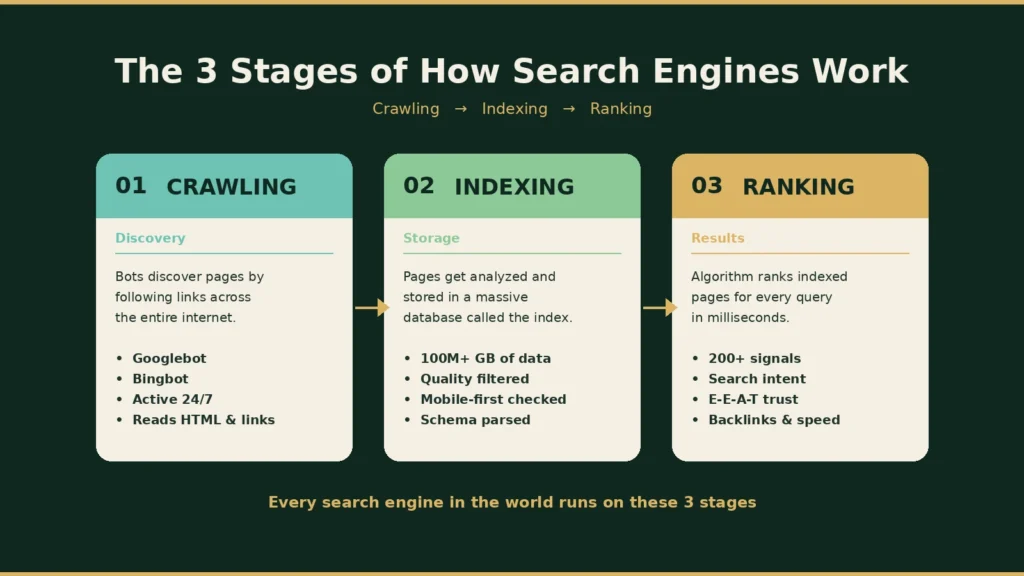
Every search engine, from Google to a niche academic search tool, runs on three core stages. Understanding these three is the foundation of every other concept in SEO. Google’s own official documentation on how Search works confirms this is the exact pipeline, and it has stayed consistent for over two decades.
Stage 1: Crawling
Crawling is how search engines discover content. Automated programs called crawlers, spiders, or bots travel across the internet, jumping from link to link to find new and updated pages. Google’s crawler is called Googlebot. Bing’s is Bingbot. These bots never stop, never sleep, and visit billions of pages every day.
When a crawler visits your page, it reads the text, the HTML structure, the images, the links, and the metadata. It then adds new URLs it finds on your page to its list of pages to visit next. If your page never gets crawled, it cannot move to the next stage.
Stage 2: Indexing
After a page is crawled, the search engine analyzes it and stores it in a massive database called the index. Think of the index as the world’s largest library catalog, holding details about hundreds of billions of pages, all organized so the search engine can find the right one in a fraction of a second.
Indexing is where the search engine decides whether your page is worth storing. In 2026, this stage matters more than ever, because Google now indexes selectively. A page can get crawled but still fail the indexing quality check, which shows up as “Crawled, currently not indexed” in Google Search Console.
Stage 3: Ranking
When someone searches, the search engine pulls every relevant page from its index and ranks them by quality and relevance. This is where the algorithm uses hundreds of signals (content quality, backlinks, page speed, mobile usability, user engagement, freshness, and many more) to decide which pages appear first.
Ranking happens in fractions of a second, billions of times per day. This is the stage SEO professionals spend most of their time trying to influence, because position one on Google captures dramatically more clicks than position five.
Search Engine Basics: The Most Important Components
Beyond the three stages, search engines run on a handful of core components every beginner should understand.
Search Index. The massive database where indexed pages live. Google’s index alone contains information from billions of pages and occupies over 100 million gigabytes across data centers worldwide.
Search Algorithm. The brain that decides which indexed pages deserve to rank at the top for any given query. Google’s algorithm uses hundreds of signals and updates constantly.
Crawlers (Bots). Automated programs that discover pages by following links. Googlebot, Bingbot, GPTBot, and Claudebot are the major ones in 2026.
SERP (Search Engine Results Page). The page you see after entering a query. In 2026, the SERP includes blue links, AI Overviews, Featured Snippets, video carousels, image packs, local results, and ads.
Search Intent. What the user actually wants when they type a query. Informational (learn something), navigational (find a specific site), commercial (research before buying), or transactional (ready to buy). Matching content to intent is one of the strongest ranking signals.
Schema Markup. Structured data added to your HTML that helps search engines understand exactly what your content covers. Critical for rich results in 2026.
Backlinks. Links from other websites to your page. They act as votes of confidence, signaling that your content is trustworthy. Quality matters far more than quantity.
The 2026 Search Engine Basics Shift: AI Search and Answer Engines
This is the part most older guides on search engine basics skip entirely, and it is the biggest shift in how search works since Google launched.
In 2026, search is no longer just blue links. Google’s AI Overviews now generate AI summaries at the top of most results, ChatGPT Search handles around 17 percent of global search style queries, Perplexity grew explosively as a cited research tool, and Microsoft Copilot pulls from Bing’s index to answer questions inside Windows and Edge.
This means three things for beginners.
1. Search engines now retrieve and generate. The old model returned the single best page. The new model reads across multiple pages, then generates an original synthesized answer.
2. Citation visibility is the new ranking. Being cited inside an AI answer is now as valuable as ranking at position one in blue links. The optimization rules are slightly different and are called answer engine optimization.
3. The fundamentals still matter. Even AI Overviews and ChatGPT Search rely on the same crawled and indexed content underneath. Search engine basics have not been replaced, they have just expanded.
The full breakdown of how this shift works is covered in AI Overviews vs Featured Snippets, which explains the new optimization layer beginners need to understand on top of the basics.
Search Engine vs Web Browser: The Confusion People Still Have
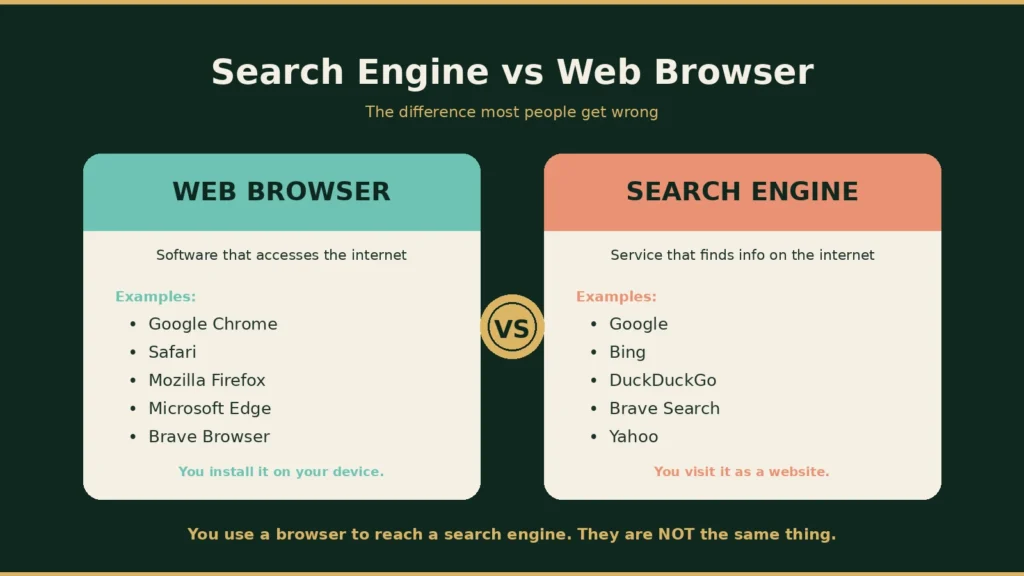
This is one of the most common misunderstandings, and even experienced internet users mix them up.
A web browser is the software you use to access the internet. Examples: Chrome, Safari, Firefox, Edge, Brave Browser.
A search engine is a service that helps you find information on the internet. Examples: Google, Bing, DuckDuckGo, Brave Search.
You use the browser to reach the search engine. You open Chrome (the browser), type a search into Google (the search engine), and Google shows you results.
The confusion happens because modern browsers have search built into the URL bar, so users often say “I Googled it on Chrome” without realizing they used two different tools.
Top Search Engines in 2026 (Market Share Data)
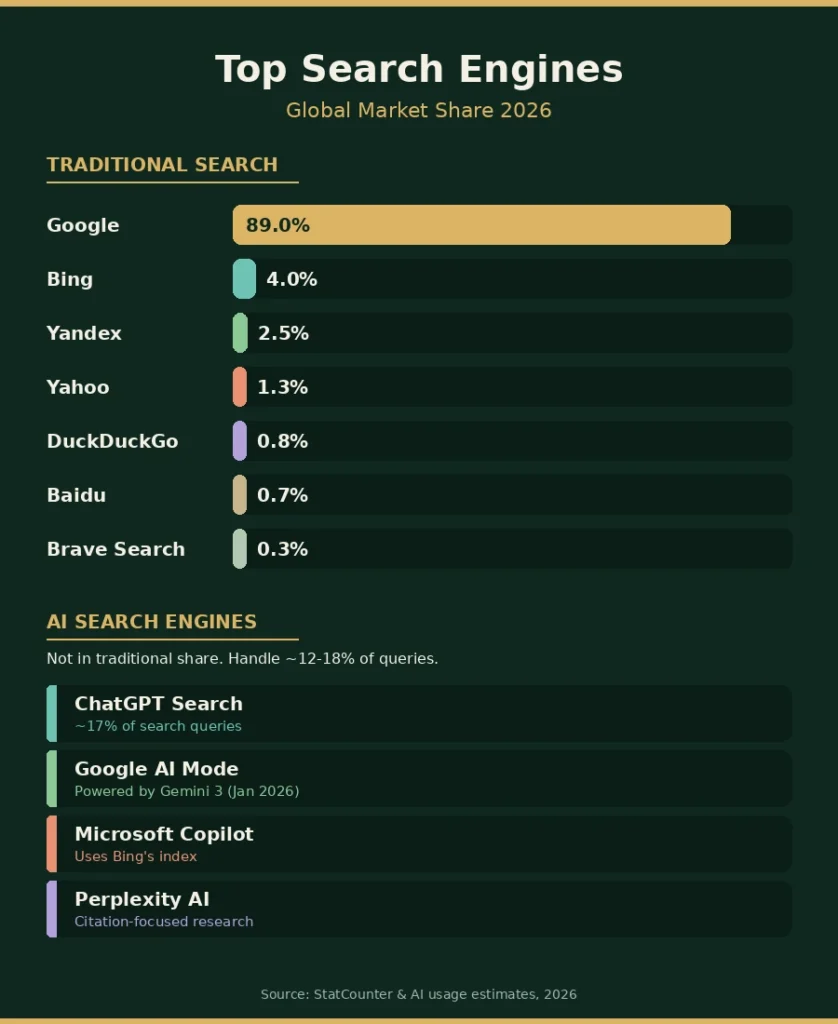
The search market in 2026 is more diverse than ever, but Google still dominates.
| Search Engine | Global Market Share (2026) | Best For |
| ~89% | General use, dominant in most countries | |
| Bing | ~4% | Microsoft ecosystem, Copilot AI |
| Yandex | ~2.5% | Russia and Eastern Europe |
| Yahoo | ~1.3% | Powered by Bing, aging user base |
| DuckDuckGo | ~0.8% | Privacy focused users |
| Baidu | ~0.7% | Dominant in China |
| Brave Search | ~0.3% | Independent index, privacy first |
AI search engines like ChatGPT Search, Perplexity, and Microsoft Copilot are not measured in traditional market share data, but they now collectively handle 12 to 18 percent of the search style queries that used to go to Google, especially among users under 35.
The Most Important Ranking Factors You Should Know
Google’s algorithm uses hundreds of signals, but a smaller group does most of the heavy lifting in 2026. These are the ones beginners absolutely need to know.
Content Quality. Original, useful content that fully answers the search query. Google’s Helpful Content System actively demotes generic, thin, or AI generated content that adds nothing new.
Search Intent Match. Your page has to match what the user actually wants. Intent mismatch is one of the most common reasons even well written pages do not rank.
E-E-A-T Signals. Experience, Expertise, Authoritativeness, and Trust. Google increasingly rewards content with real author credentials, real experience, and proven trust signals.
Backlinks. Links from reputable, relevant sites act as votes of confidence. Quality matters far more than quantity.
Mobile Friendliness. Google uses mobile first indexing, so your site is judged by its mobile version.
Page Experience. Core Web Vitals including loading speed, interactivity, and visual stability all feed into rankings.
HTTPS Security. A secure connection is a baseline expectation in 2026.
Crawlability and Indexability. If Google cannot crawl or index your page, it cannot rank. The full hierarchy is covered in the search engine ranking factors breakdown.
What Search Engine Basics Did for Leemjaz
When Leemjaz launched its own SEO content hub, the team made a deliberate decision to apply every search engine basic from the ground up, rather than chasing shortcuts.
The Setup
We built a content cluster around how search engines work, applied clean technical SEO (robots.txt, sitemap, schema), structured every post with clear H2 and H3 headings, included Quick Answer blocks at the top of every guide, added real internal linking across the cluster, and made sure every page had genuine author experience built in.
The Discovery
Within 90 days, the entire cluster of 14 connected posts had crossed the indexing threshold and started ranking for target queries. The pages that ranked fastest were the ones that fully matched search intent and had the cleanest structure, not necessarily the ones with the most words or the most backlinks.
The Result
The cluster now drives consistent organic traffic from Google, regular citations inside Microsoft Copilot answers (visible through Bing Webmaster Tools AI Performance report), and a small but high quality stream from ChatGPT and Perplexity. The conversion rate from AI search traffic runs roughly 2x higher than from traditional Google traffic, because users arriving from AI engines have already received a vetted recommendation.
The lesson is simple. Search engine basics still work in 2026, possibly better than ever, because most competitors are skipping them in favor of shortcuts. If your site is not getting the traffic it deserves and you suspect the basics are the missing piece, the SEO team at Leemjaz runs full audits that map your site against every fundamental search engine basic, then fixes the exact gaps holding rankings back.
Frequently Asked Questions
1. What are search engine basics?
Search engine basics refer to how search engines like Google find, organize, and rank web pages to deliver relevant results. They include the three core stages of crawling, indexing, and ranking, plus essential concepts like search intent, content quality, backlinks, and ranking signals. Understanding these basics is the foundation of all SEO work.
2. How do search engines work in simple terms?
Search engines work in three stages. First, automated bots called crawlers discover web pages by following links across the internet. Second, the search engine analyzes those pages and stores them in a giant database called the index. Third, when someone searches, the algorithm ranks the most relevant indexed pages to deliver as results.
3. What are the 3 main parts of a search engine?
The three main parts of a search engine are the crawler (bots that discover web pages), the index (a massive database storing the discovered content), and the algorithm (the brain that ranks indexed pages for any given query). All three must work together for a search engine to deliver useful results.
4. What is the most important search engine ranking factor in 2026?
High quality content that matches search intent is the most important ranking factor in 2026. Google’s systems are built to reward pages that fully answer the user’s question with original, useful information. Backlinks and E-E-A-T signals are close behind, but without content that truly satisfies intent, nothing else can carry a page to the top.
5. What is the difference between a search engine and a web browser?
A web browser is the software you use to access the internet, like Chrome, Safari, or Firefox. A search engine is a service that helps you find information once you are online, like Google, Bing, or DuckDuckGo. You use a browser to reach a search engine, then use the search engine to find pages.
6. Are AI tools like ChatGPT considered search engines?
Technically no, but they are increasingly used like search engines. ChatGPT, Gemini, and Perplexity are large language models that generate answers rather than indexing and ranking web pages. In 2026, the line between traditional search and AI answer engines has blurred significantly, especially since Google added AI Overviews to its own results.
Conclusion
Search engine basics may sound simple, but they are the foundation that every successful website is built on. Crawling, indexing, and ranking still run search in 2026, even as AI Overviews, ChatGPT Search, and answer engines reshape how users actually interact with results. The websites that win are the ones that get the basics right, then build everything else on top of that foundation. Master the three stages, understand the core ranking signals, match search intent in every piece of content, apply clean technical SEO, and you stop guessing why your pages do not rank. You move from being invisible to being found, which is what every business needs in 2026 regardless of how much search itself continues to change.