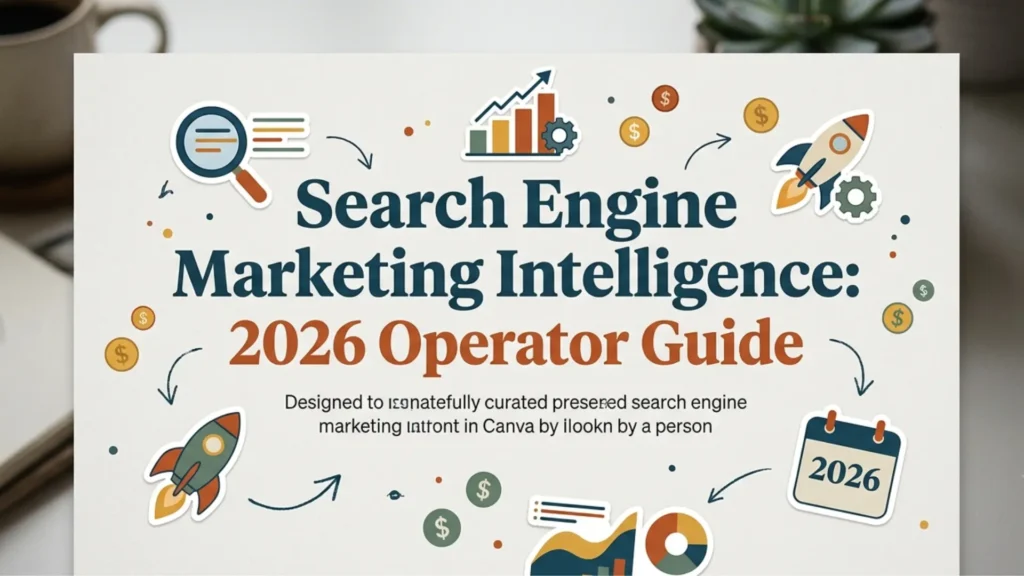
Most marketers running Google Ads or organic campaigns in 2026 are still working with a problem they never name out loud: they have data everywhere, but no real intelligence. Dashboards, weekly reports, ranking trackers, audience reports, conversion funnels, and yet decisions still come down to gut feel and last quarter’s habits. Search engine marketing intelligence is what closes that gap. It turns the raw flood of search data into the kind of clear, decision ready insights that separate campaigns that grow from campaigns that just stay busy. This guide breaks down what it actually is, how to use it, the tools that matter, and a starter workflow you can run this week.
Search engine marketing intelligence is the process of collecting, structuring, and analyzing data from search engines and AI answer platforms to make smarter decisions about your paid and organic campaigns. It covers four areas: competitive intelligence (what rivals are doing), customer intelligence (what users actually want), performance intelligence (what is working in your campaigns), and AI visibility intelligence (where you show up in ChatGPT, Gemini, Claude, and Perplexity answers). Done right, it reduces wasted ad spend by 30 to 50 percent and shifts campaigns from guesswork to evidence based growth.
What Search Engine Marketing Intelligence Actually Means
Search engine marketing intelligence is the structured practice of pulling data from search engines, answer engines, and user behavior signals, then turning that data into clear actions for your paid and organic campaigns. It is not the same as keyword research, and it is not the same as analytics reporting. Keyword research tells you what people search for. Analytics tells you what already happened. Intelligence tells you what to do next, with the confidence that the decision is backed by evidence.
The discipline pulls from five core data streams:
- Search queries. The actual phrases people type into Google, Bing, and AI assistants.
- Competitor signals. What rivals are bidding on, ranking for, publishing, and changing.
- User intent. The reason behind each search, not just the words.
- Performance data. Click through rates, conversion rates, cost per acquisition, and ROI from your own campaigns.
- AI visibility data. Where and how often your brand appears in answers from ChatGPT, Gemini, Claude, and Perplexity.
When these streams get analyzed together rather than in isolation, you stop reacting to what already happened and start positioning for what is about to happen.
Why It Matters More in 2026 Than Ever Before
The search landscape has changed more in the last 24 months than in the previous decade. According to Google Search Central’s own documentation on search quality, search is now fragmented across multiple discovery surfaces, not just traditional results pages. Three big shifts are pushing search engine marketing intelligence from “nice to have” to “non negotiable.”
Rising ad costs. Average CPCs across competitive verticals have climbed 18 to 30 percent year over year in the US market. Wasted spend is no longer affordable, and intelligence is the only reliable way to cut it.
AI search is reshaping discovery. A growing percentage of buyer research now starts inside ChatGPT, Gemini, Perplexity, and Claude rather than Google. The brands that show up in AI generated answers capture demand that the brands relying only on traditional rankings never see. Tracking your AI visibility is becoming as important as tracking your Google rankings, which is exactly why working with an answer engine optimization agency is becoming a standard line item for serious campaigns.
User intent has fragmented. A single keyword can now have three or four valid intents (informational, navigational, commercial, transactional), and Google’s algorithms increasingly reward content that matches the right one. Intelligence is what tells you which intent is dominating for any given query.
The marketers who treat intelligence as a discipline are the ones beating bigger budgets with smarter decisions. The ones who skip it are the ones whose campaigns underperform regardless of how much they spend.
The Four Pillars of Search Engine Marketing Intelligence
Effective intelligence work breaks into four pillars. Each one answers a specific question, and together they form a complete operating picture.
Pillar 1: Competitive Intelligence
The question: What are my competitors actually doing?
The data: Which keywords they bid on, which ad copy they use, which landing pages they send traffic to, how often they update their content, what backlinks they earn, and where their organic traffic comes from.
The tools that surface this: SEMrush, Ahrefs, SimilarWeb, SpyFu, and increasingly AI assisted competitive monitoring platforms.
The output: A map of where your competitors are strongest, where they are weakest, and where the gaps are that you can exploit before they notice.
Pillar 2: Customer Intelligence
The question: What do my customers actually want, and how are they searching for it?
The data: Search query intent, “People Also Ask” patterns, related search terms, content engagement signals, on site search data, and customer support transcripts.
The tools: Google Search Console, AnswerThePublic, AlsoAsked, Sparktoro, and customer interview data.
The output: A clear picture of the buyer’s questions, objections, and decision triggers at every stage of the funnel.
Pillar 3: Performance Intelligence
The question: What is working in my campaigns right now, and what is wasting money?
The data: CTR, conversion rate, cost per acquisition, return on ad spend, quality score, impression share, and conversion path data.
The tools: Google Ads, Microsoft Ads, GA4, Looker Studio dashboards.
The output: A live read on which keywords, ads, audiences, and landing pages are pulling weight, and which need to be paused or replaced. For paid campaigns specifically, this is where pairing intelligence with proper execution through professionalPPC management starts to compound, because the data informs the strategy and the strategy improves the data in a tight loop.
Pillar 4: AI Visibility Intelligence (The 2026 Addition)
The question: Where and how often does my brand appear in AI generated answers?
The data: Citation share across ChatGPT, Gemini, Claude, and Perplexity, the queries that trigger your brand mention, the context in which you are cited, and the gap between your AI visibility and your Google rankings.
The tools: A new category of tools is emerging here, including platforms that monitor AI citation patterns and benchmark your brand against competitors inside answer engines.
The output: A clear view of whether the future of discovery is working for you or against you.
SEM Intelligence vs Traditional Keyword Research: The Key Difference
Most marketers conflate the two, and the confusion costs them money.
Keyword research asks: What words do people search for, and what is their volume?
Search engine marketing intelligence asks: Why are they searching, who is winning that intent, what are they buying afterward, and what is the gap between supply and demand on that query?
Keyword research gives you a list. Intelligence gives you a plan. A keyword research tool will tell you that “best CRM for small business” gets 18,000 monthly searches. Intelligence will tell you that 60 percent of those searches end inside an AI answer rather than on a Google result, that the top three Google rankings are review sites earning affiliate commissions, that the actual buyer intent splits into two distinct segments, and that the cost per acquisition on Google Ads for that keyword has climbed 42 percent in the last six months. One of those data points is information. The other is intelligence.
The brands winning in 2026 are not the ones with the biggest keyword databases. They are the ones doing the analysis layer on top.
Top Tools for Search Engine Marketing Intelligence in 2026
There is no single platform that does everything well. A real intelligence stack mixes tools across the four pillars.
| Tool | Best For | Approximate Cost |
| SEMrush | All in one competitive, keyword, and PPC intelligence | $140 to $500 per month |
| Ahrefs | Backlink intelligence, content gap analysis, keyword research | $108 to $1000 per month |
| SpyFu | Deep competitor ad and keyword history | $39 to $299 per month |
| SimilarWeb | Traffic source intelligence, market share data | Free tier, paid from $125 per month |
| Google Search Console | Free customer query intelligence on your own site | Free |
| AnswerThePublic | Question and intent mining for customer intelligence | $11 to $99 per month |
| Sparktoro | Audience intelligence (where customers actually hang out) | $38 to $225 per month |
| Looker Studio | Custom dashboards for performance intelligence | Free |
| Profound or Goodie AI | AI visibility tracking across LLMs | Pricing varies by enterprise tier |
A practical mid market stack typically combines SEMrush or Ahrefs, Google Search Console, AnswerThePublic, and one AI visibility tracker. Total monthly spend usually lands between $200 and $700 depending on team size.
A Starter Workflow You Can Run This Week
Theory is useless without execution. This is the exact workflow a senior strategist would walk through to build a baseline intelligence picture in five working days.
Day 1: Map your competitors. Pick five direct competitors. Pull their top 50 organic keywords, top 20 paid keywords, and top 10 backlink sources. The goal is a clear picture of where they are investing.
Day 2: Mine the customer intent. Pick your top 10 commercial keywords. Run each one through AnswerThePublic and AlsoAsked. List every “People Also Ask” question Google surfaces. This becomes your content roadmap for the next 90 days.
Day 3: Audit your own performance. Open Google Ads and GA4. Identify the bottom 20 percent of keywords by ROAS. Identify the bottom 10 percent of landing pages by conversion rate. These are the cuts and the fixes that fund your next moves.
Day 4: Check your AI visibility. Manually query ChatGPT, Gemini, Claude, and Perplexity with your top 10 buyer questions. Note which ones cite your brand, which cite competitors, and which surface no brand at all. This is your AI visibility gap, and it is usually larger than marketers expect.
Day 5: Decide and act. Combine the four data sets into one decision document: three campaigns to scale, three to cut, five content pieces to publish, and three AI visibility actions to take. Then ship the first action by the end of day.
This workflow done quarterly will outperform 80 percent of the marketing strategies you compete against.
Common Mistakes That Burn Ad Budgets
Three patterns show up in almost every underperforming SEM campaign, and intelligence solves all of them.
Bidding on intent you cannot satisfy. A small SaaS company bidding on “enterprise CRM” is paying premium prices for clicks from buyers who will never close. Intelligence reveals the intent mismatch before the budget bleeds.
Ignoring branded vs non branded splits. Many campaigns look healthy on paper because branded search traffic (people who already know you) inflates the numbers. Intelligence separates the two and shows you whether you are actually growing reach or just retaining existing demand. This is exactly the kind of analysis covered in detail in the SEO agency comparison breakdown, because non-branded traffic is the metric that actually moves real revenue.
Treating SEO and PPC as separate disciplines. They share the same keyword universe, the same buyer intent, and the same conversion data. Running them in silos doubles the analytical work and halves the insight. Intelligence connects them and lets each channel inform the other.
Frequently Asked Questions
1. What is search engine marketing intelligence in simple terms?
It is the practice of turning raw data from search engines, competitors, and AI answer platforms into clear decisions about where to invest your marketing budget. Instead of guessing which keywords to target or which ads to run, you base every decision on evidence pulled from real search behavior.
2. How is SEM intelligence different from regular SEO tools?
Regular SEO tools give you data, like keyword volumes, backlinks, and rankings. SEM intelligence is the analysis layer on top of that data, telling you what the numbers actually mean, why competitors are winning specific queries, and what action you should take next. The tools are the inputs, intelligence is the output.
3. Do small businesses need search engine marketing intelligence?
Yes, often more than enterprises do. Large companies can absorb wasted ad spend. Small businesses cannot. Intelligence is the way smaller teams compete against bigger budgets, because it shifts the advantage from “who can spend more” to “who can think clearer with the data they have.”
4. What tools are best for getting started with SEM intelligence?
For most businesses, the right starter stack is Google Search Console (free), SEMrush or Ahrefs (paid), AnswerThePublic for question mining, and a manual AI visibility check across ChatGPT and Gemini. Total monthly cost lands around $150 to $300 for a lean setup.
5. How long does it take to see results from SEM intelligence?
The first decisions usually save money inside 30 days, because cutting underperforming keywords and ads has immediate ROI. Growth from new opportunities (content gaps, AI visibility, smarter bidding) typically shows measurable lift within 60 to 90 days. The compounding returns build from there.
Conclusion
Search engine marketing intelligence is the difference between running campaigns and growing a business. The marketers winning in 2026 are not the ones with the biggest budgets or the loudest agencies. They are the ones who built a tight loop between data, decisions, and action, and who refresh that loop every week instead of every quarter. Start with the four pillars, build the simplest possible tool stack, run the five day workflow, and protect your campaigns by treating intelligence as a discipline, not a project. The clarity it gives you compounds, and the gap between you and the competitors still guessing widens with every cycle.