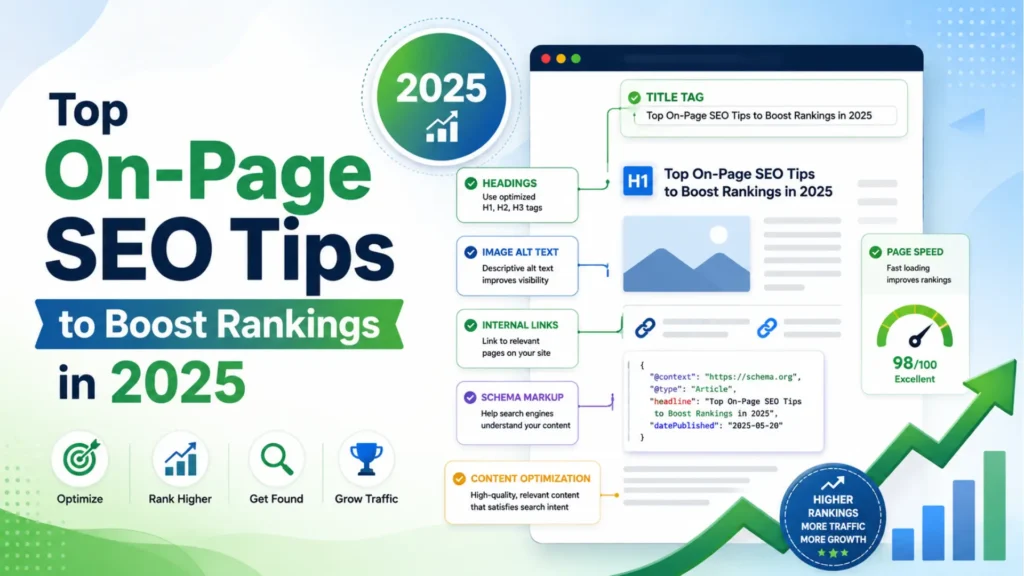
On-page SEO is one of the most crucial aspects of any successful search engine optimization (SEO) strategy. It involves optimizing the elements of your website that are within your control to improve its ranking on search engines like Google. If you want to increase organic traffic, improve user experience, and enhance search engine visibility, on-page SEO is where you should start. In this article, we’ll walk you through the best on-page SEO tips to help you optimize your website for maximum visibility and improved rankings.
Whether you’re new to SEO or looking to refine your existing strategy, these actionable tips will guide you in the right direction.
1. Why On-Page SEO Matters for Your Website’s Success
What is On-Page SEO?
On-page SEO refers to the optimization techniques applied within your website’s content, HTML source code, and structure. It involves everything from the use of keywords to the page layout, and it directly influences how search engines interpret and rank your website. Optimizing your on-page elements is essential because it helps search engines understand the context of your content and index it correctly.
Why Does On-Page SEO Matter?
On-page SEO impacts your rankings, user experience (UX), and ultimately, your conversion rates. By following on-page SEO best practices, your site becomes more accessible to search engines, ensuring that it ranks higher for relevant queries. With Google’s emphasis on relevance, mobile-friendliness, and fast-loading pages, on-page SEO plays a significant role in overall SEO success.
2. Optimizing Title Tags for Maximum Impact
The Power of Title Tags
The title tag is one of the most influential SEO elements on your page. It appears as the clickable link in search results, influencing both rankings and user engagement. Optimizing title tags for relevance, clarity, and length can significantly improve CTR (Click-Through Rate) and search rankings.
Best Practices for Optimizing Title Tags:
- Primary Keyword: Always include your target keyword near the beginning of the title tag.
- Length: Keep title tags between 50 and 60 characters to avoid truncation in search results.
- Unique and Engaging: Each page should have a unique title that accurately reflects its content and attracts clicks.
- Compelling Language: Write a title that speaks to the user’s intent, such as offering solutions, benefits, or information.
Leemjaz, a leading SEO agency, helps clients improve their on-page SEO strategies by fine-tuning title tags to boost rankings and CTR.
3. Crafting Effective Meta Descriptions for Higher CTR
What is a Meta Description?
Meta descriptions are short snippets of text that appear under your page’s title in search engine results. Though they don’t directly impact rankings, a well-written meta description can influence a user’s decision to click on your link.
Best Practices for Meta Descriptions:
- Include Keywords: Naturally incorporate your primary keyword into the meta description.
- Length: Keep your meta description between 150 and 160 characters to ensure it’s fully displayed in search results.
- Action-Oriented Language: Use compelling language that entices users to click, such as including offers, questions, or unique selling points.
- Be Specific: Make sure the description accurately represents the page content.
By optimizing meta descriptions, Leemjaz ensures that clients not only rank higher but also increase their website’s CTR, ultimately driving more organic traffic.
4. Using Header Tags (H1, H2, H3, etc.) to Organize Content
Why Header Tags Matter
Header tags are vital for both SEO and user experience. They break up your content into digestible sections, helping both search engines and users navigate your page more easily. Proper use of header tags improves the structure of your content, which enhances readability and SEO rankings.
Best Practices for Using Header Tags:
- H1 for the Main Heading: Each page should have one H1 tag that clearly describes the main topic of the page.
- H2 and H3 for Subheadings: Use H2 tags for primary subheadings and H3 tags for further divisions. Make sure each tag reflects the content structure.
- Keyword Usage: Incorporate relevant keywords into your headers, but ensure it reads naturally.
- Maintain Hierarchy: Always use header tags in a logical order to create a well-organized content structure.
Optimizing header tags is one of the simplest yet most effective ways to improve both user experience and SEO. Leemjaz helps clients strategically use header tags to enhance their content and improve search engine rankings.
5. Optimizing URL Structure for Better SEO
Why URL Structure Matters for SEO
A clean and structured URL not only helps search engines understand your content, but it also improves user experience. A well-structured URL should be easy to read and reflect the content of the page.
Best Practices for URL Optimization:
- Keep URLs Short and Descriptive: Use concise URLs that include relevant keywords and are easy for both users and search engines to understand.
- Avoid Special Characters: Remove unnecessary characters (e.g., &, %, or underscores) that could confuse search engines.
- Hyphens for Word Separation: Use hyphens to separate words in the URL, as search engines treat hyphens as space.
6. Image Optimization for SEO and Faster Page Speed
Why Image Optimization is Crucial
Images are an essential part of any web page, but large, unoptimized images can significantly slow down your site, which negatively impacts both user experience and search engine rankings. Image optimization is an often overlooked yet powerful part of on-page SEO.
Best Practices for Image Optimization:
- File Size: Compress images to reduce their file size without sacrificing quality. Tools like TinyPNG or ImageOptim can help.
- Alt Text: Include descriptive alt text for each image to help search engines understand the content, and use relevant keywords.
- Image Formats: Choose the right image format. Use JPEG for photos, PNG for graphics, and consider WebP for modern browsers.
- Lazy Loading: Implement lazy loading to ensure that images only load when they are needed (when users scroll to them), improving page load times.
Leemjaz’s SEO experts ensure that clients’ images are optimized for speed, which in turn boosts page speed and helps rank better in search engines.
7. Improving Content Quality and User Engagement
Content Quality: The Key to Ranking
Google’s algorithms are becoming increasingly sophisticated in evaluating content. They look for content that satisfies the user’s search intent, provides value, and is engaging.
Best Practices for Content Optimization:
- Thorough Content: Aim to provide comprehensive answers to users’ queries. Longer, in-depth content tends to perform better in search rankings.
- Engaging Writing: Write in an engaging, conversational tone that makes your content easy to digest. Break up the text with short paragraphs, bullet points, and visuals.
- Content Updates: Regularly update older posts to keep them relevant and up-to-date with current trends and information.
Leemjaz helps clients craft content that not only ranks well but also captivates readers, turning visitors into loyal customers.
8. Mobile Optimization: Ensure a Mobile-Friendly Website
Why Mobile Optimization Is Vital
With mobile-first indexing, Google primarily uses the mobile version of your website for ranking and indexing. This means that if your site isn’t optimized for mobile, it could hurt your rankings and user experience.
Best Practices for Mobile Optimization:
- Responsive Design: Ensure that your site’s layout adapts to any screen size, whether desktop, tablet, or mobile.
- Test for Mobile Compatibility: Use Google’s Mobile-Friendly Test to ensure your site performs well on mobile devices.
- Page Speed on Mobile: Focus on improving loading times, as mobile users are less likely to stay on a page that loads slowly.
Frequently Asked Questions About On-Page SEO
What is the difference between on-page and off-page SEO?
On-page SEO refers to the elements of your website that you can control directly, such as content, keywords, title tags, and internal links. Off-page SEO, on the other hand, focuses on activities outside of your website, like building backlinks, social media engagement, and improving domain authority.
How long does it take to see results from on-page SEO?
Results from on-page SEO can take anywhere from a few weeks to a few months, depending on the competitiveness of your industry and the current state of your website. However, if done correctly, the improvements will continue to benefit your site for the long term.
Can I do on-page SEO myself or should I hire an expert?
While it’s certainly possible to perform on-page SEO yourself, working with an SEO expert can provide more effective and efficient results. Experts like Leemjaz can help you develop a tailored strategy to ensure your website is fully optimized for search engines.
How AI Can Help You Write Optimized SEO Blogs?
Artificial intelligence (AI) has become a powerful tool for SEO content creation. AI can help automate and streamline the process of writing SEO-optimized blogs, providing a significant boost to your content strategy.
How AI Assists in Blog Writing:
- Keyword Optimization: AI tools can help identify relevant keywords and suggest where to place them throughout your blog for maximum impact.
- Content Generation: AI-powered writing tools can assist in generating content ideas, drafting posts, and even structuring content in a way that aligns with SEO best practices.
- Content Refinement: AI can help refine your content, ensuring it reads naturally while still being optimized for search engines.
- Speed and Efficiency: With AI, you can significantly reduce the time it takes to produce high-quality SEO content, making it an efficient solution for businesses that need to generate large volumes of content.
Leemjaz uses AI-driven tools alongside our expert team to create high-quality, optimized content that delivers results. Whether you are writing a blog post or optimizing an entire website, AI can enhance your SEO efforts and improve the overall quality of your content.
Conclusion
On-page SEO is crucial for improving your website’s visibility and search engine rankings. By following these tips such as optimizing title tags, meta descriptions, URLs, and images, as well as enhancing content quality and mobile optimization, you will be on your way to improving your site’s performance. If you’re looking for professional help with your SEO strategy, Leemjaz provides comprehensive SEO services designed to improve every aspect of your website’s on-page SEO. Our team of experts can help you optimize your website for better performance and long-term success..
surely SEO help companies a lot.